




Why does my foundation look grey or ashy? The diagnosis, step by step
Grey is not one foundation problem. It is four different problems wearing the same dull cast, and each one has a different fix, which is why random shade swaps keep failing.
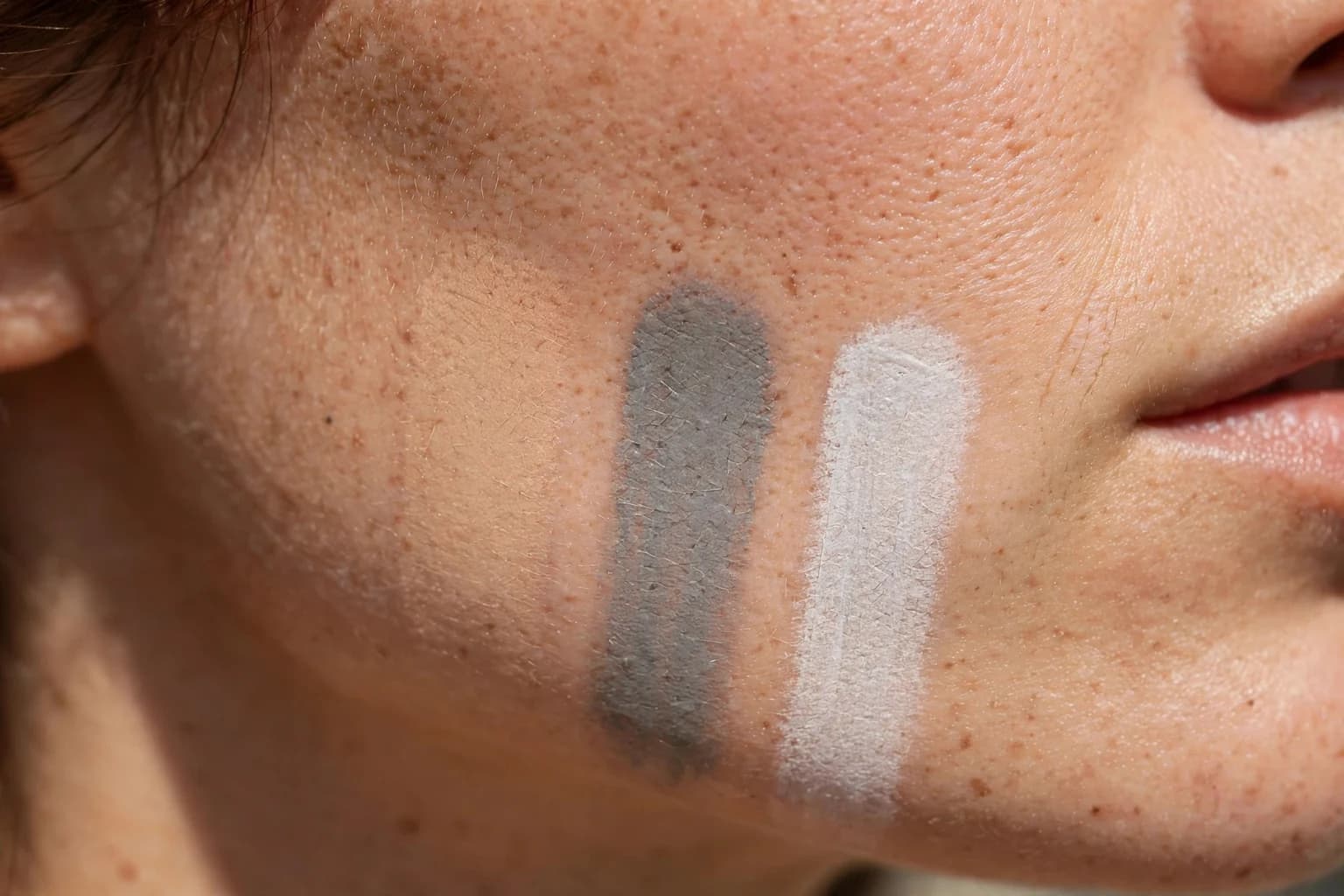
The grey stripe and the chalky stripe are different failures. One is undertone, the other is depth, and daylight separates them.
Direct answer
Why does my foundation look grey? Usually because one of four things is wrong: the undertone fights yours, most often a pink or grey based shade over warm or olive skin; the shade is too light, so its pale pigment sits on your skin as an ashy film; your olive cast is cancelling the color the shade does have; or the grey only exists in photographs, where SPF and powder flash back. The fixes do not overlap, so diagnose before you buy: stripe the shade at your jaw in daylight, wait fifteen minutes, then check it in a flash photo as well as the mirror.
How is a grey foundation different from an orange one?
Orange and grey are opposite failures. Orange means the shade carries warmth your skin does not have, or warmth that deepens as the formula dries and mixes with oil. Grey means the shade is missing something your skin does have: depth, warmth, or the green balance that olive skin needs. The two problems also behave differently over time. Orange often creeps in over ten to thirty minutes as the film dries down. Grey is usually there from the first minute, because nothing about wear time adds the missing pigment back.
That is why this guide exists separately from its companion. The orange problem, its dry down mechanism and its fixes are covered in full here. This page stays on the grey side of the family: the cast that makes a face look tired, muted and slightly separate from the neck.
What are the four causes of a grey or ashy cast?
Formula choices can amplify any of the four. The Beauty Radar's grey foundation guide notes that matte formulas often look lighter and chalkier because their powders scatter light, full coverage magnifies undertone errors because it blocks more of your own pigment, and high SPF bases can read grey when their mineral content is heavy.
- Undertone mismatch: a pink based or grey based shade laid over warm, golden or olive skin has nothing to agree with, so the pink mutes into grey. This is the most common cause, and makeup artist Ashunta Sheriff states the depth half of the rule plainly: a makeup that is too light will make you look ashy or grey, while the wrong family does the same at the correct depth.
- Too light a shade: pale pigment, much of it white based, forms a film your own color cannot warm up. The face reads chalky and mask like, and the jaw line shows because the neck keeps its real color. One depth deeper in the same family is the whole fix.
- Olive cancellation: olive skin already carries green and grey in its balance. A shade with no green or muted pigment of its own can be cancelled by that cast, so a shade that looked neutral on the back of a hand turns grey on an olive face. Olive skin has its own full guide.
- SPF and powder flashback: mineral SPF ingredients such as zinc oxide and titanium dioxide scatter light, and pale setting powders do the same. In the mirror the base can look correct while a flash photograph returns a grey white face. This is a photography problem, not a shade problem, and it is diagnosed differently from the other three.
How do you diagnose which cause you have?
Work through the checks in order. Each one removes a suspect.
First, timing. Put the foundation on clean skin and look immediately in daylight. Grey at minute one means undertone, depth or olive cancellation. A shade that matches at minute one and dulls later is moving toward the dry down and oil problem in the orange guide, not this one.
Second, location. Grey across the whole face, including the jaw and edges, points at the shade itself. Grey that is worst in the center of the face, where coverage is heaviest, suggests opacity and formula: the product is blocking your own color and replacing it with its pigment alone. Sheerer layers are the test and often the fix.
Third, the flash test. Take a flash photo in a dim room. A face that is fine in the mirror and grey only in the photo has flashback: suspect your SPF product, a high SPF foundation, or a pale setting powder, and change one product at a time until the photo clears.
Fourth, the neck comparison. If the face is grey and the neck is warm, the shade is missing warmth or depth. If face and neck are both grey under the same product, the undertone family is wrong for you everywhere, which is the olive and undertone pattern rather than a depth error.
If you do not know your undertone, guessing from a shade wall will keep producing this result. The tests that separate undertone from surface color are in the undertone guide.
What is the fix for each cause?
Once the cause is named, the shade hunt gets short. Cross brand matches organized by undertone, so a shade that works in one range can be translated into another, are in the foundation shade match hub:
See how a shortlisted shade sits across your whole face before you buy it, not just as a stripe:
- Wrong undertone: change family, not depth. Grey from pink based shades means moving to neutral, warm or olive based shades at the same depth. Going deeper inside the pink family only gives you a darker grey.
- Too light: go one depth deeper in the same undertone family, and retest at the jaw. If the deeper shade disappears, depth was the whole problem and nothing else needs to change.
- Olive cancellation: choose shades built with muted or olive pigment, and judge them only on the face in daylight, never on the hand. The ranges that actually formulate for olive skin are compared in the companion guide.
- Flashback: lower the mineral load at night and for events. Use a chemical or hybrid SPF under makeup, skip pale translucent powder in favor of a tinted or finely milled one, and confirm with a flash photo before the event, not after it.
- Formula amplification: drop one coverage level, or apply the same foundation in thinner layers. Your own pigment showing through is not a flaw in the base; on grey prone skin it is often what keeps the base alive.
What should you change first when everything looks grey?
Change one variable, in the order the diagnosis gave it to you, and keep the rest of the routine still. If the cast is present in daylight at minute one, change the shade family or depth first and leave your SPF, powder and primer alone, because new products layered into the test will hide which change worked. If daylight passes and only the flash photo fails, do the opposite: keep the shade and strip the routine back to foundation alone, then reintroduce SPF and powder one at a time until the grey returns and names its cause.
Readers with several suspects at once should run the two tests on different days. Wear the current routine and photograph it in daylight and flash on day one. On day two, wear the same foundation with no SPF product and no setting powder. A cast that survives day two lives in the bottle. A cast that vanishes with the layers was never a shade problem, and no new bottle would have fixed it.
Which habits keep the grey coming back?
Swatching on the hand approves shades the face rejects, because the hand differs in both depth and undertone. Judging under shop lighting flatters pink and hides ash, which is the exact failure being tested. Settling the verdict at minute one judges the wet shade, which is lighter and cooler than the settled one. And buying a deeper shade of the same wrong family is the most expensive habit of all: it converts a grey cast into a darker grey cast and adds a jaw line to it.
Source: Uptone guide: Why does my foundation turn orange or grey
Grey in person and grey on camera are different appointments
A base can be honestly correct in daylight and still flash grey under a phone flash at an evening event, because flashback lives in the product layer, not the shade. Test for the occasion you are buying for: daylight and a mirror for daily wear, a flash photograph for anything where you will be photographed at night.
Take the theory out of it.
Three of the four causes are undertone and depth errors, and the finder cross references shades across brands on undertone first, which is the order that prevents the grey result rather than correcting it bottle by bottle.
Questions people ask
Why does my foundation look grey or ashy?
Most often the undertone is wrong: a pink or grey based shade over warm or olive skin mutes into grey. The second cause is depth, a shade too light sitting on the skin as a pale film. Diagnose at the jaw in daylight before changing anything, because the two fixes are opposites.
Why does my foundation look grey on olive skin specifically?
Olive skin already carries green and grey in its balance, so a shade without muted or olive pigment of its own can be cancelled by that cast and read grey on the face. The same shade often looks neutral on a hand swatch, which is why olive matches must be judged on the jaw in daylight.
Why does my foundation look fine in the mirror but grey in photos?
That is flashback, not a shade error. Mineral SPF ingredients such as zinc oxide and titanium dioxide, plus pale setting powders, scatter the flash back at the camera and return a grey white face. Test with a flash photo, then reduce the mineral or powder layer for photographed occasions.
Should I go darker to fix a grey foundation?
Only if the diagnosis says depth. One shade deeper fixes a shade that is too light, but if the undertone family is wrong, deeper just makes a darker grey with a visible jaw line. When grey comes with a pink cast, change the family to neutral, warm or olive at the same depth instead.
How long should I wait before judging a foundation shade?
Fifteen minutes is a working minimum, so the formula can dry down and settle before you decide. The Beauty Radar's grey foundation guide recommends a first check at fifteen minutes and a second at one hour on oily skin, where oil keeps shifting the shade through the day.