


How to find your undertone, and why the vein test keeps failing you
Every guide gives you the same four tests. Almost none of them explain what to do when the tests contradict each other, which is what happens to most people.
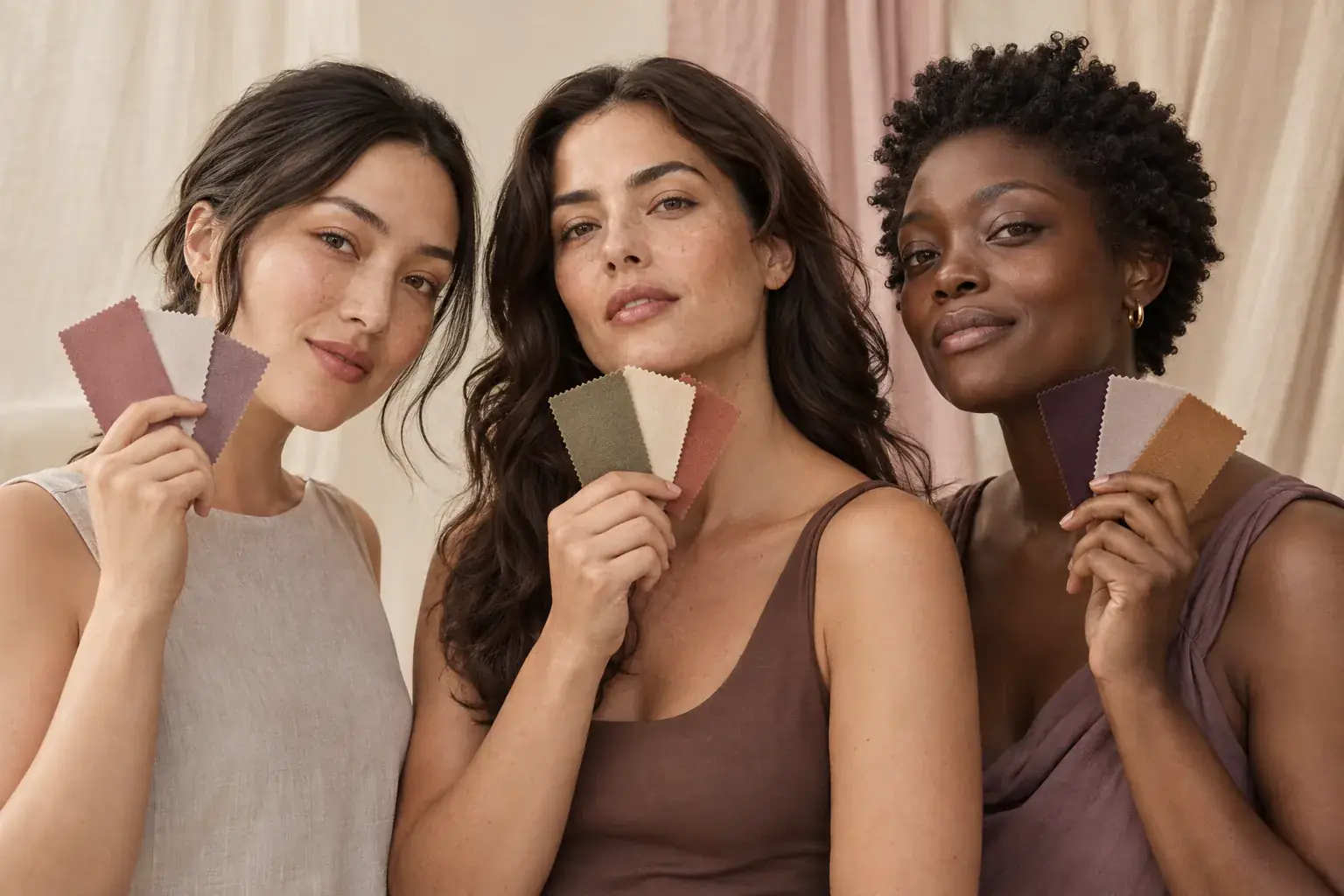
Undertone is not the same as skin tone
Skin tone is how light or deep your skin is, and it moves. It shifts with sun, with season, with a bad winter indoors. Undertone is the colour underneath that, and it does not move. It is the same in July as in January, and the same at the top of your forehead as along your jaw.
This matters because almost every shade decision you will ever make is an undertone decision wearing a skin-tone costume. A foundation that is the right depth and the wrong undertone reads as grey or orange in daylight and looks fine under the shop lights that sold it to you. A hair colour that fights your undertone looks like it was applied to someone else's head.
There are three usual answers (warm, cool, and neutral) and one that gets left out of most articles: olive, which behaves like its own category and is the single most common reason the standard tests give people a confusing result.
The four tests, and what each actually measures
These are the tests every guide lists. They are worth doing, but they are not equally reliable and they are not measuring the same thing, which is why they disagree.
- The vein test. Look at the inside of your wrist in daylight. Green-looking veins suggest warm, blue or purple suggests cool. What it actually measures is how your skin scatters light over a blood vessel, which is affected by how thin your skin is there, so it is least reliable on very fair and very deep skin, where the veins are either too visible or not visible enough.
- The jewellery test. Hold gold against one side of your face and silver against the other. Whichever makes your skin look brighter rather than sallow is the direction. This one is more reliable than the vein test because it is a comparison rather than a judgement, but it is confounded by what you are used to seeing yourself in.
- The white paper test. Hold plain white paper next to your bare face in daylight. Warm skin looks yellow or golden against it, cool skin looks pink or blue, olive looks faintly green. This is the most useful of the four, and the one most people skip because it requires actual daylight.
- The sun test. Skin that tans readily tends to be warm; skin that burns and stays pink tends to be cool. It is a real signal but a weak one, and it says more about melanin than about undertone.
What to do when they disagree
If two tests say warm and two say cool, you are most likely neutral or olive, and the honest answer is that you are hard to categorise rather than that you failed the test.
Neutral means the warm and cool signals are genuinely balanced. It is the easiest undertone to shop for and the hardest to identify, because nothing looks obviously wrong and nothing looks obviously right.
Olive is different and more often misread. Olive skin carries a green or grey cast alongside a warm base, so the vein test reads green and says warm, the jewellery test often prefers gold and agrees, and then a warm foundation goes distinctly orange. If warm shades keep turning orange on you, olive is the likely explanation and neutral-to-olive foundations are the fix.
Why lighting decides the answer
Every one of these tests is a colour judgement, and colour judgements are only as good as the light you make them in.
Indoor bulbs are the problem. Warm domestic lighting pushes everything golden and will tell almost anyone they are warm. Older fluorescent lighting pushes green. Phone screens throw blue. This is why people get different answers in different rooms and conclude the tests are useless, when what changed was the light.
Do it once, properly: daylight, near a window, no direct sun, no makeup, and ideally somewhere without a strongly coloured wall bouncing light back at you. That single condition matters more than which of the four tests you pick.
What your undertone actually decides
Once you have an answer, it is worth knowing how much it governs, because it is less than the internet suggests, and in specific places.
- Foundation. This is where undertone matters most, and where getting it wrong is most visible. Depth can be adjusted with bronzer; undertone cannot.
- Hair colour. Undertone sets whether ashy or golden versions of the same colour suit you. It does not stop you going any colour: a cool-toned person can be a warm blonde, it just needs the shade chosen deliberately rather than by name.
- Lipstick. Less than you would think, and mostly at the extremes. Very blue-based reds and very orange-based corals are the shades that care; most of the middle is far more forgiving than shade charts imply.
- Jewellery and clothing. Real, but this is preference territory. Plenty of people suit gold by undertone and wear silver because they prefer it, which is a completely legitimate way to make the decision.
What nobody can tell you from a photo
Undertone can be estimated from a photo and it cannot be measured from one. Camera white balance shifts colour before you ever see the image, and phone cameras apply their own correction on top. Anyone (any person, any tool, us included) reading your undertone from a photo is making a good inference from degraded information. It is worth having as a starting point and it is not worth treating as a verdict, which is why every trait Uptone infers stays editable by you.
Take the theory out of it.
If you would rather start from an estimate than a wrist and a piece of paper, Uptone reads undertone, colour family and depth from a photo of you, and shows you what it concluded so you can correct it, rather than handing you a label.
Questions people ask
Can your undertone change?
No, skin tone changes with sun and season; undertone does not. If warm shades suited you in summer and look wrong in winter, what changed is your depth, not your undertone. You likely need the same undertone in a lighter shade.
What if I have no visible veins?
Then skip that test rather than squinting. It is the least reliable of the four anyway, and it is specifically unreliable on deeper skin where veins do not show through. The white paper test in daylight works at every depth.
Is olive the same as warm?
No, and treating it as warm is the most common shade-matching mistake there is. Olive carries a green cast that warm foundations turn orange. If gold suits you but warm foundations go orange, you are very likely olive rather than warm.
Does undertone decide what hair colour I can have?
It decides which version of a colour suits you, not which colours are available. Ashy and golden blondes are both blonde; undertone tells you which one sits comfortably against your skin. Nothing here is a rule about what you are allowed to wear.
Do I need to know my undertone to buy makeup?
For foundation, it saves you a lot of money. For almost everything else, it is a useful tiebreaker rather than a requirement. Most lipstick and eyeshadow is more forgiving than shade charts suggest.