






Why does my foundation turn orange or grey? Two different problems, two fixes
A foundation that turns orange and a foundation that looks grey are usually blamed on the same fault, and they are not the same fault at all: one was wrong in the shop, the other changed on your skin.
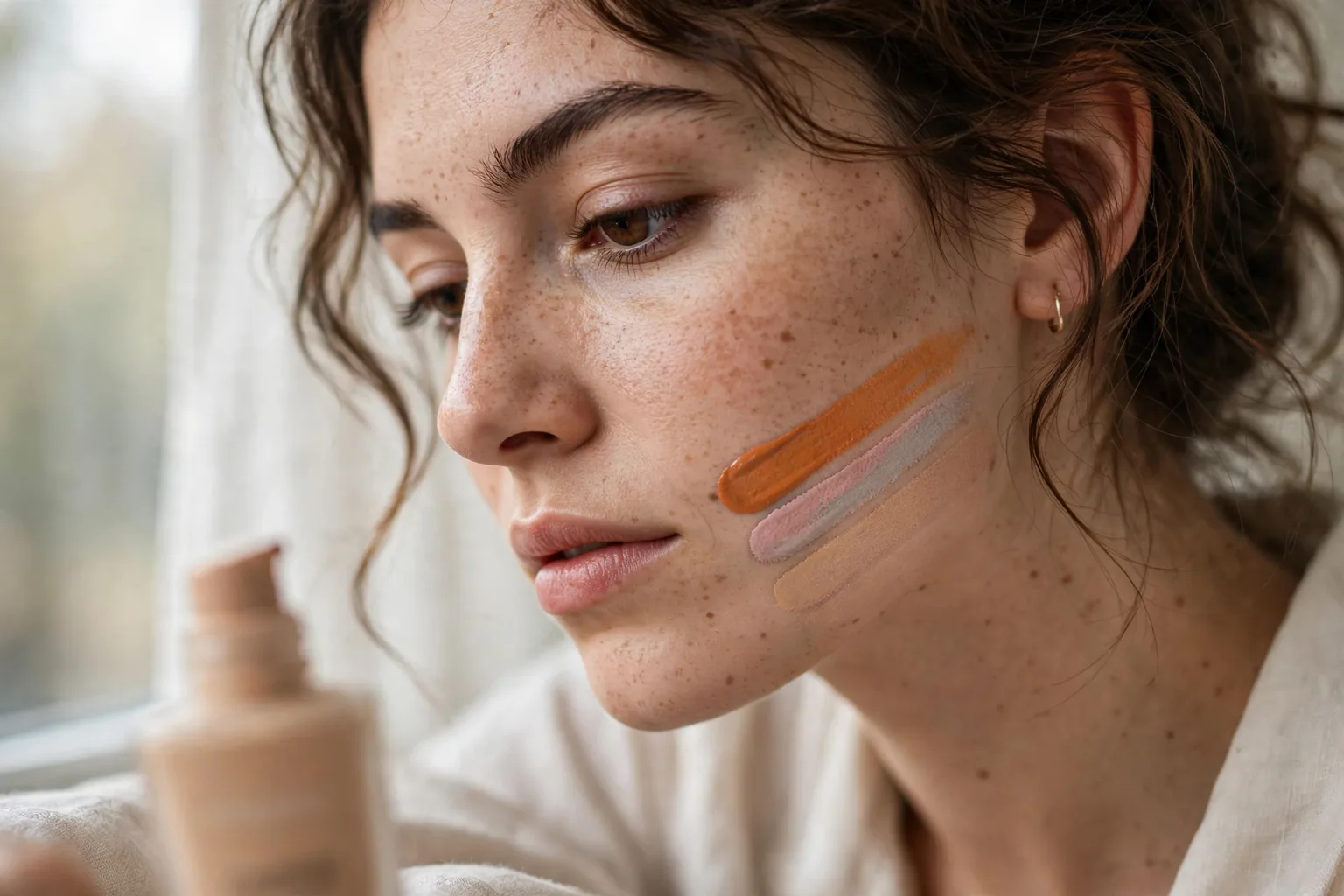
Three stripes, three verdicts: one match, one shade that was too warm from the start, and one pink based shade reading grey on warm skin.
Direct answer
Why does my foundation turn orange or grey? There are two separate problems, and they have different fixes. A wrong undertone fails immediately: a pink based shade on warm or olive skin reads grey and ashy, and an overly warm shade reads orange, both visible in daylight the moment the makeup goes on. A true color shift is slower: the shade matches at application, then dries down darker and mixes with your skin's oils over the next 10 to 30 minutes, so it looks deeper and warmer by the time you check a mirror.
How can I tell which problem I have?
Timing tells you, and timing is the whole diagnosis.
If the shade is wrong within a minute of application, in daylight, it was wrong when you bought it. That is an undertone error, and no amount of wear time will improve it. If the shade is right at application and wrong twenty minutes later, the shade itself moved. That is a color shift, and the undertone may be perfectly correct.
Location reports the same answer. An undertone mismatch shows everywhere the foundation is, including the jaw and the edges of the face. A shift concentrates where oil arrives first, usually the T zone, so the forehead and nose drift darker and warmer while the jaw stays closer to the bottled color. Check both spots before deciding which problem you are solving, because the fixes do not overlap: one means changing the shade's color family, the other means changing how you test and wear the same family.
Why does a wrong undertone read orange or grey?
Undertone errors fail in two opposite directions.
Too warm reads orange. A shade built on strong yellow and golden pigment, worn on neutral or cool skin, adds warmth the face does not have. The mismatch is usually worst where the foundation ends, at the jaw, because that is where your real skin is available for comparison.
Too cool reads grey. A pink based shade on warm or olive skin has nothing to agree with, and pink laid over yellow green skin mutes into grey. This is the ashy, slightly tired look that people often blame on the shade being too light. Sometimes it is too light, and depth errors do read ashy, but the more common cause is the pink. Going deeper in the same pink family makes it worse, not better, which is the surest sign the undertone was the fault all along.
Olive skin gets both failures from the same ranges, which is why it has its own guide to makeup for olive skin. And if you do not yet know your undertone, start with the guide to finding your skin undertone rather than at the shade wall.
Source: NDTV Shopping, how to fix grey foundation with the right shade and undertone
What is foundation oxidation, and is it real?
Oxidation is the word everyone uses for the slow shift, and it is mostly a misnomer. The pigments that give foundation its color are iron oxides, and iron oxides are chemically stable: they are already oxidized, which is precisely why they are used. They do not rust darker on your face over a morning.
What actually changes is everything around the pigment. Most liquid foundations are built to dry down: volatile ingredients evaporate in the first 10 to 30 minutes, the film left behind is more concentrated, and a more concentrated film reads darker and deeper than the wet swatch did. Then your own sebum joins in. Skin oil mixing into the film through the day darkens and warms it further, which is why the shift is worst on oily skin, worst in the T zone, and why a foundation can look acceptable at lunch and clearly darker by evening without being reapplied. Some formulas shift more than others, because the balance of pigment, oil and volatile ingredients differs, but the mechanism is the same.
The practical consequence is that there is no special anti oxidation product to buy your way out with. The shift is a property of drying films and skin oil, and it is managed by testing and wearing habits, not by a different category of makeup.
Source: Adore Beauty, why does my foundation turn darker on my skin
Source: The Free Library, a cosmetic chemist on foundation color change
How do I test a foundation so it cannot fool me?
This is the same discipline the shade matching pages here are built on: jaw swatch, daylight check, ten minute wait, undertone over depth. It costs one extra trip outside the shop and removes most of the guesswork. Cross brand matches by undertone, for translating a shade that works into another range, are in the foundation shade match hub.
Check how a shortlisted shade sits on your whole face, not just a stripe.
- Swatch on the jaw, never the back of the hand. The hand is a different depth and often a different undertone from the face, and it has decided more bad purchases than any other body part.
- Use three stripes: your best guess, plus one depth either side, all in the same undertone family.
- Check the stripes in daylight. Shop lighting is warm, dim or both, and it flatters exactly the shades that fail outside.
- Wait ten minutes before judging anything. That pause covers the dry down, so the color you approve is the color the foundation settles into, not the wet version.
- Trust undertone over depth. If the undertone is right and the depth is slightly off, the shade is wearable and adjustable. If the depth is perfect and the undertone is wrong, no adjustment saves it.
What is the fix when the undertone is wrong?
Change the color family, not the depth. If your shade reads grey and ashy, move away from pink based shades toward neutral, warm or olive bases at the same depth. If it reads orange, move away from golden shades toward neutral or cool bases at the same depth. Resist the instinct to go lighter or darker: depth changes treat a symptom, and a wrong undertone at a new depth is still a wrong undertone, now with a visible line at the jaw as well.
What is the fix when the shade truly shifts?
- Go one depth lighter, but only after the shift is confirmed on your own skin, with the ten minute test, in the same undertone family. Buying lighter on suspicion trades one error for another.
- Blot before you judge, and blot rather than powder over oil at midday. Adding product over an oil darkened film deepens it further.
- Primer under foundation on oily zones puts a barrier between sebum and the film, which slows the darkening where it starts.
- Let moisturizer and sunscreen absorb fully before applying foundation. A wet base dilutes the first layer and changes how it dries.
- Apply thinner layers. A thinner film carries less pigment to concentrate as it dries, and it is easier to correct at noon.
Which habits make both problems worse: wrong vs right?
- Swatching on the back of the hand vs the jaw: the hand approves shades your face would reject, in both depth and undertone.
- Judging under shop lights vs stepping into daylight: warm store lighting hides orange and flatters pink, which are the two failures you are testing for.
- Buying at minute one vs judging at minute ten: minute one shows you the wet shade, which is lighter and cooler than the one you will actually wear.
- Going darker to fix grey vs changing undertone family: deeper pink is still pink, and the ashiness deepens with it.
- Adding more foundation at midday vs blotting first: more product over an oil darkened film is the fastest route to the evening orange mask.
Your skin changes depth even when your undertone does not
A shade that behaved all winter can fail in August without anything being wrong with it or with your testing. Skin deepens with sun exposure while the undertone stays the same, so a summer failure is often a depth problem, the one kind neither fix in this article addresses. Keep the undertone family, move the depth, and retest on the jaw.
Take the theory out of it.
The article's first fix is an undertone led match, and the finder cross references shades across brands on that basis, which is what a reader holding a grey or orange bottle actually needs next.
Questions people ask
Why does my foundation turn orange?
Either the shade is too warm for your undertone, which shows in daylight straight away, or the shade shifted after application as it dried down and mixed with skin oil. Test at the ten minute mark to find out which one you have.
Why does my foundation look grey or ashy?
Usually because the shade is pink based and your skin is warm or olive, so the pink mutes into grey over your natural coloring. A shade that is simply too light can also read ashy, but changing the undertone family fixes more cases than changing depth.
What is foundation oxidation?
The popular name for foundation changing color after application. The iron oxide pigments themselves are chemically stable, so most of the shift is the formula drying down darker plus your skin's oils darkening the film through the day.
How do I stop foundation changing color?
Test on the jaw, in daylight, and wait ten minutes before judging, so the dry down happens before you buy. If a confirmed shift remains, go one depth lighter in the same undertone family, and use primer and blotting on oily zones to slow the oil driven darkening.
Why does foundation look darker by evening?
Because by evening the film has fully dried down and spent hours mixing with sebum, which darkens and warms it, worst in the T zone. Blot rather than adding more product; extra foundation over an oil darkened layer makes the effect stronger.