

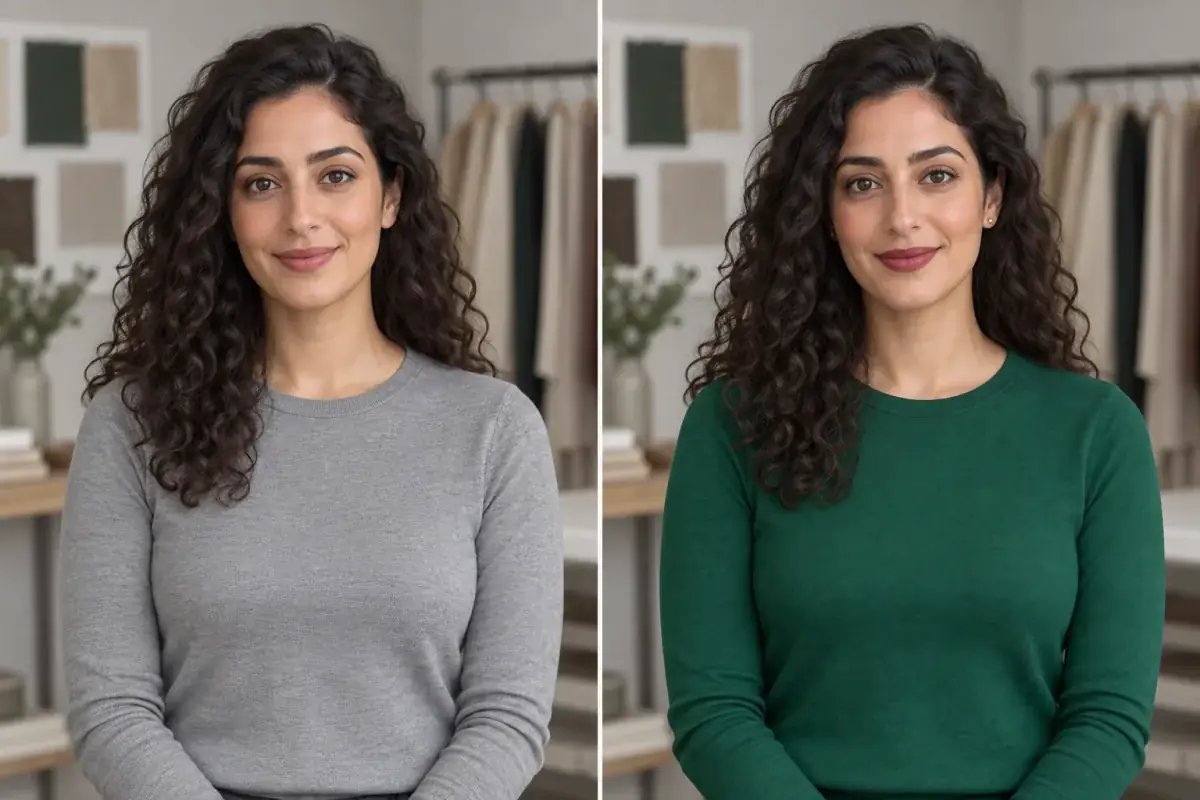
Best foundation for olive skin: the shade families and ranges that actually carry olive pigment
Olive skin is not a depth and it is not simply warm. It is a pigment balance most ranges skip, so the best foundation is the one formulated with that balance inside the bottle.
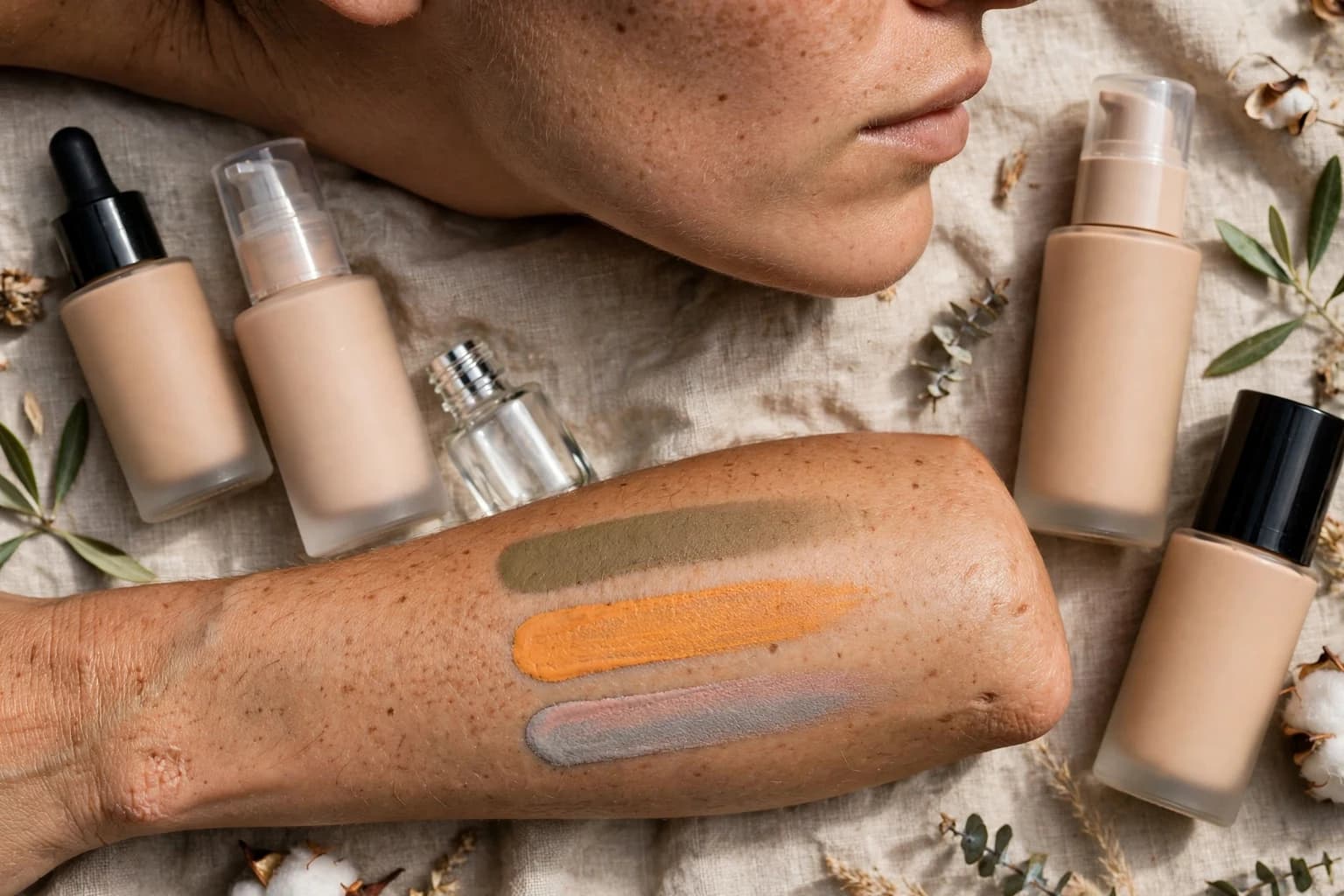
Olive matches are found by pigment, not by depth alone: muted, green balanced swatches disappear on olive skin where golden and pink ones sit on top.
Direct answer
What is the best foundation for olive skin? The best foundation for olive skin is one that carries muted green pigment at your depth and your temperature: true olive or neutral olive shades, from ranges that build olive into several depths rather than offering a single token shade. Strong starting points are Kosas Revealer, which names olive shades from 160 to 430, about face The Performer, with an olive shade at nearly every depth, Haus Labs Triclone, Lisa Eldridge Seamless Skin and Fenty Pro Filt'r. Test two depths at the jaw in daylight and wait fifteen minutes, because olive matches fail in both directions: golden shades turn orange and pink shades turn grey.
Why does olive skin defeat most foundation ranges?
Most ranges are built on three undertone families: warm, meaning yellow and golden; cool, meaning pink; and neutral, meaning a balance of the two. Olive is a fourth balance, yellow muted by green and grey. Because the red in olive skin is subdued, the green shows, and that green is an active ingredient in every match: it changes what the foundation on top of it looks like.
So a golden shade, correct on warm skin, gains saturation against the green and reads orange. A pink shade, correct on cool skin, is muted by the green and reads grey. A shade can match your depth exactly and fail completely, because depth was never the missing variable. The full pattern of olive makeup failures, including blush and lipstick, is in the parent guide.
This is also why the fix is not a mixer habit for most readers. Green adjusters rescue a near miss, but a range that formulates olive pigment into the shade gives you a repeatable bottle instead of a daily mixing ritual.
Which shade families should you look for?
Temperature still matters inside olive. Olive is a balance, not a temperature, so a warm olive wearing a cool olive shade gets the grey failure in an olive bottle. Decide your temperature with the undertone tests before you shop depths.
- True olive: the shade name or description says olive without a warm or cool push. This is the starting family for muted, grey green skin that reads neither golden nor pink.
- Neutral olive: olive pigment balanced toward neutral, the most forgiving family and the right first test for most olive readers. Kosas builds much of its olive run this way: 160 Light+ Neutral Olive, 210 Light Medium Neutral Olive, 260 Medium Tan Neutral Olive, 290 Medium Deep Neutral Olive, 360 Medium Deep Neutral Olive, 400 Deep Neutral Olive and 430 Rich Deep Neutral Olive.
- Warm olive: olive with golden lean, for skin that tans easily and reads green gold in daylight. Kosas separates this from neutral olive at 270 Medium Tan Olive, described by the brand as olive green in undertone.
- Cool olive: olive with a muted, slightly grey lean, for skin that burns more than it tans and reads green under pink surface tones. This is the family drugstore ranges almost never make at fair depths.
- Muted neutral, the honest fallback: where no olive shade exists at your depth, a desaturated neutral usually sits closer than any warm or cool shade, because muted pigment argues less with the green cast.
Which named ranges actually carry olive shades?
Range sizes move as brands reformulate, so treat any single shade number as a starting test rather than a promise. The pattern to trust is structural: several olive shades, at several depths, in your temperature.
Two reading habits save money inside these ranges. First, shop by the undertone word before the depth number: in Kosas the olive run is scattered through the numbering, so reading sequentially by depth walks straight past it. Second, distrust any range whose olive shade exists only in a medium depth. That pattern usually means the brand added olive as a trend shade rather than a family, and readers at fair and deep depths will be handed a warm or cool shade and told it is close enough. It is not close enough, and the grey and orange failures in the companion guides are what close enough looks like on the face.
- Kosas Revealer Skin Improving Foundation: the clearest naming on the market, with olive shades at 160, 210, 260, 270, 290, 360, 400 and 430 on the brand's own shade list, spanning light to rich deep. Start here if you want the undertone printed on the bottle.
- about face The Performer: eight olive shades in the tested roundup at Medium Olive, listed as F2O, LM2O, M2O, MD1O, MD2O, D1O, D2O and D3O. Phyrra's fair olive testing found The Performer in F2 Olive and The Illusionist Concealer in F1 Olive to be the only true olive options at fair depths at drugstore prices.
- Haus Labs Triclone Skin Tech: five olive foundations listed as 19O, 26O, 33O, 44O and 47O. Read the labels carefully, because the brand's warm and cool naming runs opposite to the convention most shoppers expect.
- Lisa Eldridge Seamless Skin: seven olive shades listed as 2.5, 9, 9.5, 16, 17, 23 and 35, with the olives specified as neutral, true or golden. Shade 2.5 is repeatedly cited by fair olive testers as a genuine very fair olive, a depth most ranges skip.
- Fenty Beauty Pro Filt'r: the matte line lists olive shades at 130, 225, 265, 290, 345, 425 and 445, and the luminous line at 130, 225, 265, 345, 425 and 445. Depth coverage is the strength here, from fair to deep in one formula family.
- Rare Beauty Liquid Touch: six shades in the tested olive roundup, 170W, 230N, 280N, 360W, 430W and 510W, shared between the foundation and concealer lines so a match can be carried across products.
- Alima Pure Satin Matte: nine olive shades numbered 0 to 7 in a loose powder formula. The depth run is unusually complete, but it is powder only, which will not suit readers who need a liquid.
How do you test an olive shade so it cannot fool you?
Stripe two depths of the same olive family, plus one muted neutral, from the lower cheek down the jaw to the neck. The neck matters because faces carry redness that lies, and the winning shade is the one that disappears into both.
Judge in daylight, not shop light, and wait fifteen minutes. Olive failures declare themselves in that window: the golden leaning shade warms toward orange as it dries, and the pink leaning one settles grey. The stripe that is boring at minute fifteen is the match.
Take a flash photo as the last check. High SPF formulas can flash pale on olive skin even when the daylight match is right, and event photographs are where that failure gets kept forever. If the flash fails but daylight passes, keep the shade and change the SPF or powder layer for photographed occasions.
Retest when your depth moves. Olive skin often deepens a full shade between winter and late summer while its temperature stays fixed, so keep the family and move the depth. The two seasonal failures, orange and grey, and how depth and dry down interact, are diagnosed together here and here.
Preview a shortlisted olive shade across your whole face before you buy the bottle:
What should you do when your depth has no olive shade?
Work in this order. First, the muted neutral in your depth from the same range, tested on the jaw: it is the closest factory made approximation. Second, a green or olive adjuster mixed into a near miss, a few drops at a time, which is a workable rescue when the formula itself suits your skin. Third, translate the match sideways: a confirmed olive shade in one brand can be cross referenced into other ranges by undertone in the foundation shade match hub:
What not to do is split the difference between a warm and a cool shade and hope they average into olive. They average into a muddier version of both mistakes, because neither bottle contains the green pigment that was missing.
A named olive shade still needs your face to agree
Brands use the word olive with different leans, and two shades with the same name in one line, a foundation and its matching concealer, can wear noticeably differently, as fair olive testers have documented. The range lists here are verified starting points, not verdicts. The jaw stripe, the daylight check and the fifteen minute wait make the final call.
Take the theory out of it.
Olive matching fails when readers shop depth first inside ranges that may not carry their pigment at all. The finder starts from undertone and cross references shades across brands, which is the order this article argues for from its first paragraph.
Questions people ask
What is the best foundation for olive skin?
One with muted green pigment at your depth and temperature, from a range that builds olive into several depths. Kosas Revealer names olive shades from 160 to 430, about face The Performer carries an olive shade at nearly every depth, and Haus Labs, Lisa Eldridge and Fenty all publish multi shade olive runs worth testing.
How do I know if a foundation shade is really olive?
The shade name or description says olive or neutral olive, and the swatch reads muted and slightly green beside warm and cool shades at the same depth. On the jaw in daylight it should disappear without warming orange or settling grey. If a brand offers exactly one olive shade in one depth, be skeptical and test it against a muted neutral.
Why does foundation turn orange or grey on olive skin?
Both are the green cast at work. Golden shades gain saturation against green skin and read orange, while pink shades are muted by it and read grey. The cause is missing olive pigment in the bottle, so changing depth alone fixes neither failure.
Can I fix a near miss foundation with a green mixer?
Yes, as a rescue. A green or olive adjuster can pull a too warm or too pink shade toward your balance, a few drops at a time. Treat it as a bridge, though, because a shade formulated with olive pigment is repeatable every morning without measuring drops.
Should olive skin choose warm or cool foundation?
Neither label, on its own. Olive is a pigment balance that exists in warm, neutral and cool versions, so choose the olive family first and your temperature inside it second. Warm olives read green gold and tan easily; cool olives read muted and burn more readily, and each fails in the other temperature's olive shades.