

How to preview a hair color before the salon, and what to bring
A salon appointment goes wrong in the first five minutes, at the consultation, when the color in your head and the color in your colorist's head turn out to be different colors. A preview done properly ends that gap before you sit down.
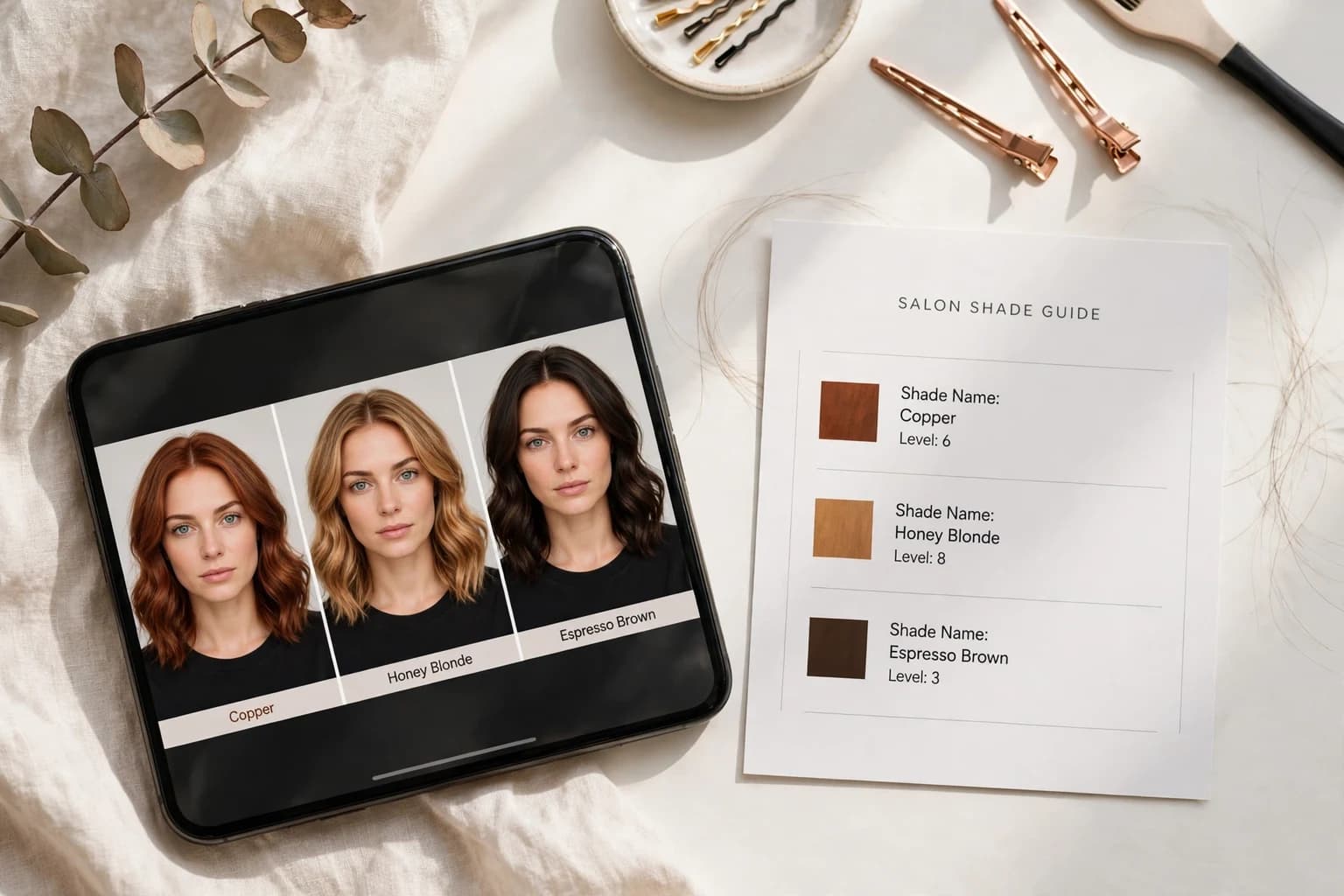
Three finalists on one face, one winner saved as a Salon Card: shade name, level and placement, ready to hand over.
Direct answer
How do I preview a hair color before the salon? Pick two or three finalist shades, preview each one on the same honest photo of yourself, and judge them against your skin, not against each other. Save the winner as a Salon Card: the shade name, the level, the placement and the preview photo itself. Bring the card and the photo to your appointment, brief your colorist from them, and agree in advance what happens if the result differs. The whole workflow takes about fifteen minutes and uses a few credits.
What photo should you preview on?
Every judgement downstream depends on this photo, so it has to be an honest one. Front facing or slight three quarter angle, in plain daylight, with your hair down and visible around your face, no beauty filter, no heavy makeup edit, no hat or sunglasses. Filters are the silent failure here: a smoothed, warmed selfie makes cool shades look better and warm shades look cheaper than either will in the salon mirror.
Use one photo for every finalist. Testing copper on a golden hour selfie and ash blonde on a bathroom selfie tells you about the lighting, not the colors. The full rules for a photo that gives an accurate read, including distance and background, are in our photo guide.
Retake it if your hair is currently a very different color or length from how you will arrive at the appointment. The preview changes the color of the hair in the picture, so the picture should start from the hair you actually have.
How do you pick your finalists?
Do not preview at random; twenty shades on your face teaches you nothing except that your face can wear a screen. Finalists come from the decision rules: your undertone names the temperature, your depth names the level range, and your curiosity gets one wild card. That system is set out in full in our decision guide.
Three is the working number, and the mix matters:
If you are deciding between two techniques as well as two colors, preview the same shade both ways where the tool allows it: all over color against a balayage placement read very differently at the same level.
It also helps to decide what question each finalist is answering. The winner answers "what will I wear", the stretch answers "how brave am I really", and the control answers "can I stop wondering about that shade". Naming the questions stops the common failure mode of this workflow, which is previewing six versions of the same safe brown and calling it research. If every finalist is a variation of what you already have, add one genuine alternative before you judge; the preview costs a credit, the wrong appointment costs a season.
- The likely winner: the shade in your family, at your level range, that you would book today if forced. Most workflows end here, and that is fine; the other two exist to prove it.
- The stretch: one step bolder in the same direction, a brighter copper, a lighter blonde, a deeper red. It tells you whether your instinct was cautious or accurate.
- The control: the version you think you want but suspect is wrong for you, often the celebrity shade. Previewing it costs one credit and retires months of wondering, whichever way it lands.
How should you judge a preview?
Judge against your coloring, in a fixed order. First, your skin: the right shade evens it out and makes it look rested; the wrong one brings out redness, sallowness or shadow. Second, your eyes: the right frame sharpens them without you being able to say why. Third, the whole picture at arm's length, because that is the distance the world sees you at, and a shade that only works in a zoomed crop does not work.
Check the preview's honesty before trusting any of this. Your face, eyebrows, skin tone and background should be exactly as they were in the original photo; if the tool has quietly beautified you, every shade will look good and the test is void. This is the failure people meet in general chatbots, where the edit redraws the whole portrait; a try-on that changes only the hair is the version worth judging.
Run the check in two lights, not one. Screens flatter warm shades in the evening and cool shades at noon, so look at your finalists once in morning daylight and once under your bathroom light, the two places your hair will actually be judged. A shade that survives both is a shade; a shade that only survives one is a lighting effect, and it will disappoint you in the other room for as long as you wear it.
Sort the results into yes, maybe and no, then live with the yes for a day. A shade that still looks right tomorrow morning, in different light on your screen, has passed the only test that predicts month two.
Run your three finalists on one photo now and sort them into yes, maybe and no.
What goes on your Salon Card?
The Salon Card is where the preview becomes a brief a colorist can execute. Save these fields for the winning shade:
The card lives here: /salon-card. It takes a minute to save, and it is the difference between describing a color and handing one over.
- Shade name, in family terms: true copper, honey blonde, mocha balayage, not "the reddish one".
- Level: the depth number, 1 to 10, that the preview shows and that you are asking the chair to match.
- Placement and technique: all over color, balayage, face framing, shadow root; the same shade in two placements is two different appointments.
- The preview photo itself, plus your starting photo, so the colorist sees both ends of the journey.
- Your current hair facts: natural level, any existing dye, and when it was applied. This is what decides your session count.
What should you say to your colorist?
Open with the card, then say the three sentences colorists actually need. "This is the shade and level I want, on my own face" (show the preview). "This is what is in my hair now, and when it got there" (the history, honestly, including box dye). "If my hair cannot reach this in one session, show me the halfway point you would be proud of" (which turns a limitation into a plan instead of a disappointment).
Then ask the two questions that protect you. How many sessions will this really take, and what will the upkeep cost me per month? A colorist who answers both plainly is the right chair. Show the maybe folder too if you are torn between the winner and the stretch; choosing between two previews of your own face is a two minute conversation, while choosing between two descriptions is a twenty minute one.
What if the salon result differs from your preview?
It will differ slightly, and the plan for that is agreed before the appointment, not argued after it. Real color lands on real hair: your porosity, history and starting level all bend the result, and toner in particular drifts over the first two weeks as it settles and fades. Judge the color after two or three washes, in daylight, against your preview photo, not under salon lighting in the chair.
If it is genuinely off, a level too dark, a temperature too warm, speak within the first week. Most salons have an adjustment window of 7 to 14 days, and a gloss or toner correction is a small fix at that point and a paid correction later. Ask about the window when you book, and save everyone the awkwardness. And if the difference is that your hair could not lift as far as the preview in one session, that is not an error; it is the staged plan doing its job, and the preview remains the target the next session aims at.
Source: Uptone Salon Card
Source: Uptone photo guide
A preview is a brief, not a guarantee
The preview shows the destination on your face with a fidelity no shade chart can match, and it cannot promise the chemistry. Your hair's history decides what is achievable and how fast, which is why the colorist still gets the final word in the chair. What the preview guarantees is narrower and more valuable: that you and your colorist are looking at the same color before anyone mixes anything.
Take the theory out of it.
The article's whole workflow converges on one artefact, the card with shade name, level, placement and photo that the reader hands to her colorist. Linking the card itself, where she can build it from her winning preview, completes the task the article taught.
Questions people ask
How many hair colors should I preview before a salon visit?
Three is the working number: the likely winner in your shade family, one bolder stretch in the same direction, and one control shade you have been wondering about. More than five and the comparisons blur into each other. Each preview uses a credit, so a disciplined shortlist is also the cheaper workflow.
Does a preview guarantee my salon result will match?
No, and any tool claiming otherwise is overselling. The preview fixes the destination: this shade, this level, on your face. The result still depends on your hair's history, porosity and starting level, which is why the colorist may stage it over sessions. What it removes is the misunderstanding about which color you meant.
What should I bring to a hair color appointment?
Your Salon Card and the photos it holds: the winning preview, your starting photo, the shade name, its level and the placement you want. Add your hair history, including box dye and when it was applied. That set answers nearly every consultation question before it is asked.
What if my colorist disagrees with my preview?
Listen to the reason, because it is usually technical rather than aesthetic: your hair may not lift that far safely, or your history may bend the shade. Ask them to show you the closest achievable version, ideally previewed or swatched, and agree the staged route if the full shade takes two sessions. Disagreement about feasibility is expertise; disagreement about what you like is not theirs to win.
How far before my appointment should I do the preview?
A few days ahead is ideal: close enough that your hair, skin and mind have not changed, far enough that you can live with the winner for a day and cancel or rebook without penalty if the stretch shade wins instead. Doing it the night before invites panic decisions in both directions.