

Best haircut for a round face: the cuts that add vertical line
Round faces do not need a slimming haircut; they need a directional one. Every flattering cut for this shape does the same three things: height on top, quiet sides, length below the chin.
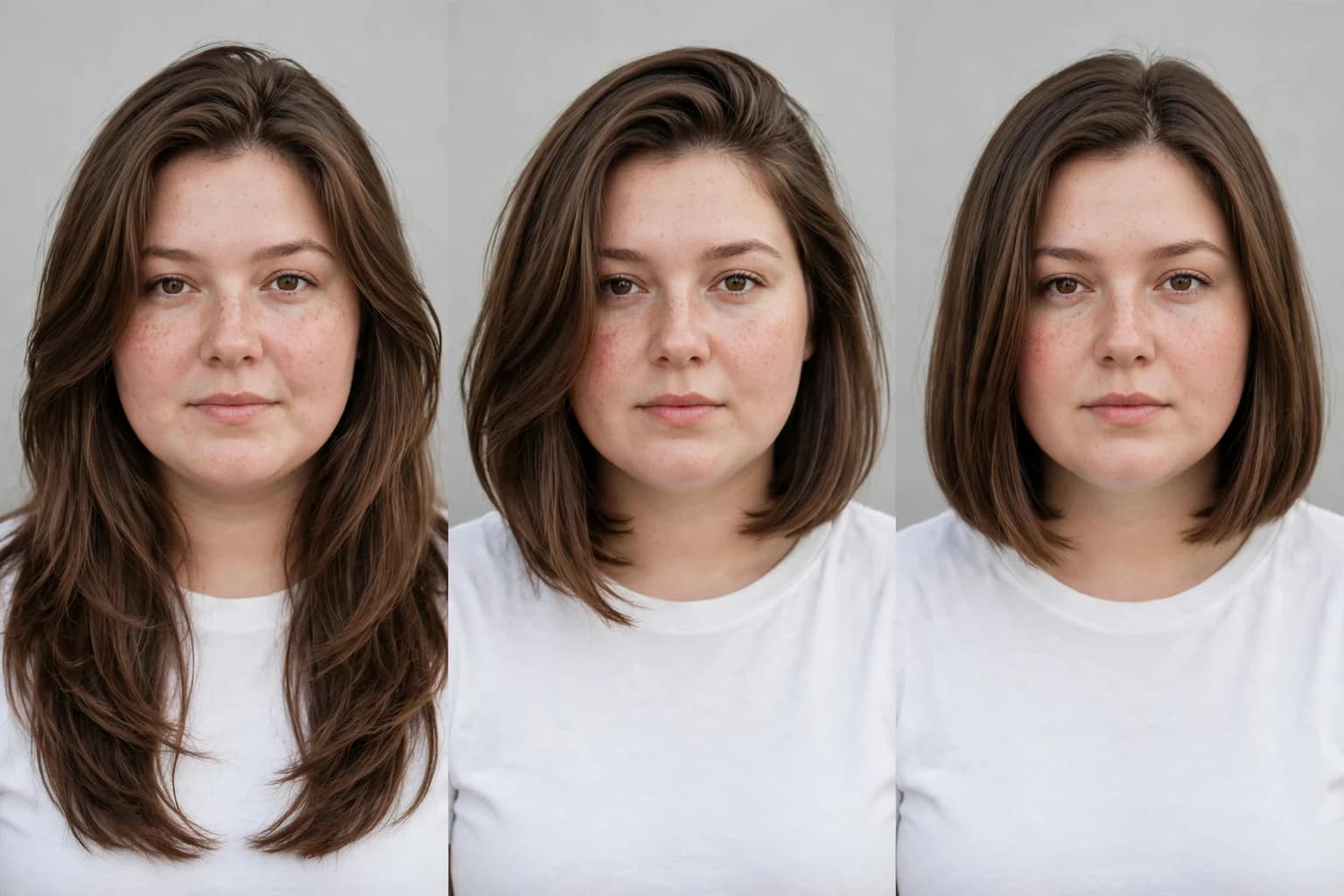
One round face, three cuts: the layered lengths draw the eye down, the chin-length blunt bob draws it across.
Direct answer
What is the best haircut for a round face? A cut that adds vertical line: long layers that start below the chin, an angled lob that falls past the jaw and runs longer at the front, or a butterfly cut with height at the crown and length through the ends. All three keep volume on top, keep the sides quiet, and put the hemline below the widest part of the face. The length rules are simple: nothing blunt should end at chin height, layers should start at or below the jaw, and a side or off centre parting will lengthen more reliably than a centre parting on short hair. The classic mistake is the chin-length blunt bob, which ends a solid horizontal hem exactly at cheek width and makes the face look wider than it is.
What makes any haircut lengthen a round face?
Four mechanics, and every recommended cut below is just a different combination of them. Height at the crown adds apparent inches to the top of the silhouette, and the eye adds those inches to the face. Quiet sides matter just as much: hair that hugs or falls straight past the cheeks leaves the face's width as the widest point of the picture, while hair that swells outward at cheek height adds width the face never asked for. Length below the chin moves the hemline, the place the eye stops, down to the neck and collarbone, so the outline reads as a column instead of a circle. Diagonal lines, from an angled hem, a side parting or a swept fringe, break the symmetry that makes a round face read as round. Our parent guide sets out the face shape charts behind this; what follows is the round face application, cut by cut.
Which cut families add vertical line?
- Long layers: the most reliable answer and the one most stylists reach for first. Length runs to the collarbone and beyond, and the layers start at or below the chin, ideally around the collarbone, so they remove weight from the ends without releasing volume at the cheeks. Styled in soft waves that bend away from the face, the layers draw two long verticals down both sides. This family forgives almost every hair type and is the lowest risk change on the page, because it keeps your length and only moves where the layers begin.
- The angled lob: a long bob cut shorter at the back and longer at the front, falling somewhere between the jaw and the collarbone, with the front points clearly below the chin. The diagonal hem is the trick: it points down, and the eye follows it down. Worn with a side parting, the lob stacks two lengthening mechanics at once, the angle and the asymmetry. Ask for soft layering through the ends rather than a solid one length wedge, which can sit heavy at the back.
- The butterfly cut: long layers with short, lifted layers around the crown and face, and the length kept through the ends. For a round face it works because its volume is placed high, at the crown and cheekbones, and its face framing pieces fall long and narrow. It is the most styled of the three families and the one with the most movement, so it suits medium to thick hair that can hold the shape. The full breakdown of who it suits is in our butterfly cut guide.
- The textured midi and the voluminous pixie: the two ends of the length scale, both built on crown height. A shoulder length textured cut with layers and lift at the top works like a shorter version of long layers. The pixie surprises people: with the sides kept close and the top left long and lifted, plus a side-swept fringe, it is almost pure vertical line. Short hair is not the enemy of a round face; width at the sides is.
What are the length rules?
Length is where round face cuts are won and lost, and the rules are few enough to say to a stylist verbatim. Nothing blunt ends between the cheekbones and the chin, because that stretch is the widest part of the face and a hem parked there underlines it. If you want a bob, it ends either clearly below the chin with an angle, as in the lob above, or it does not happen. Layers start at or below the jaw; a layer that begins at cheekbone height releases its volume and movement exactly at the width you are trying to quiet. Face framing pieces follow the same logic as the fringe rules in our sibling guide: they fall past the cheekbone before they curve. And the crown rule overrides the rest: whatever the length, the top of the cut should carry more height than the sides carry width. A long, flat, centre parted cut with the hair hanging in two curtains of equal weight can waste every one of these advantages, which is why length alone is not the answer; placed length is.
Why does the parting change the whole cut?
Because a parting is the highest line on the head, and the eye starts there. A side parting, especially a deep one, does three lengthening jobs at once: it breaks the left right symmetry that makes a round face read as a circle, it draws a diagonal across the forehead, and the hair lifted over the part gains height at the crown for free. An off centre parting is the softer version and the safer daily default, keeping most of the asymmetry with less of a swept look. A centre parting is not banned for round faces, but it only earns its place on longer cuts, where long layers hang vertically on both sides and the parting becomes one vertical line among several; on short or blunt cuts it splits the face into two equal halves and emphasises the symmetry you are trying to interrupt. The practical test costs nothing: whatever cut you choose, photograph it with your usual parting and with the parting flipped or deepened, and compare the two pictures before you judge the cut itself. The parting trick rescues more round face haircuts than any product does.
Which mistakes make a round face look wider?
The list is short, specific and worth checking any candidate cut against. The chin-length blunt bob: a one length hem ending at the chin, at cheek width, with no layers and no angle; it is the single most widening silhouette available, and it is the cut our contrast example uses deliberately. The French bob belongs on the same warning line for round faces: it is a beautiful cut, chin length by design, often worn with a full fringe, which stacks a horizontal hem under a horizontal fringe; our French bob guide compares it honestly with its layered alternative, and round faces should take the layered side of that comparison, worn longer and with a side parting. Width at the cheeks, from layers that start too high, curls that spring outward at cheekbone height, or flicked out ends. A flat top with wide sides, the inverted version of the crown rule. And the rounded fringe with a rounded cut combination, two circles echoing each other; the fringe half of that mistake is covered in full in our bangs for a round face guide.
What does the decision table say?
- Long layers: Hemline at the collarbone, layers below the jaw; Best on: Most hair types, the safe default; Watch out for: Layers starting at the cheekbones
- Angled lob: Diagonal hem plus a side parting; Best on: Straight to wavy hair, fine to medium; Watch out for: A hem creeping up to chin length
- Butterfly cut: Crown height, long narrow framing; Best on: Medium to thick hair; Watch out for: Needs styling most mornings
- Voluminous pixie: Close sides, height and sweep on top; Best on: Fine to medium hair, bold owners; Watch out for: Sides left long and wide
- Chin-length blunt bob: It does not: hem at maximum width; Best on: Almost no round faces; Watch out for: This is the mistake, listed for contrast
How do you decide on your photo?
Take one clear front facing photo in daylight, hair in its natural state and usual parting, and run the three families through the haircut try-on: long layers, the angled lob, the butterfly cut. Judge the silhouette, not the hair: height on top, quiet sides, hem below the chin. Then flip the parting on the winner and judge again, because the parting test is free and changes the result more than most styling products will. If the choice narrows to a bob of any kind, take the narrower question to with the exact length you are considering, since two centimetres of hem position is the whole argument on a round face. And if you are pairing the cut with a fringe, settle the fringe with our sibling guide, which applies the same vertical line logic to the top of the face. When one combination wins, save the photo and take it to your stylist: your own face wearing the cut, at the length you chose, is a complete brief. Each try-on uses credits from your plan, so run the three or four serious candidates rather than the whole catalogue.
Texture, density and shrinkage can move the answer
The length rules are written in finished, styled inches. Curly and coily hair shrinks as it dries, sometimes by a third of its wet length, so a layer cut to start below the jaw can land at the cheekbone by the time it is dry; ask your stylist to place layers by dry position. Very fine hair may not hold crown height without product, and very thick hair may need weight removed internally rather than in visible layers. The mechanics stay the same; the measurements have to be taken on your hair, in its dry state.
Take the theory out of it.
The round face cut question is a silhouette question: height, quiet sides and a hem below the chin. Three cuts on one photo of your own face show the silhouette honestly before anyone cuts.
Questions people ask
What is the single most flattering haircut for a round face?
Long layers, starting at or below the jaw and falling to the collarbone or beyond, are the most reliable answer across hair types. They add vertical line, keep the sides quiet and keep your length. The angled lob is the strongest shorter option, provided its front points land clearly below the chin.
Is short hair good for a round face?
Yes, when it is built on height and close sides. A voluminous pixie with length and lift on top and a side-swept fringe is almost pure vertical line. What fails is short hair with width at the cheeks or a rounded, one length shape, not short hair itself.
Does a bob suit a round face?
A lob does: longer at the front, angled, ending below the chin, ideally with a side parting. A chin-length blunt bob usually does not, because its hem ends at the widest part of the face and underlines the width. If you love the bob shape, length and angle are the two adjustments that make it work.
Which parting suits a round face best?
A side or off centre parting, because it breaks the face's symmetry, draws a diagonal and lifts the crown. A centre parting works on longer layered cuts, where the hair hangs vertically on both sides. On short or blunt cuts, the centre parting is usually the widening choice.
Do layers make a round face look slimmer?
Layers placed below the jaw do, because they remove weight from the ends and draw long lines down the sides of the face. Layers that start at cheekbone height do the opposite, releasing volume at the widest point. The placement of the first layer matters more than the number of layers.