






The butterfly cut, tested: who should actually get the layers
The butterfly cut keeps your length and borrows the shape of a shorter cut at the front. Whether it suits you is decided by one thing: where the shortest layer lands.
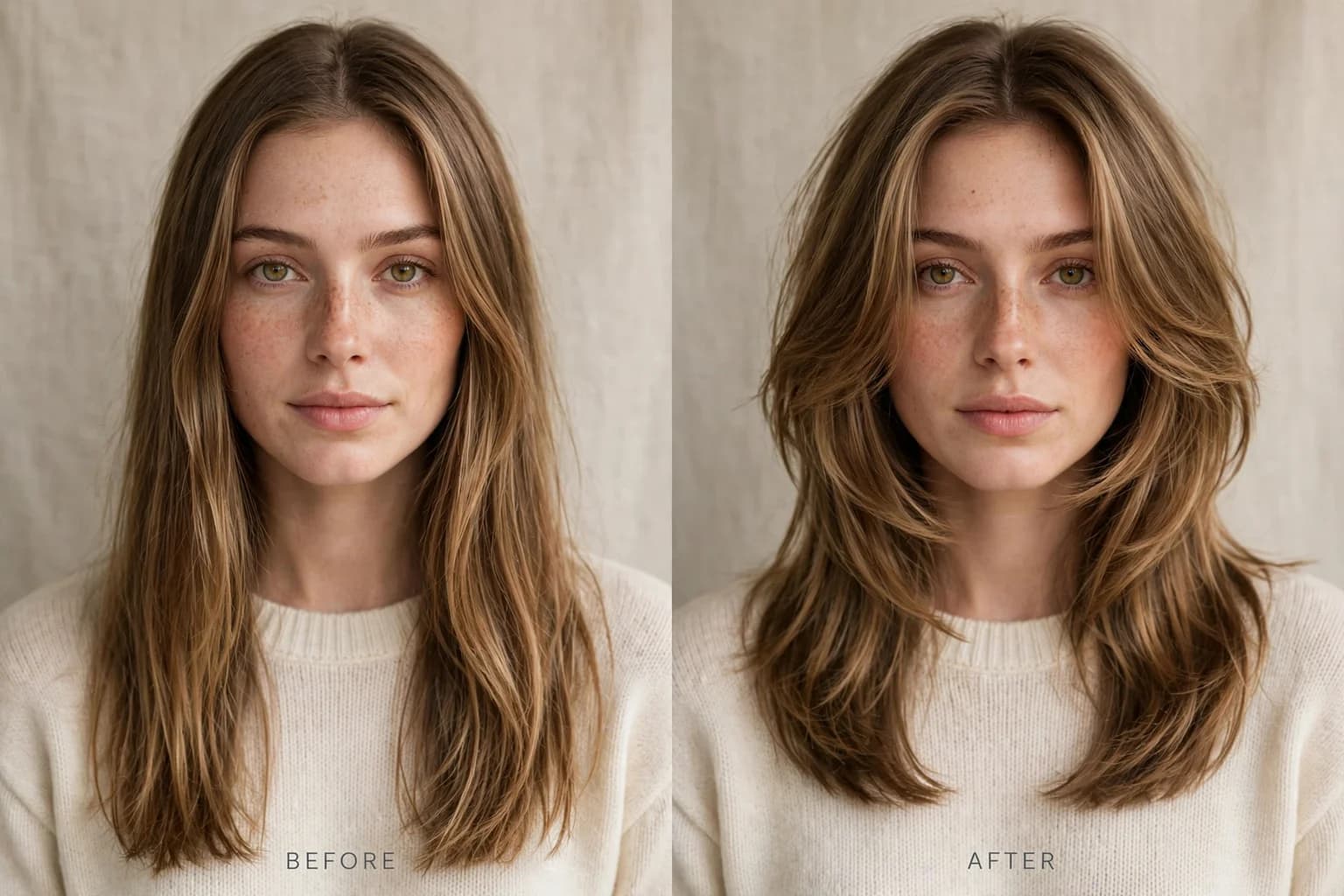
Same length, new architecture: the after photo's shortest layers sit at the cheekbone, and the back length is untouched.
Direct answer
What is a butterfly cut, and who does it suit? A butterfly cut is a layered cut with short face-framing layers starting near the cheekbones or jaw and longer layers through the back, so you keep your length while the front reads as a shorter, shaped cut. It suits most face shapes, but only when the shortest layer is placed for yours: at or above the cheekbone to lengthen a round face, longer and softer for square and long faces. It also needs enough hair to layer, because the wing shape needs room to form.
What is a butterfly cut, exactly?
Two tiers of layering doing two different jobs. The front tier is short: face-framing pieces that start somewhere between the cheekbones and the jaw and flick outward, away from the face. The back tier is long: graduated layers that keep most of your length while removing the weight that makes long hair hang flat. The name comes from the silhouette, shorter wings at the front, length flowing behind.
It is not a shag. A shag layers the whole head, crown included, and takes the length up with it. It is not simply layers in the generic sense either: ordinary layering is distributed evenly, while the butterfly's defining move is the deliberate gap between the short front and the long back.
That gap produces the cut's party trick. Gather the long back tier into a ponytail or clip it away, and the short front tier reads as a bob-length cut. The butterfly is, in effect, two haircuts sharing one head, which is why it photographs as a transformation while technically removing very little length.
Which face shapes does it suit, and where should the layers start?
The cut is adjustable rather than universal, and the adjustment is always the same dial: the height and softness of the shortest front layer.
If a consultation for this cut does not include a sentence about where your shortest layer starts, measured against a landmark on your face, it has not really started. That sentence is the cut.
- Round faces: start the shortest layer at or above the cheekbone, or drop it below the jaw toward the collarbone. Both lengthen. The one placement to avoid is starting exactly at the jaw, which adds width at the widest point and rounds the face further.
- Oval faces: any placement works, which makes oval the reference shape the trend photos are usually taken on. Choose by hair type and by how short you want the ponytail illusion to read.
- Square faces: longer, softer face-framing pieces, often with a curtain fringe. The layers should blur the jaw's corners rather than end beside them; a sharp layer finishing at the jaw underlines the angle you are trying to soften.
- Heart faces: the classic candidate. The wing shape is at its most natural here, with shorter layers at the cheekbone balancing a narrower jaw, and the long back tier adding width where the face has least.
- Long or oblong faces: layers that touch the jawline and fall outward, adding width at the sides. Avoid a long, low shape, which elongates everything further; this is the one face shape where the short tier should be genuinely short.
Source: Paul Edmonds, butterfly haircut: layer placement by face shape
Does it work on fine, thick or curly hair?
Hair type decides the second half of the brief: how much layering the back tier can take.
Fine hair is the case the sceptics get wrong. Layering creates the illusion of volume that a blunt, one-length cut cannot, because the shorter pieces lift and move instead of lying flat against the lengths. The control is restraint at the back: layer the front properly, layer the back lightly or not at all, and keep the longest layers near the collarbone rather than well past the shoulders, where fine ends turn stringy. A butterfly cut that layers fine hair heavily all over produces thin ends and a disappointed client.
Thick hair is the opposite brief. It can take, and usually needs, real internal layering through the back, or the silhouette collapses into the triangle shape every thick-haired reader knows: flat at the crown, wide at the ends. The front tier then does the framing while the back tier does the weight removal.
Curly hair shows the layering most dramatically of all, because each short piece springs up and frames the face on its own, which is presumably why the curly version of this cut is the one Pinterest reports growing fastest. Two conditions apply. The cut should be done dry, so the stylist sees the actual curl pattern and shrinkage before removing length, and the shortest layer must be planned longer than it looks on straight hair, because a cheekbone layer on wet curls can dry to the eye line.
Straight hair wears the shape but does not perform it for free. The wings flick outward because they are styled outward; left to air-dry, straight hair's butterfly layers can fall straight down and read as ordinary layers. The upkeep section below is honest about what that costs in daily effort.
What does the upkeep actually look like?
Better than a bob, worse than one length, and concentrated entirely at the front.
The shape's trims run every 8 to 10 weeks in most salon guidance, because the shortest layers are the cut's architecture and they grow out of position first. Byrdie's experts put the forgiving end of the range at up to 12 weeks, since the layers are soft rather than blunt and the grow-out is graceful compared with a fringe or a bob. What you cannot do is skip trims indefinitely and keep the effect: a butterfly cut a year untrimmed is just long layered hair, which is a perfectly good haircut and a different one.
Daily effort is the front tier only. The guides converge on the same routine: rough-dry or round-brush the shortest face-framing pieces so they take their outward flick, and let the length underneath do what it likes, including air-drying. That is minutes, not a full blowout, but it is not zero, and it is not optional if you want the shape in the photographs. The back of the cut asks for nothing but the trim schedule.
Source: Byrdie, the butterfly haircut: maintenance and who should consider it
What should I ask my stylist for?
Ask in landmarks and tiers, not in trend names. A stylist can execute landmarks precisely; butterfly alone leaves the two decisions that matter to chance. Photograph the result, save the layer landmarks and trim interval as a Salon Card, and bring a photo of the layer placement on your own face to the consultation rather than a model's: her face shape is doing half the work in every reference photo, and it is the half that will not transfer.
- Keep my length: state the longest layer's endpoint, in inches or against your body, and agree it before cutting starts.
- The shortest layer named by landmark: cheekbone, chin or jaw, chosen for your face shape. This is the sentence the whole cut hangs on.
- Face-framing layers graduated forward, with the back layered lightly or heavily according to your hair type: say which, and why, out loud.
- For curly hair, the cut done dry, and the shortest layer planned with shrinkage included.
- The trim interval agreed and written down: 8 to 10 weeks is the shape's lifespan per visit cycle.
Length is the entry requirement, not a detail
Stylists who specialise in this cut give a blunt rule of thumb: the hair needs to be at least half as long again as the length of your face, or there is no room for the two tiers to separate and the wing shape never forms. On shorter hair the honest options are a bob with face-framing, which gives a similar front view by different means, or growing the length first. A butterfly cut attempted on too-short hair is not a subtler version of the cut; it is a different, blunter one.
Take the theory out of it.
The article's central claim is that the cut succeeds or fails on where the shortest layer lands relative to the reader's face shape. The try-on shows that placement on her own face, at her own length, before scissors are involved, which no reference photo can do.
Questions people ask
What face shapes suit a butterfly cut?
Most of them, with the shortest layer placed differently for each: at or above the cheekbone for round faces, longer and softer for square faces, at the jaw for long faces. The placement to avoid is a sharp layer starting exactly at the jaw on a round face, which adds width where the face is already widest.
Does a butterfly cut work on fine hair?
Yes, and fine hair is one of its best cases, because the layering creates volume a blunt cut cannot. The controls are restraint: layer the back lightly rather than heavily, and keep the longest layers near the collarbone so the ends do not turn thin and stringy.
How often does a butterfly cut need trimming?
Every 8 to 10 weeks for most people, because the shortest face-framing layers grow out of position first. The grow-out is softer than a bob's, and some can stretch to 12 weeks, but an untrimmed butterfly eventually becomes ordinary long layers.
What is the difference between a butterfly cut and layers?
Ordinary layers are distributed evenly through the hair. A butterfly cut deliberately separates two tiers: short face-framing layers at the front and long layers at the back, with a visible gap between them. That gap is what lets the front read as a shorter cut while the length stays.
Can I get a butterfly cut with curly hair?
Yes, and curls show the layering more dramatically than any other texture, because the short pieces spring up and frame the face by themselves. Ask for the cut to be done dry, and for the shortest layer to be planned longer than the target, since curls shrink as they dry.