

Bangs for a round face: the fringes that lengthen, not widen
A round face does not rule out bangs; it rules out one specific fringe, the heavy straight line at brow height. Everything else is a question of direction: diagonal, parted or lifted.
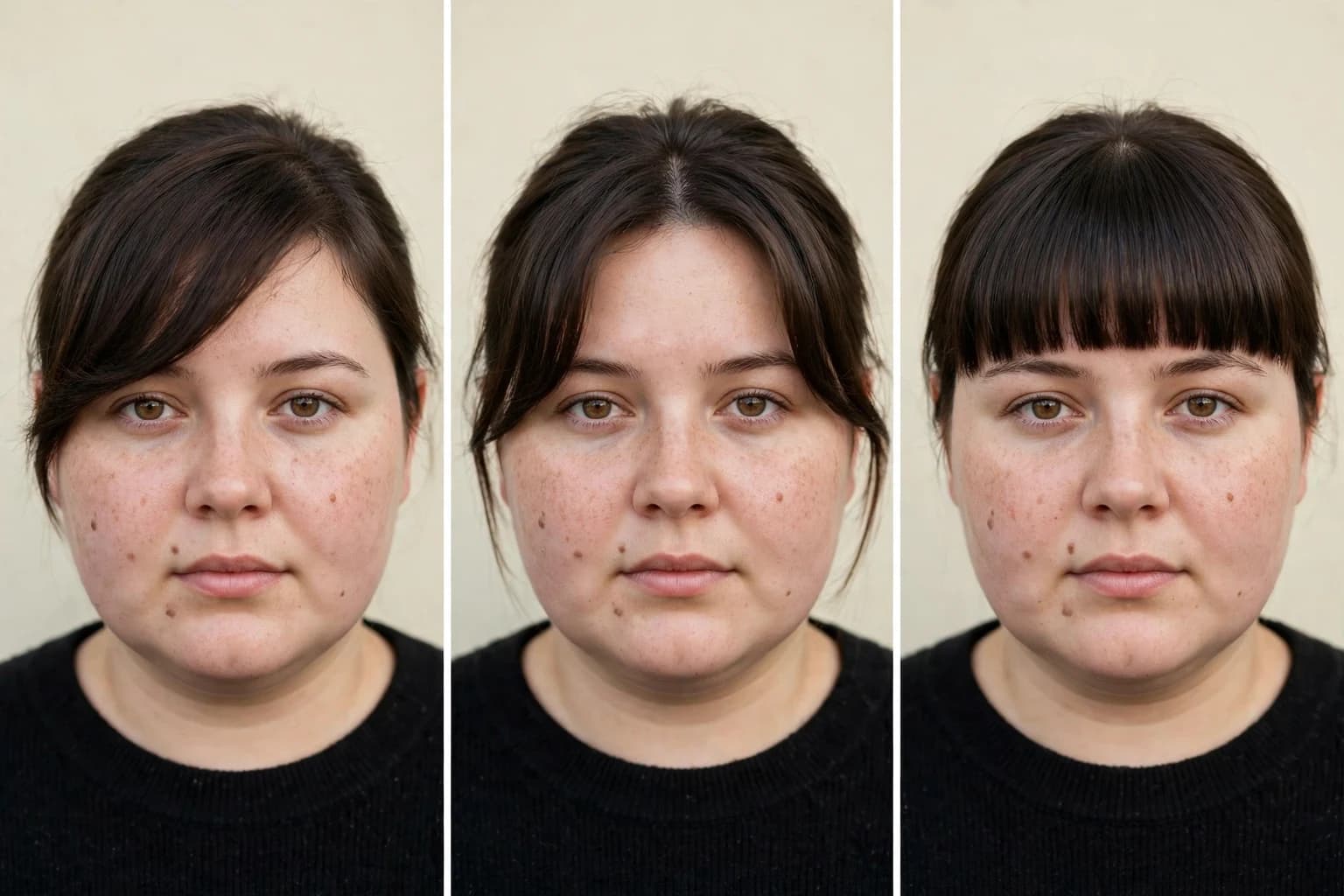
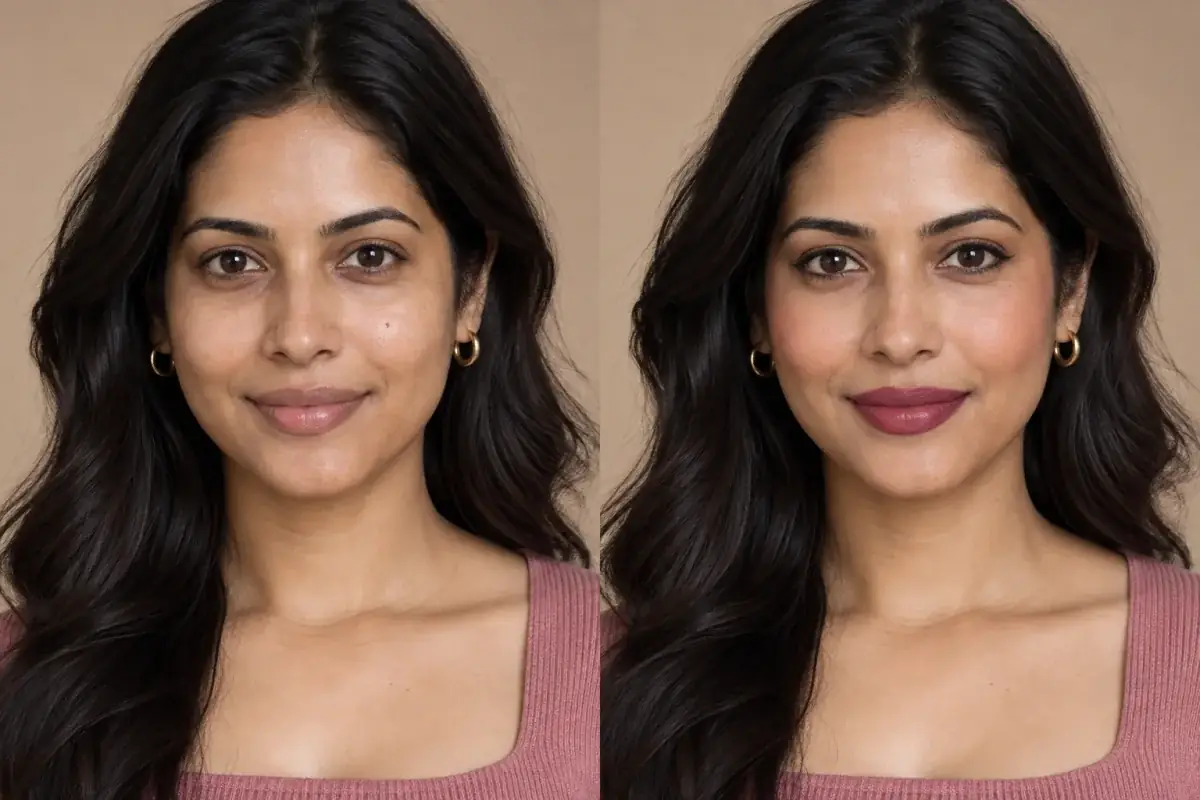
One round face, three fringes: the diagonal and the parting draw length, the straight heavy line draws width.
Direct answer
What bangs suit a round face? The fringes that draw a diagonal or a vertical line: a long side-swept fringe, curtain bangs parted in the middle or just off centre, and a wispy fringe styled with height at the roots. All three pull the eye up and down instead of across, so the face reads longer. The one style to avoid is a blunt, straight-across fringe at brow level, especially a full or wide one: it draws a horizontal line at the widest part of the face and underlines the width. Stylist Paul Edmonds gives round faces the same rule in one sentence: avoid very full fringes or wide fringes, because they can make the face look rounder, and choose something layered instead.
Why does direction matter more than the fringe itself?
A round face is roughly as wide as it is long, with the width carried at the cheeks and no strong angles to interrupt it. Every fringe draws one dominant line on that canvas, and the eye follows the line. A horizontal line tells the eye to travel sideways, which spends the face's budget on width it already has. A diagonal line, a centre parting or height at the crown tells the eye to travel up and down, which buys apparent length the face does not naturally have.
That is why the round face question is never really "bangs or no bangs". It is "which direction does this fringe draw". The general five style comparison in our parent guide scores curtain and side-swept bangs as the round face favourites for exactly this reason, and this guide takes the next step: the lengths, partings and styling details that make each of the three winners work on a round face, and the precise versions of the blunt fringe that undo them.
Which bangs lengthen a round face?
Three styles earn their place, each for a different mechanical reason:
- Long side-swept bangs: the strongest lengthener of the three. A fringe swept diagonally from a side part crosses the forehead on a slope, and a slope is a vertical journey disguised as a horizontal one. The details decide it: the sweep should start from a part set well to one side, fall past the cheekbone at its longest point, and stay soft and feathered at the edges rather than cut in one thick slab. Paul Edmonds describes the round face version as soft around the edges but longer and wider at the cheek, a swoop that adds depth instead of a shelf.
- Curtain bangs, parted: the centre parting is the vertical line, and the two sides sweeping out and down to cheekbone length or longer frame the cheeks instead of sitting on them. On a round face, keep the centre slim rather than wide, part it in the exact middle or a fraction off centre, and let the shortest point stay below the brows so the curtains open the forehead instead of closing it. A very short or centre-heavy curtain does the opposite job, stopping right at the widest point of the cheeks.
- Wispy bangs with height: the exception that proves the direction rule. A thin, feathered fringe lets the forehead show through, so it never forms the solid horizontal bar that widens. Styled with lift at the roots, it adds height at the top of the face, and height is length. Paul Edmonds even allows a shorter, layered wispy fringe on round faces, because the broken edge squares off a rounded outline instead of tracing it. What makes it work is the combination: see-through texture plus volume above it, never a flat, thin fringe pasted to the forehead.
Which bangs widen a round face, and why?
One family, in four versions. A blunt straight-across fringe cut level at the brows draws the widest possible horizontal line and ends it exactly where the face is widest, so the eye measures the face against the line and finds them equal. A full or wide fringe, cut deep and taken wide toward the temples, adds a block of weight at the top of the face that a round outline cannot absorb; this is the version stylists warn against most directly. A fringe that ends at cheekbone height and stops parks a horizontal edge at the widest point. And a short blunt micro fringe cut high and heavy combines the horizontal line with extra exposed roundness below it. Lighter, choppier versions of a straight fringe soften every one of these effects, because texture breaks the line, but if your heart is set on the blunt look, the honest test is the photo one in the last section: on some round faces, with enough height in the rest of the cut, it reads as a deliberate statement rather than a widening mistake. Deliberate is the key word. It should be a choice, not a surprise.
What does the decision table say?
- Long side-swept: Lengthens: the diagonal draws the eye down; Daily styling: About 3 minutes; Grow-out: Fast: sweeps into face framing layers
- Curtain, parted: Lengthens: the parting is a vertical line; Daily styling: About 5 minutes; Grow-out: Blends into layers within weeks
- Wispy with height: Lengthens gently: no solid line, lift on top; Daily styling: About 2 minutes; Grow-out: Fastest: thins into the hairline
- Blunt, straight across: Widens: a horizontal line at brow height; Daily styling: 5 to 10 minutes, plus trims; Grow-out: Slowest: months of pinning back
How many minutes does each style cost a round face?
The minutes matter double here, because the lengthening effect of all three winners lives in the styling, not just the cut. The side-swept fringe takes about three minutes: dry it across the forehead in the opposite direction first, then sweep it back, which is what makes it lie flat and keeps the diagonal clean. Curtain bangs take about five minutes with a round brush, rolling each side away from the face; skip the brush and the curtains collapse inward, the centre parting disappears, and with it the vertical line you bought them for. Wispy bangs take about two minutes, a downward blast of warm air plus a fingertip of product, but the height is not optional: thirty extra seconds lifting the roots with the dryer is the difference between a lengthening fringe and a flat one. The blunt fringe is the expensive row of the table, five to ten minutes of drying flat and straightening, plus a trim every three to four weeks, and it spends all that effort on the one style working against the face. If your morning budget is genuinely zero minutes, be honest with the table and choose the side sweep, the style whose direction survives being left alone.
What is growing these fringes out like?
Hair grows about half an inch a month on average, according to the American Academy of Dermatology figure published by Dyson, so the grow-out maths is the same as for any fringe; what differs is how cooperative each style is on the way. The side-swept fringe is the easiest exit in hairdressing: it sweeps further across week by week and is simply a face framing layer inside about three months. Curtain bangs start long, so they blend into layers within weeks and stop reading as a fringe inside two months. Wispy bangs barely have a grow-out at all, being thin enough to thin into the hairline. The blunt fringe is the long commitment, roughly four to six months from brow level to a length you can sweep aside and tuck, with a pinning and clipping stage in the middle months. For a round face there is one consolation in that stage: a growing out blunt fringe worn parted or swept is, for a few months, exactly the lengthening styles this guide recommends.
How do you decide on your photo?
Put the three winners and, if you are tempted by it, the blunt fringe on one clear front facing photo of your own face in daylight, using the haircut try-on. Judge them by the line each one draws, not by which looks prettiest as hair: does your eye travel up and down, or across? Then check the winner against the cut underneath it. A fringe is only the top half of the decision; our sibling guide covers the lengths and layer placements that keep the vertical line going below the chin, and the face shape guide walks the full shape maths, including how to confirm that your face is round rather than square or heart shaped before you optimise for it. If two fringes survive the photo test, take the narrower question to. When one wins, save the photo: a picture of the fringe on your own face, at the length and parting you chose, is the brief your stylist actually needs. Each try-on uses credits from your plan, so test the three or four serious candidates, not the whole salon menu.
Forehead height and cowlicks can overrule the table
The direction rules assume an average forehead and a hairline that tolerates partings. A short forehead gives curtain bangs no room to sweep, which pushes the answer toward the long side sweep or a wispy fringe started further back, and a strong cowlick at the front hairline will keep splitting a centre parting no matter how well it photographs. If either sounds like you, weight the side-swept row of the table, and ask your stylist to cut the first version longer than the final length so you can live with the direction for a week before it is final.
Take the theory out of it.
The round face fringe question is a direction question, and direction is visible at a glance: three fringes on one photo of your own face show which line each one draws before anyone cuts.
Questions people ask
Can a round face wear bangs at all?
Yes, comfortably, as long as the fringe draws a diagonal or vertical line. Long side-swept bangs, parted curtain bangs and wispy bangs with root lift all lengthen a round face. The only style working against it is a full, blunt, straight-across fringe at brow level.
Do curtain bangs suit a round face?
Yes, in their longer, parted form. Keep the centre slim, part in the middle or just off centre, and let the sides sweep to cheekbone length or below, so the parting reads as a vertical line. Short, wide or centre-heavy curtain bangs stop at the widest point of the cheeks and lose the effect.
Why do blunt bangs make a round face look wider?
Because they draw a solid horizontal line at brow height, and the eye reads the face's width against that line. A round face carries its width at the cheeks, close to that height, so the line and the width reinforce each other. Texture, choppiness or a longer length breaks the line and softens the effect.
What fringe suits a round face with a small forehead?
A long side-swept fringe is the safest answer, because it needs no vertical room and still draws the diagonal. A light wispy fringe started a little further back also works. Curtain bangs are the hardest fit on a small forehead, since the two sides meet before they have space to sweep.
How long do bangs take to grow out on a round face?
At the average growth rate of about half an inch a month, a side-swept or curtain fringe blends into layers within two to three months. A blunt fringe takes roughly four to six months to reach a sweepable length. Worn parted or swept during that stage, a growing out fringe actually lengthens a round face on its way out.