

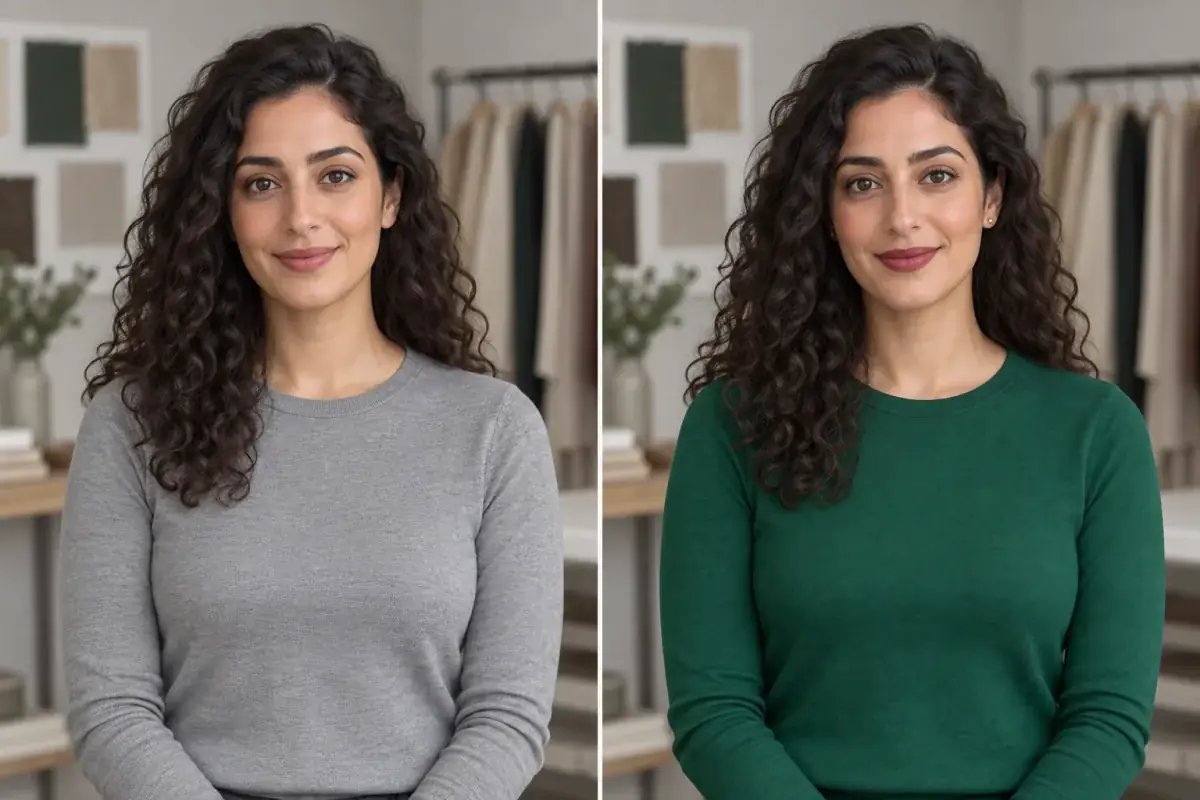
What is the best hair color for green eyes?
Green is the rarest iris color in the salon chair and the most mechanical to dress: its opposite on the color wheel is red, so the shades that move it are known in advance. What changes from reader to reader is which half of the list her skin can wear.
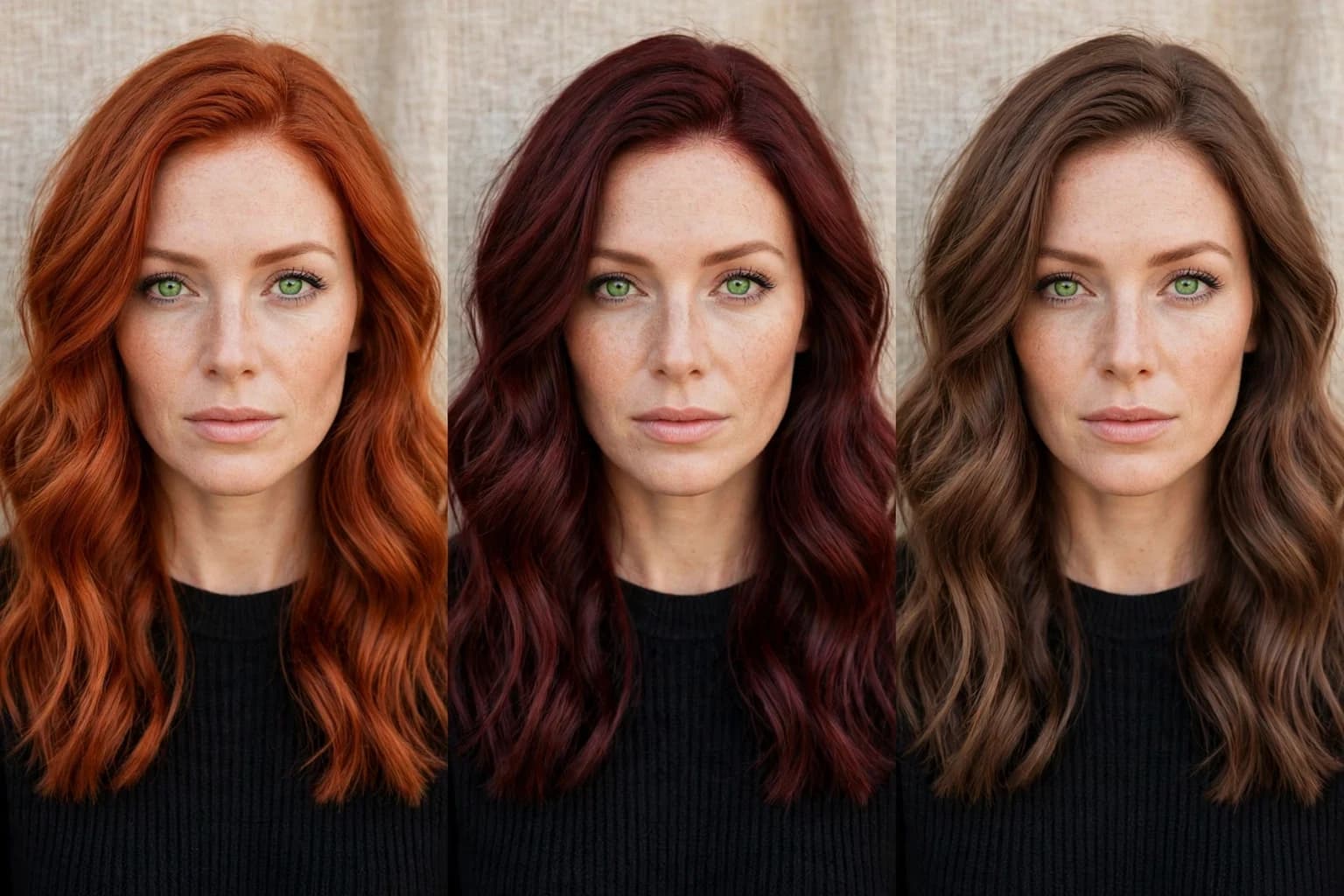
Two routes to the same result: copper argues with the iris and wins, burgundy cools the frame and lets the green carry the warmth alone.
Direct answer
What is the best hair color for green eyes? Start by checking which eyes you actually have: pure green, with no brown or gold center, runs on opposition, because red sits opposite green on the color wheel, so copper, auburn and red based browns make the iris read greener. Warm skin wears the copper and golden end of that family; cool skin wears its violet end, burgundy, plum and blue based reds, with ash brown and espresso as the quiet frames. Hazel eyes, which carry a brown or gold center inside the green, are a different question with a different answer, covered below.
Key takeaways
- Pure green and hazel are not one question: green runs on contrast with red, hazel runs on whichever half of the iris, green or amber, you choose to feature.
- Red is opposite green on the color wheel, so copper and auburn raise the iris directly; the effect belongs to red based shades, not to warm shades in general.
- Cool skin wears the violet end of the red family, burgundy and plum, plus ash brown and espresso frames; warm skin wears copper, gold and caramel.
- The shades that dull green eyes are the ones that imitate them: green and teal fashion shades turn the iris into part of the color scheme instead of the feature.
Are your eyes green or hazel, and why does it change the answer?
Look at your iris in daylight, close up. A pure green eye is green all the way through, sometimes with a lighter or darker green ring at the edge, but with no brown in it. A hazel eye is a mixture: green around the outside with brown, gold or amber gathered toward the pupil, and it famously changes apparent color with light and clothing because the balance between its two colors keeps shifting.
The split matters because the two eyes are flattered by opposite strategies. Pure green has one color to amplify, and opposition does it: surround it with red and the green saturates. Hazel has two colors sharing one iris, and no single shade can oppose both at once. Hazel readers do better with dimension: multidimensional browns, bronde and golden caramel, where the highlights repeat the amber center and the depth repeats the green rim, so the eye reads as complex rather than competed with. If your eyes have a brown center, borrow the warm lists below for their golds and coppers, but expect harmony, not the electric contrast a pure green eye gets from the same shade.
If you arrived from the parent question, what hair color suits me, the parent guide weighs eyes against undertone and depth contrast together. This page isolates the green and hazel logic, the way the sibling guides isolate brown eyes, where harmony does the work, and blue eyes, where contrast does.
Why does red sit at the top of the green eye list?
Complementary contrast. The eye judges a color partly by its surroundings, and green surrounded by its opposite, red, appears more saturated to anyone looking at it. It is the same mechanism that makes copper the strongest single shade for blue eyes in the sibling guide, rotated one step around the wheel: there, orange opposes blue; here, red opposes green.
Two limits keep the rule honest. First, the effect belongs to shades with a real red base: true copper, auburn, mahogany, cherry reds. A merely warm shade, a golden brown with no red in it, harmonizes with green rather than opposing it, which is pleasant but weaker. Second, violet belongs on this list for a subtler reason: purple is red mixed with blue, so burgundy, plum and violet reds keep part of the opposition while running cool, which is what lets cool skin use the mechanism at all. Ash and espresso work differently again: they supply no opposition, only a cool, deep frame that makes a light green iris look clearer by comparison, the framing strategy the blue eye guide uses.
None of this overrules skin. A complementary shade that fights your undertone will make your eyes pop in a face that looks wrong everywhere else, and the skin is the larger surface. Undertone picks which end of the red family you shop in; the color wheel only explains why the family works.
Which shades suit green eyes on warm skin?
Warm skin and green eyes are the coloring the classic advice was written for, because skin and shade family pull in the same direction.
- True copper, level 6 to 7: the strongest effect available to any eye color in this chain. The orange red raises the green directly, and on warm skin it reads as glow rather than dye. Its upkeep, the fade and the gloss habit, is weighed in full in the copper decision guide.
- Auburn and copper brown, level 5 to 6: the wearable version of the same argument. The red is woven through brown, so the contrast survives at office strength, and these are the shades stylist roundups name most often as the single most flattering family for green eyes.
- Golden and honey blonde, level 8 to 9: green and yellow sit next to each other on the wheel, so golds harmonize instead of opposing. The effect is brightness rather than electricity: the eyes look lit, especially where the iris carries gold flecks of its own.
- Caramel and toffee dimension over a brunette base: contrast placed in ribbons. The dark base frames the face; the warm ribbons near it supply the red adjacent warmth that wakes the iris.
- Warm chocolate, level 4 to 5: the deep route in a warm register, for green eyed readers who want the frame dark and the temperature golden.
Which shades suit green eyes on cool skin?
Cool skin cannot take the fiery end of the red family without flushing, so it uses the same wheel from the other side: the violet end of red, and the cool frames.
Neutral skin can shop both lists, but pick a route per shade, not a blend: a burgundy with warm copper pieces is two arguments in one head of hair.
The warm and cool routes look close in a shade chart and nothing alike on a face. Run one of each on the same photo and look only at your eyes.
- Burgundy, level 4 to 5: the cool red. Its base is blue as much as red, so it keeps the opposition to green while agreeing with pink based skin. On deep skin it is also the richest of the cool options.
- Plum and violet glints: red at its coolest extreme. As an all over shade it is a statement; as glints or a gloss over dark brown it is the precise version, a flash of opposition that appears when the hair moves.
- Ash brown and mushroom brown, level 5 to 6: the quiet frame. Blue gray pigment echoes nothing in a green iris, so the eye becomes the only warm, saturated thing in the face, and it reads greener by isolation.
- Icy blonde and platinum, level 9 to 10: maximum depth contrast on cool, fair coloring. The hair goes nearly white so the iris carries all the color; keep a shadow root so the frame still exists.
- Cool espresso, level 2 to 3: the deep frame in a cool base. Green eyes against near black hair are the highest contrast pairing on this page, and the one that asks the least upkeep.
Which shades dull green eyes?
- Green, teal and mint fashion shades: harmony carried past its limit. When the hair matches the iris, the eye stops being the feature and becomes part of the color scheme, exactly the failure the blue eye guide flags with blue hair on blue eyes.
- Flat mid level shades with no dimension: a matte level 6 or 7 brown at the iris's own softness cancels against it. Green eyes need the hair clearly warmer, clearly cooler or clearly deeper than the eye itself.
- Orange gold and brassy yellow blonde: copper's cheap imitation. Brass competes with the skin instead of opposing the iris, and green eyes end up looking tired inside the noise.
- Ash overload on warm skin: ash is a servant on cool skin and an argument on warm. Gray toned hair over golden skin reads greenish at the hairline, in the wrong way: the green moves from the eyes to the hairline.
How do you choose between the warm and cool routes?
Let your undertone make the shortlist, then let your eyes vote. Preview one warm finalist, true copper or auburn, and one cool finalist, burgundy or ash brown, on the same daylight photo. Look at your eyes first in each version: the right route makes you notice the iris before the hair. Then look at your skin: the route that evens it out wins, because a shade that pops the eyes while flushing or draining the face is a shade you will tire of by week two. Previewing uses credits from your plan, and a two shade test is exactly what they are for.
Source: Uptone parent guide
Source: Uptone sibling guide, brown eyes
Source: Uptone sibling guide, blue eyes
The wheel proposes, the skin disposes
Complementary contrast is real, and it is a lever, not a law. It reliably ranks the red family first for green eyes, but it cannot tell you whether your skin wants that red fiery or violet, at level 5 or level 8. Those are undertone and depth questions, and they are answered by the parent decision guide and by seeing the finalists, not by a stricter reading of the wheel.
Take the theory out of it.
The warm and cool routes to green eyes cannot be ranked from a shade chart, because the winner depends on the reader's own undertone. One preview of each on the same photo settles which end of the red family her face votes for.
Questions people ask
What hair color makes green eyes pop the most?
True copper, on skin that can wear it, because red sits opposite green on the color wheel and raises the iris's saturation directly. Cool skin gets the same mechanism from burgundy, whose blue based red opposes green without adding warmth. Preview both on your photo and look at which one makes you notice your eyes first.
Are my eyes green or hazel, and does it matter for hair color?
Check the center of the iris in daylight: pure green has no brown or gold in it, while hazel carries brown or amber toward the pupil and shifts color with the light. It matters because green runs on contrast and hazel runs on dimension, so hazel readers usually do better with multidimensional browns and golden caramel than with one flat red.
Does ash hair color suit green eyes?
Yes, on cool skin. Ash brown and icy blonde frame a green iris by isolation: the hair goes cool and quiet, so the eye becomes the most saturated thing in the face. On warm skin the same ash reads gray green at the hairline and dulls both the skin and the eyes.
What is the best hair color for green eyes and pale skin?
Warm, fair skin takes strawberry blonde and soft copper, which give the red family effect at a depth pale coloring can fund. Cool, fair skin takes burgundy at level 5 or a rooted icy blonde. The depth ceiling for fair skin is worked through in the pale skin guide.
Can green eyed readers wear blonde without losing the eye color effect?
Yes, if the blonde is chosen by route. Golden and honey blondes harmonize with green and brighten it, while icy platinum frames it by contrast on cool skin. The blonde that fails is a flat, rootless mid level one with no dimension, which sits at the iris's own softness and cancels against it.