



Soft copper blonde vs honey blonde: which warm blonde suits you?
Both are warm blondes, but they are warm in opposite directions: copper leans red, honey leans gold, and your undertone picks between them.
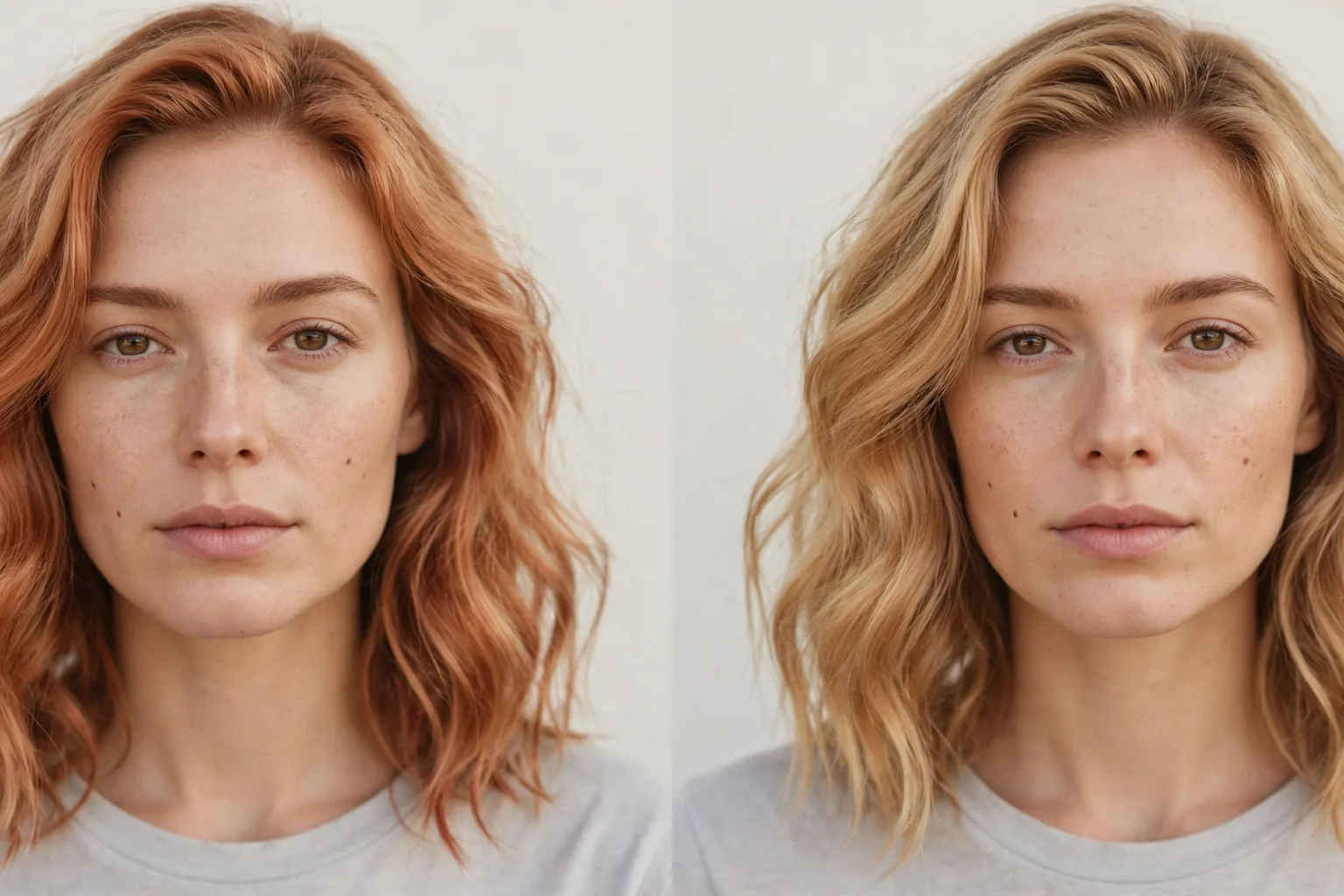
Same face, two warm blondes: the copper on one side, the honey on the other, and undertone decides which one is hers.
Direct answer
Soft copper blonde or honey blonde: which warm blonde suits you? Soft copper blonde suits warm and neutral warm undertones best, because its red reflect echoes the warmth already in the skin. Honey blonde suits warm and golden undertones, and it is usually the gentler of the two to reach from dark hair. If your undertone is neutral or olive, honey is the safer first test and copper is the bolder one, and when both look plausible, skin depth and your starting color settle it.
What is the actual difference between soft copper blonde and honey blonde?
The difference is the reflect, the color the hair throws back in the light. Soft copper blonde is built on copper pigment, so beneath the blonde it runs red orange, like light through amber. Honey blonde is built on gold pigment, so it runs yellow, like the inside of a honeycomb. Both sit at roughly the same depth, which is why they get confused in shade charts and why the choice feels harder than it is.
Professional color numbering makes the difference explicit. The first number is the depth level, and the numbers after the point are the reflect: 3 is gold and 4 is copper in the international system most salon brands follow. A soft copper blonde is usually a level 8 with a copper gold reflect, written 8.34 or 8.43. A honey blonde is usually a level 8 or 9 with a gold reflect, written 8.3 or 9.3. When a shade name is vague, ask your colorist for the number. The number cannot hide which way the color leans.
How do soft copper blonde and honey blonde compare side by side?
- Reflect: soft copper blonde is copper, a red orange reflect; honey blonde is gold, a yellow reflect.
- Typical salon number: 8.34 or 8.43 for soft copper blonde; 8.3 or 9.3 for honey blonde.
- Suits best: soft copper blonde suits warm and neutral warm undertones; honey blonde suits warm and golden undertones.
- On neutral skin: soft copper blonde works if kept soft, and can read pink as it fades; honey blonde is the safer of the two.
- On olive skin: soft copper blonde needs care, as the olive section below explains; honey blonde is usually the better warm blonde.
- From dark brown hair: soft copper blonde is often reachable in one session; honey blonde often needs two sessions.
- Fade behavior: copper fades fastest, because red pigment leaves first; honey fades toward brassy yellow.
- Grow out: a copper regrowth line shows sooner; honey blends out softly and is balayage friendly.
- Upkeep: copper needs a gloss or toner every 4 to 6 weeks; honey needs toner to correct brass, less frequently.
Which warm blonde suits a warm undertone?
Both of them can, so the warm undertone reader has the luxury problem. Choose soft copper blonde if your skin carries visible warmth and you like color with a point of view: the red reflect picks up the warmth in cheeks and lips and makes green and hazel eyes look greener. One caution for warm skin that runs flushed: a strong copper can double the redness in the face, so flushed skin should take the soft version of this shade, heavy on the gold and light on the copper.
Choose honey blonde if your warmth is golden rather than rosy, or if you wear gold jewelry almost by default. Honey keeps the face bright without adding a second warm color to argue with, which is why it is the classic warm blonde in most salon portfolios. The general rules behind both choices are laid out in our hair color for your skin tone guide; this article is the narrower question of which warm direction to take once you know you are warm.
Which warm blonde suits a neutral undertone?
Honey, first. Neutral skin has no strong warm or cool signal for a red reflect to harmonize with, so copper's redness can sit on the face as a separate event, flattering on some faces and restless on others. Honey's gold is quieter. It warms neutral skin without demanding that the skin answer back, and it stays safe as it fades, where copper drifts pink and then dull, a fade path neutral skin shows mercilessly.
Neutral readers who love copper should take the version closest to honey: a copper gold with the gold first in the formula, at level 8 or lighter. Depth matters here too. On neutral skin, a deeper copper reads as a fashion color and a lighter one reads as a blonde, and most neutral readers asking this question want the blonde.
What about olive skin: copper or honey?
Olive skin is where this comparison earns its keep, because the two blondes behave very differently against a greenish cast. Copper sets red against that green, and the contrast can go either way: on some olive faces it is striking, on others the hair and the skin seem to be lit by different lights. The full copper family on olive skin, including the shades that work and the ones that fail, is covered in our copper hair on olive skin guide.
Honey is usually the better warm blonde for olive skin, with one condition. Gold softens the green cast instead of fighting it, but the gold must stay muted. A bright, saturated honey can tip yellow against olive skin and bring out sallowness. Ask for honey with a neutral base rather than a pure gold one, and test it on your photo before committing, because olive is the undertone where guessing costs the most.
Which one is easier to reach from dark hair?
Soft copper blonde, and it is not close. Dark hair already contains red and copper pigment, the very pigment stylists expose when they lift it. Reaching a copper blonde means lifting dark hair to around level 7 or 8 and depositing copper on top of warmth that is already there, which is often one session of work. Honey blonde needs the hair lifted cleaner, to level 8 or 9, with the underlying warmth toned into gold rather than left as orange. From a level 4 or 5 brown, that is frequently two sessions, and the honest version of the process, with costs and timelines, is in our going blonde from dark hair guide.
From light brown or existing blonde hair, both are a single toner decision and this section stops mattering. From black hair, add a session to each estimate and take the copper first if you want a warm blonde this month rather than this season.
Which fades faster, and which grows out softer?
Copper fades faster. Red pigment molecules are the largest of the color molecules and the first to wash out, so a soft copper blonde typically needs a gloss or toner refresh every 4 to 6 weeks to keep its reflect, and it fades through rose gold toward a pale, warm blonde. Honey fades slower but drifts: the gold warms up into brassiness over time, especially with heat styling and hard water, and needs a toning shampoo or an occasional toner rather than a full refresh.
For grow out, honey wins. It is most often applied as balayage or with a melted root, so the regrowth line is soft and the color can stretch 10 to 12 weeks between appointments. A full head copper shows its roots sooner and more clearly, because the reflect difference between new growth and colored hair is visible even when the depth matches.
How do you decide between copper and honey on your own face?
By this point the rules have probably narrowed it to a lean, not a certainty, and a lean is exactly what a photo test is for. Upload a daylight photo to the hair color try-on and put both shades on your own face, side by side, in the same light. Copper announces itself quickly: you will see within seconds whether the red reflect lights your skin up or starts an argument with it. Honey is the quieter test, so check it against your usual makeup rather than a bare face. Each try-on uses credits from your plan, so test the two finalists rather than the whole blonde chart, and screenshot the winner to show your colorist along with its shade number.
Rules narrow the choice; they do not make it
Undertone rules are a sorting tool, not a verdict. Some faces wear the technically wrong warm blonde beautifully because their eye color, brow depth or personal style carries it. Use the rules to pick which shade to test first, then let your own photo overrule them.
Take the theory out of it.
The article's central claim is that reflect, not depth, separates the two blondes, and it is testable in one step: the same face in a copper reflect and a gold reflect, side by side, before any salon money is spent.
Questions people ask
Is soft copper blonde warmer than honey blonde?
Yes, in effect. Copper carries a red orange reflect and honey carries a gold one, and red reads warmer and stronger on the face than gold at the same depth. Both are warm blondes; copper is simply the louder warmth.
Which blonde suits olive skin, copper or honey?
Honey, usually, as long as the gold is muted rather than bright. Copper can work on olive skin but the red against the green cast is a gamble, while a neutral based honey softens the cast instead of fighting it.
Can I go from dark brown hair to honey blonde in one session?
Sometimes, but plan for two. Honey needs hair lifted clean to level 8 or 9 with the warmth toned into gold, and from a dark brown start that is more lift than most hair should take in one sitting.
Which fades faster, soft copper blonde or honey blonde?
Copper, by a clear margin. Red pigment washes out first, so copper needs a gloss refresh roughly every 4 to 6 weeks, while honey fades more slowly and mainly needs toning when it drifts brassy.
Does soft copper blonde suit cool undertones?
Rarely at full strength. Cool skin and red orange hair usually fight, but a muted copper gold at level 8 or lighter can work on cool neutral skin, which is exactly the case worth testing on a photo first.