


Hair color levels 1 to 10 explained: depth, tone codes and lift math
Every professional shade is two numbers: a level for depth and a tone code for temperature. Learn to read the pair and the whole shade chart, salon menu and box dye shelf stops being guesswork.
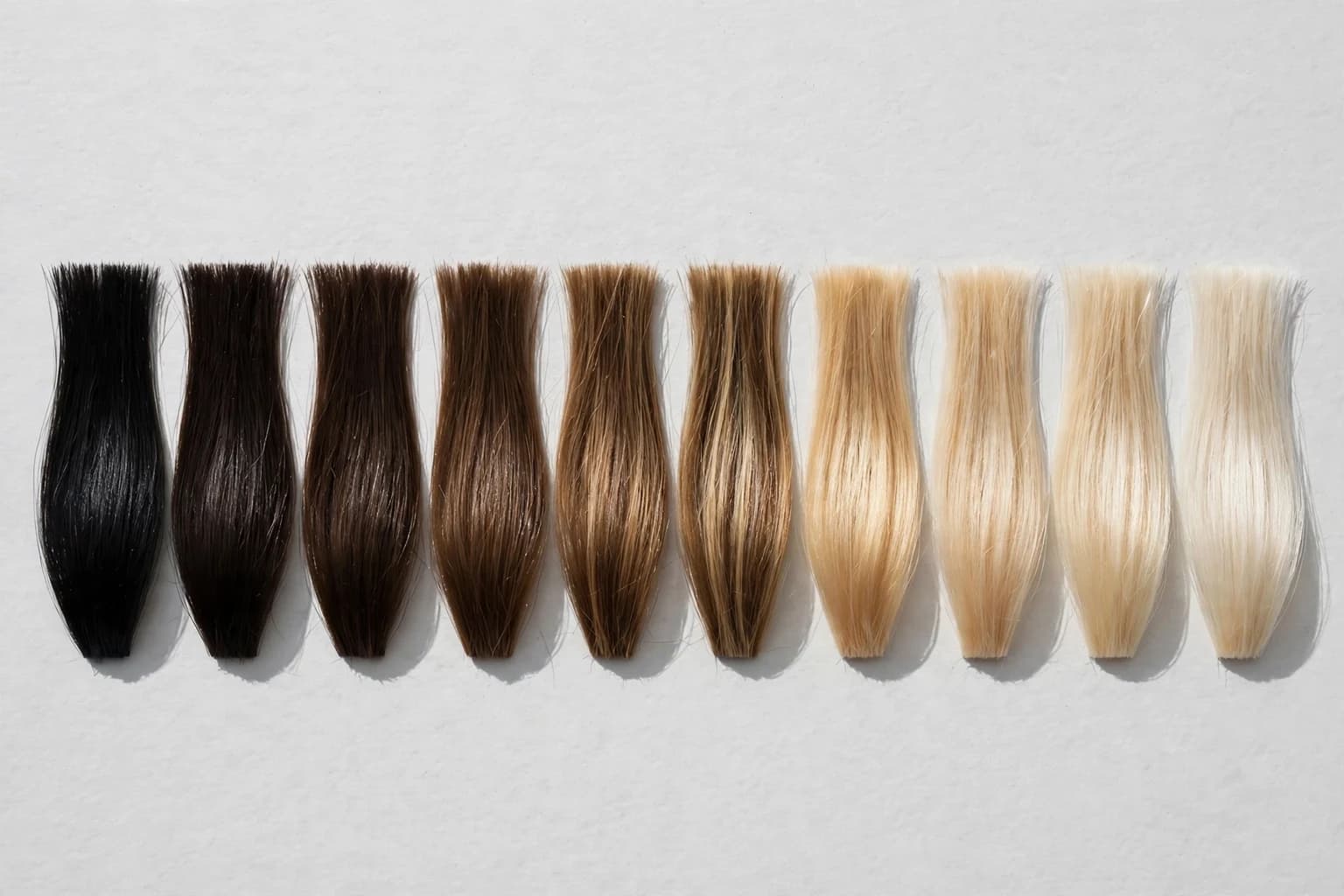
Ten levels, one scale: level 1 black at one end, level 10 the lightest blonde at the other, and every natural and dyed shade placed somewhere between them.
Direct answer
What are hair color levels? Hair color levels are the standard scale of depth that runs from level 1, black, to level 10, the lightest platinum blonde, and every shade is written as a level plus a tone code: 7.4, for example, is a level 7 medium blonde depth carrying a copper tone. The level tells you how light or dark a color is; the code after the point tells you its temperature, such as .1 ash, .3 gold, .4 copper or .6 red.
Key takeaways
- Levels measure depth only: level 1 is black, level 5 is light brown, level 7 is medium blonde, level 10 is the lightest blonde.
- The tone code after the point carries the temperature: .1 ash, .3 gold, .4 copper, .6 red, .0 natural with no added tone.
- Most natural hair sits between levels 2 and 7, and most people rate their own hair one or two levels darker than it is.
- Going lighter is arithmetic: target level minus starting level equals the levels of lift you need, and permanent color alone lifts about 1 to 3 of them.
- Numbers travel between brands and salons; shade names do not. A level and a tone code are the portable version of any color.
What does each level from 1 to 10 actually look like?
Two habits make the chart usable. First, judge your own level at the mid lengths in daylight, not at the roots and not at the sun lightened ends, because those are the two places your hair is not its true level. Second, expect to be wrong in one direction: most people describe themselves one or two levels darker than a colorist would, so the reader who says level 2 dark brunette is very often a level 4 or 5 with a gold glint in sunlight. That single misjudgment explains a large share of box dye results that come out darker than the picture.
- 1: Black; What it looks like on real hair: The darkest shade there is; in daylight it can throw a blue or brown sheen, but no lighter pigment shows through
- 2: Darkest brown; What it looks like on real hair: Looks black indoors and reads as very dark brown in sunlight; the most common natural level in the world
- 3: Dark brown; What it looks like on real hair: Unmistakably brown, still deep; espresso and dark chocolate shades live here
- 4: Medium brown; What it looks like on real hair: The classic brunette midpoint; warm versions read as chestnut, cool versions as ash brown
- 5: Light brown; What it looks like on real hair: Brown that lightens visibly in sun; mousy brown and light chestnut sit at this level
- 6: Dark blonde; What it looks like on real hair: The border crossing: brown in flat light, blonde in bright light, and the level most often argued about
- 7: Medium blonde; What it looks like on real hair: Clearly blonde with real depth left in it; most copper and strawberry shades are built at this level
- 8: Light blonde; What it looks like on real hair: Bright blonde that still holds a yellow note; honey and golden blondes live here
- 9: Very light blonde; What it looks like on real hair: Pale blonde, one step from platinum; the minimum canvas most ash and pastel shades need
- 10: Lightest blonde; What it looks like on real hair: Platinum and near white; the ceiling of the scale and the level pastel and silver shades are built on
What do the numbers after the point mean?
The digits after the point are the tone, also called the reflect: the temperature and hue the shade adds on top of its depth. One digit is common; two digits mean a primary tone followed by a weaker secondary one, so 6.46 is a dark blonde whose main tone is copper with red behind it.
The system is shared, not identical. Most professional brands agree on .1 ash, .3 gold and .4 copper, but a few number ash differently, and some brands print letters instead of digits, such as Wella style slashes or the rc shorthand for red copper that clients quote from salon videos. The level digit, by contrast, means the same thing almost everywhere. Our stylist vocabulary guide decodes the codes as they are actually spoken in the chair, including how to say your own target back.
- .0: Natural; Temperature: Neutral; What it does in a shade: No added tone; the base shade as it is, and the family used for reliable grey coverage
- .1: Ash; Temperature: Cool; What it does in a shade: Blue and grey based; cancels warmth and reads smoky rather than shiny
- .2: Pearl; Temperature: Cool; What it does in a shade: Violet based; softens yellow in blondes
- .3: Gold; Temperature: Warm; What it does in a shade: Pure warmth and shine; the golden in golden blonde
- .4: Copper; Temperature: Warm; What it does in a shade: Red orange reflect; the engine inside every copper shade
- .5: Mahogany; Temperature: Warm to neutral; What it does in a shade: Red with violet behind it; deeper and moodier than a true red
- .6: Red; Temperature: Warm; What it does in a shade: The direct red reflect, strongest in shades like cherry and auburn reds
- .7: Violet; Temperature: Cool; What it does in a shade: Used mainly to neutralise yellow; exact numbering varies the most between brands
How does your starting level change what a color can do?
Color math has one rule that runs everything else: lighter is subtraction, darker is addition. A dye can deposit pigment and take you down any number of levels in one step. Going up is different, because the dye first has to remove your existing pigment, and that removal is called lift. The lift you need is simple arithmetic: target level minus starting level. A natural level 4 who wants a level 7 copper needs 3 levels of lift; a level 6 who wants the same copper needs 1.
Lift also exposes what was underneath. As hair lightens it passes through a fixed sequence of underlying pigments: levels 1 to 4 uncover red, levels 5 and 6 uncover orange, levels 7 and 8 uncover yellow, and levels 9 and 10 uncover pale yellow. That sequence is why ash shades turn brassy on darker bases, because the ash in the tube is fighting the orange the lift just uncovered, and why every pale blonde goal is really a pale yellow goal first.
One more rule saves real money: color does not lift color. A lighter dye cannot lighten hair that is already dyed, because artificial pigment does not respond to developer the way natural pigment does. If your hair carries old dye, the honest routes are a color remover, lightener in a stylist's hands, or a target at or below your current level. Our copper decision guide is built on exactly this arithmetic, because whether copper needs bleach is decided entirely by your starting level.
What do developer volumes actually do?
Developer is the peroxide mixed with the color, and its volume number is its lifting strength. In brief:
Read the table with one ceiling in mind: permanent color, even at 40 volume, tops out at roughly 3 to 4 levels of lift on healthy natural hair. Beyond that, the tool changes from color to lightener, meaning bleach, and big jumps stop being a single appointment. Going from brunette to blonde is a 4 to 7 level journey for most people, which is why our blonde guide treats it as sessions with a map rather than one sitting.
- 10 volume: 3 percent; What it does: Deposits tone with little to no lift; Typical use: Going darker, toning, level on level color
- 20 volume: 6 percent; What it does: Lifts 1 to 2 levels; Typical use: The standard permanent color; also the usual choice for grey coverage
- 30 volume: 9 percent; What it does: Lifts 2 to 3 levels; Typical use: Noticeable lightening and highlight work
- 40 volume: 12 percent; What it does: Lifts up to about 4 levels; Typical use: High lift blondes; professional territory, and the volume most likely to damage hair used carelessly
How do you use levels when you shop for dye or brief a stylist?
Shopping first. On a box dye, ignore the name on the front and find the number: that is the commitment. Then check the small print for the base range the shade was tested on, because the model swatch is usually shown on level 7 or 8 hair, and the same tube on a level 4 base delivers a darker, warmer result. For grey coverage, choose a .0 natural shade at your own level rather than a fashion tone one level up; natural shades are formulated to fill unpigmented hair evenly.
Briefing a stylist, the level system turns a screenshot into a sentence. "Level 7 with a .4 copper reflect, kept off a shadow root" is a formula a colorist can quote, mix and repeat next visit; "copper like this photo" is a hope. The same pair of numbers is what a Salon Card stores, and it is the fastest way to check a target before the appointment: preview the shade at its level on your own photo, then carry the number, not the picture, into the chair.
Pick a level on the chart, then see that exact depth on your own hair.
Source: Uptone stylist vocabulary guide
Source: Uptone copper guide
Numbers travel, names and small print do not
The level scale is the nearest thing hair color has to a universal language, but it is a convention, not a law of physics. Brands name the same level differently, a level 10 in one line can read as a 9 in another, and tone numbering has real exceptions, especially around ash and violet. Use the numbers to communicate and to plan, then confirm against the specific brand's own swatch, because the swatch is what will actually be in your hair.
Take the theory out of it.
Levels are abstract until they are on a face. The try-on lets the reader place a target depth on their own hair and judge the jump from their starting level before any dye, developer or bleach is involved.
Questions people ask
What level is my natural hair?
Compare your mid lengths, not your roots or ends, against the chart in daylight. Most natural hair sits between levels 2 and 7, and most people rate themselves one or two levels darker than a colorist would. A brown that glints gold in sunlight is usually a level 5, not the level 3 it gets called.
Can hair color lift hair color?
No. A lighter dye cannot lighten hair that is already dyed, because artificial pigment does not lift with developer the way natural pigment does. Previously colored hair needs a remover or lightener to go lighter, or a new target at or below its current level.
What level do I need for platinum or pastel shades?
Level 9 to 10, the pale yellow canvas. Pastels and clean ash shades have almost no pigment of their own, so whatever warmth is left in the hair becomes part of the color. From a dark natural base that is several lightening sessions, not one appointment.
Do levels mean the same thing in every brand?
The depth scale, yes, almost everywhere: level 1 is black and level 10 is the lightest blonde in every major system. The names attached to levels vary, and tone codes have exceptions, so a 7.4 in one brand may be spelled with letters in another while meaning the same depth and copper tone.
Why did my dye come out darker than the box showed?
Because the box result is photographed on a lighter starting level, usually around level 7 or 8, and dye deposits onto whatever level you bring to it. On a level 4 or 5 base the same shade lands darker and warmer. Porous ends also grab extra pigment, which is why lengths often read a level deeper than roots.