
What nail shape suits my hands? The full table, then see it on your hands
This is the beauty question the internet still answers with charts alone: two measurements of your hands, one table, and then the step no chart can do, seeing the finalists on your own hands.
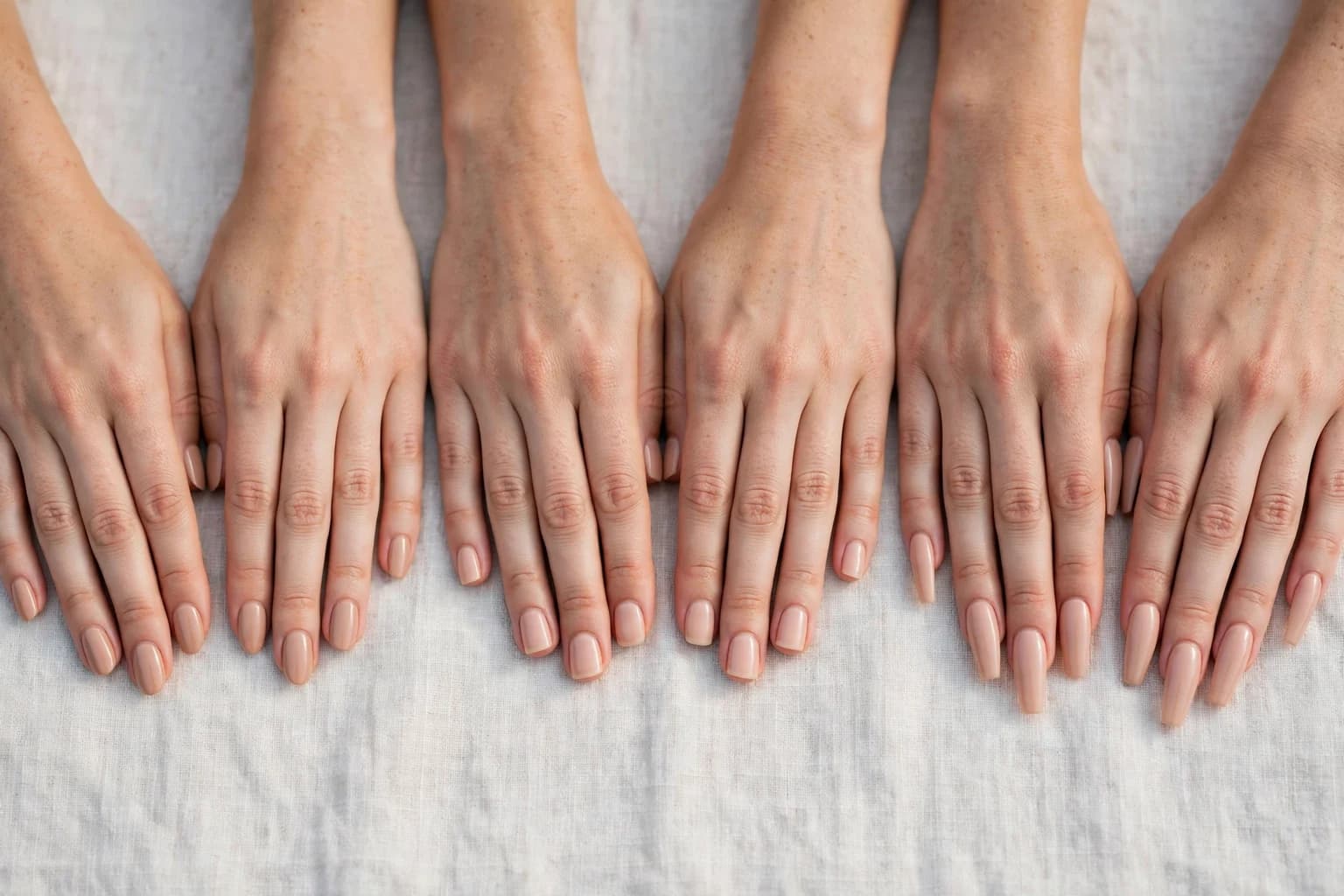
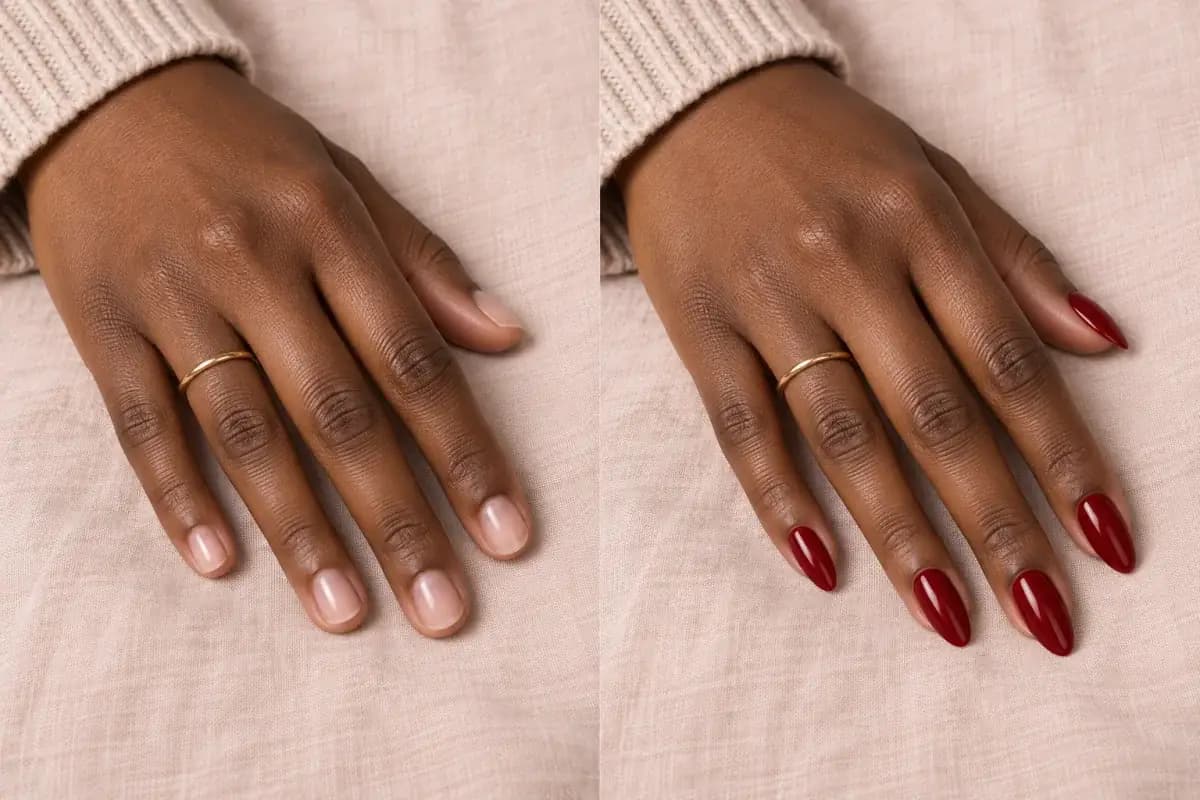
Same hands, three shapes: the shape changes the apparent length and width of the fingers, which is the whole decision.
Direct answer
What nail shape suits my hands? Measure two things, your finger length and your nail bed width, and the table below does the rest. Long fingers carry straight edged shapes: square, squoval and coffin. Short fingers look longest in tapered shapes: almond and oval. Wide nail beds look slimmer in oval and squoval, and narrow beds gain width from square. If you only remember one rule, remember this one: tapered tips add apparent length, straight tips add apparent width, and every hand is trading in those two currencies. Then check the two finalists on a photo of your own hands before the appointment.
What should you measure before you look at shapes?
Two measurements and one observation. Finger length is relative, not absolute: compare your fingers to your palm. Fingers clearly longer than the palm read as long; fingers about the same length or shorter read as short, and it is the proportion your eye actually judges. Nail bed width is the width of the nail plate itself, cuticle to cuticle across its widest point. Compare it with the fingertip: a bed that spans nearly the whole fingertip is wide, one with visible skin at both sides is narrow.
The observation is your cuticle line. Nail artists use it as the tiebreaker because the eye expects the tip to echo it: a rounded cuticle line usually suits round, oval and almond tips, and a flatter, squarer cuticle line suits square and squoval. Nail artist Galdina Jimenez, quoted by InStyle, gives the same starting advice from the bed side: shorter nail beds are best served by square or round shapes that need no added length, while longer beds can carry coffin and almond. Measure first and the table stops being generic advice and becomes your row.
What is the full rule table?
Two rows deserve a footnote. The oval is the closest thing the table has to a universal answer: OPI's nail shape guide calls the squoval the universal shape and rates oval as flattering across wide beds and long nails alike, and most nail artists treat oval as the safe default when a client cannot decide. And length is a separate dial from shape: coffin and stiletto only exist at medium to long lengths, usually on extensions, so a short natural nail narrows your real shortlist to almond, oval, square and squoval before taste even enters it.
- Long fingers; First shapes to try: Square, squoval, coffin; Why it works: Straight edges and a flat tip spend some of the length you have in surplus, so proportions balance; What to avoid: Very long stiletto, which stretches an already long line.
- Short fingers; First shapes to try: Almond, oval; Why it works: The tapered sides and rounded peak continue the finger's line past its end, creating a length illusion; What to avoid: Short square, whose flat tip and corners cut the line off early.
- Wide nail beds; First shapes to try: Oval, squoval; Why it works: Curved sides and softened corners narrow the bed's apparent width without losing polish area; What to avoid: Wide flat square at short length, which matches the bed's width exactly.
- Narrow nail beds; First shapes to try: Square, squoval, coffin at length; Why it works: A straight tip adds visual width and structure to a slim nail plate; What to avoid: Very tapered almond at long length, which can make narrow beds look pinched.
Why does each shape change how your hands look?
The logic is optical, and it is worth understanding shape by shape, because it lets you break the rules deliberately once you know what each one costs.
- Almond: sides taper in and the tip rounds to a soft peak, so the eye travels along a narrowing line and reads the finger as longer and slimmer. The most lengthening shape that still works at a medium, everyday length.
- Oval: the same taper with a blunter, egg shaped curve. Slightly less drama than almond, slightly more forgiving, and the shape that narrows wide nail beds most gently.
- Square: a straight tip with sharp corners. The flat edge stops the eye, which reads as width and structure. On long fingers and narrow beds that is balance; on short fingers it is a full stop halfway down the line.
- Squoval: square with the corners rounded off in one stroke. It keeps the width and structure of square and drops the harshness, which is why OPI calls it the shape that looks good on everyone, short and long fingers alike.
- Coffin: tapered sides running long, finished with a flat tip. It spends length to buy elegance: the taper lengthens, the flat tip keeps it deliberate rather than claw like. It needs length to exist, so it is an extensions shape for most hands.
- Stiletto: the taper taken to a point. The strongest length illusion of all and the least practical: the point snags, bends and breaks, and nail artists are blunt that stiletto wearers must use their fingertips, not their nails, for every task.
Where does the almond versus square argument land?
It is the most common version of this question, because the two shapes sit at opposite ends of the logic above: almond spends width to buy length, square spends length to buy width. On short fingers or wide beds, almond wins on the optics almost every time. On long fingers or narrow beds, square wins, and it also wins on durability, since its corners are supported by the full width of the nail where an almond tip narrows to its weakest point.
The fuller comparison, including how the two wear at different lengths and which breaks less, is in our almond versus square guide. What this table adds is the context the two shape argument usually misses: for a large share of hands the correct answer is neither, because squoval exists, and it quietly takes the best of both for wide beds and indecisive owners.
How do you see the finalists on your own hands?
The table narrows you to two shapes. It cannot tell you how those shapes look on your hands, in your skin tone, with your rings, at the length you actually wear. That is a picture question, and it is the step the editorial guides cannot take you through because they do not have your hands.
Take one clear photo of your hands in daylight, palms down, fingers relaxed, and run your two finalists through the nail try-on. Compare them at the same length first, so shape is the only difference, then try the winner a step longer or shorter. Check the photo at arm's length as well as close up: hands are mostly seen at distance, in motion, holding things, and a shape that delights you in a close-up can read as too much across a table. Each try-on uses credits from your plan, so the two or three finalists are the right spend. When one wins, save it and show your nail tech the photo at the appointment: a shape on your own hands is a complete brief, where a celebrity's manicure photo is a guess about somebody else's proportions.
One more check belongs in this step, because hands live a life the table ignores. Look at the winning shape against your actual week: a keyboard, a gym, a toddler, a job in gloves, an instrument you play. Stiletto and long coffin shapes fail more appointments than any face logic ever saved, not because they look wrong but because their owners cannot open cans, type or type comfortably by Thursday. Nail artist Galdina Jimenez makes lifestyle the first consultation question for exactly this reason, before shape is even discussed. If your week is physical, take the table's answer one step shorter and one step softer, almond toward oval, square toward squoval, and the shape will still be on your hands, unbroken, at the next appointment. That is what suiting your hands finally means: a shape your proportions flatter and your life can keep.
The table assumes your nails can hold the shape
Rules about hands come second to rules about nails. Long tapered shapes need strong natural nails or extensions to survive; weak, peeling nails will lose a stiletto point or an almond tip within days whatever your proportions say. If your nails are fragile, take the table's answer at a shorter length, or in its squoval form, until the nail health catches up with the plan.
Take the theory out of it.
The table gives you two candidates and a reason for each. The try-on shows both on your actual hands, which is the only version of the comparison your nail tech will recognise as a brief.
Questions people ask
What nail shape makes fingers look longer?
Almond, followed closely by oval. Both taper the sides of the nail so the eye reads one continuous narrowing line from finger to tip, which registers as length. Stiletto lengthens most of all but needs long extensions and careful handling, so almond is the practical answer for most hands.
What is the most flattering nail shape for most hands?
Oval and squoval share the title. Oval flatters wide beds and short fingers by narrowing and lengthening at once, and squoval, which OPI calls the universal shape, suits short and long fingers alike. If the table leaves you torn, start with one of these two.
Do square nails suit wide nail beds?
Usually not at short lengths. A short, wide square matches the bed's own width and corners, so the nail reads as broad as it is. Oval or squoval narrows the same bed visually, so if you love square, wear it longer, where the proportions change, or soften the corners into squoval.
Which nail shape is strongest on natural nails?
Round and squoval are the most durable shapes on natural nails, because they have no point and no unsupported corner to catch and split. Square corners chip more readily, and almond, coffin and stiletto tips are the most fragile, which is why the long versions usually live on gel or acrylic extensions.
Can I see a nail shape on my own hands before the appointment?
Yes. Upload a clear photo of your hands to the nail try-on and compare the finalist shapes at the same length, then at the length you plan to wear. Save the winner and show it to your nail tech: your own hands settle arguments that a chart or a celebrity photo cannot.