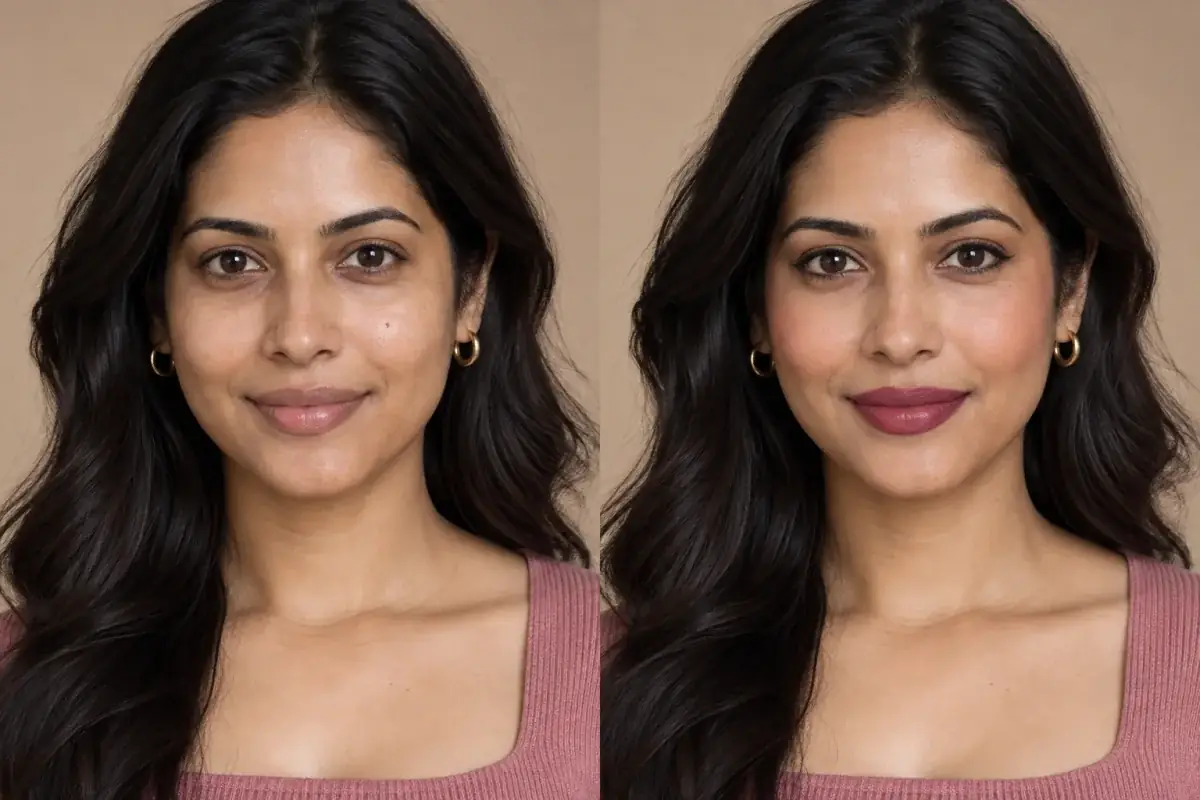

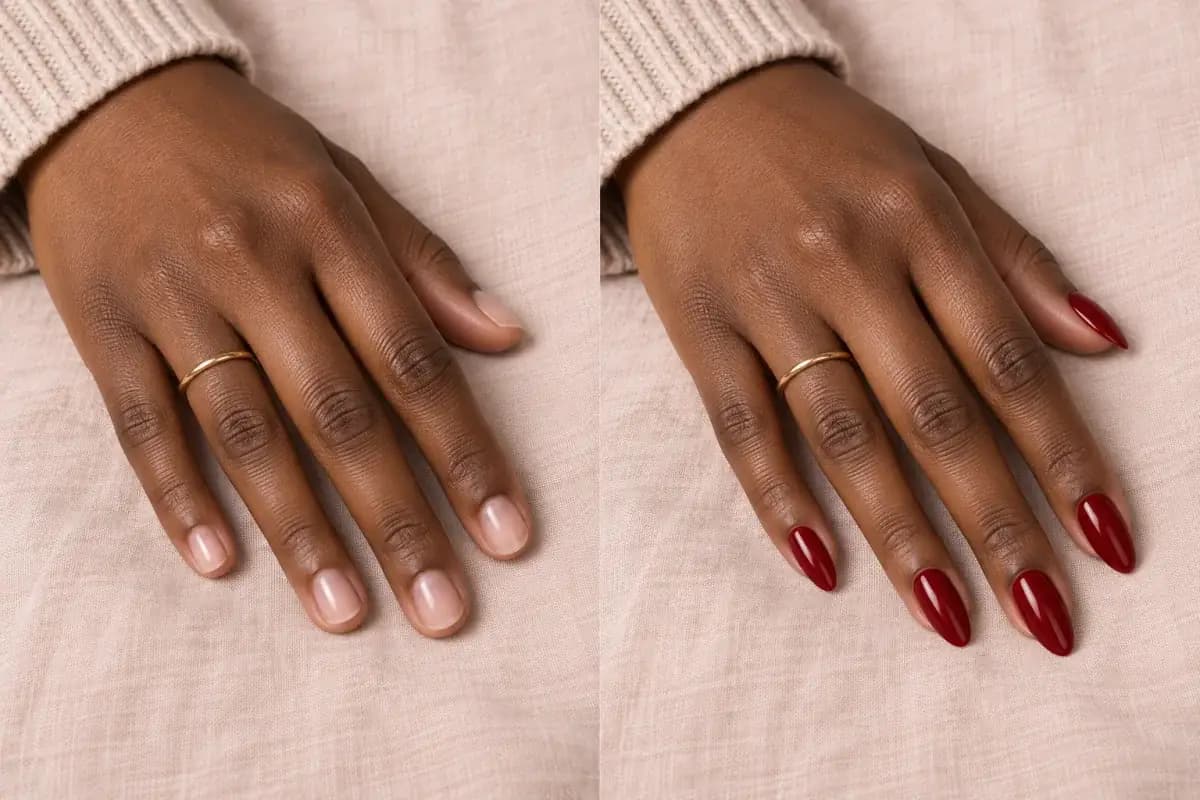

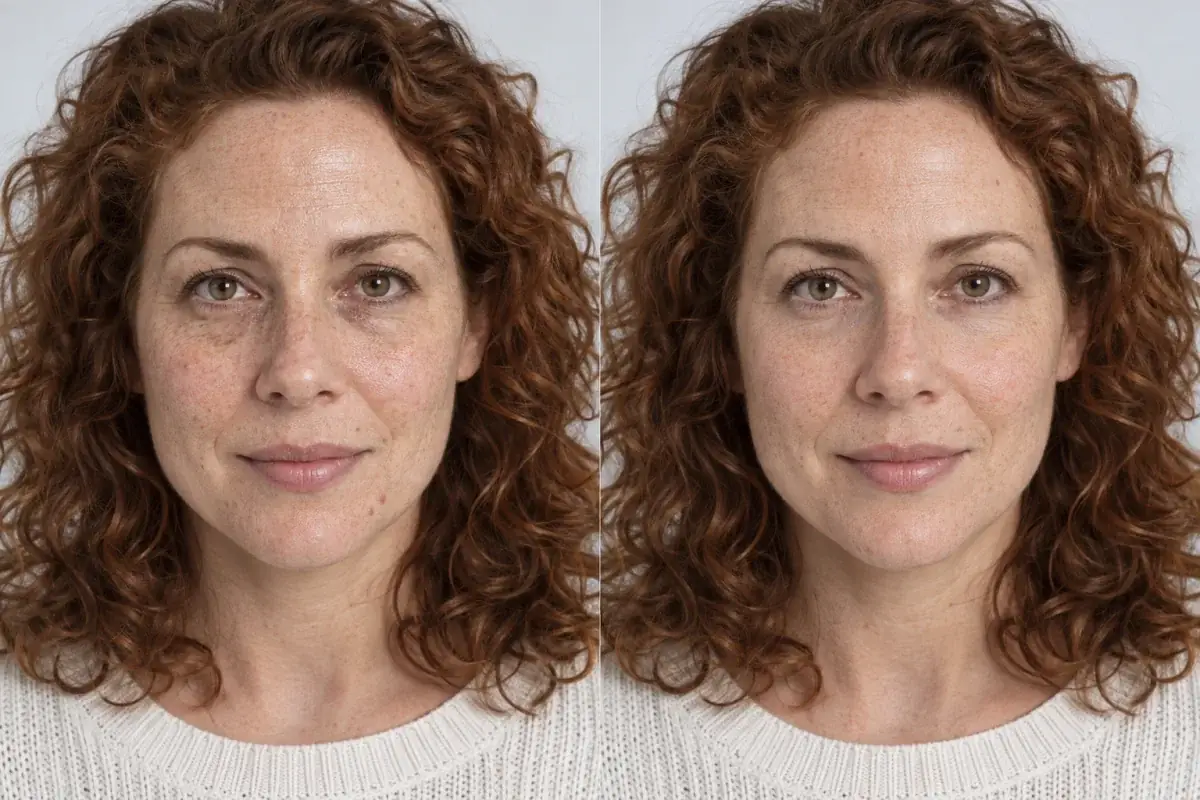


Best nail colors for your skin tone: shades by undertone and depth
Polish advice fails when it sorts you by depth alone. This guide sorts by undertone first and depth second, then names actual shades, including the nude rule almost everyone gets backwards.
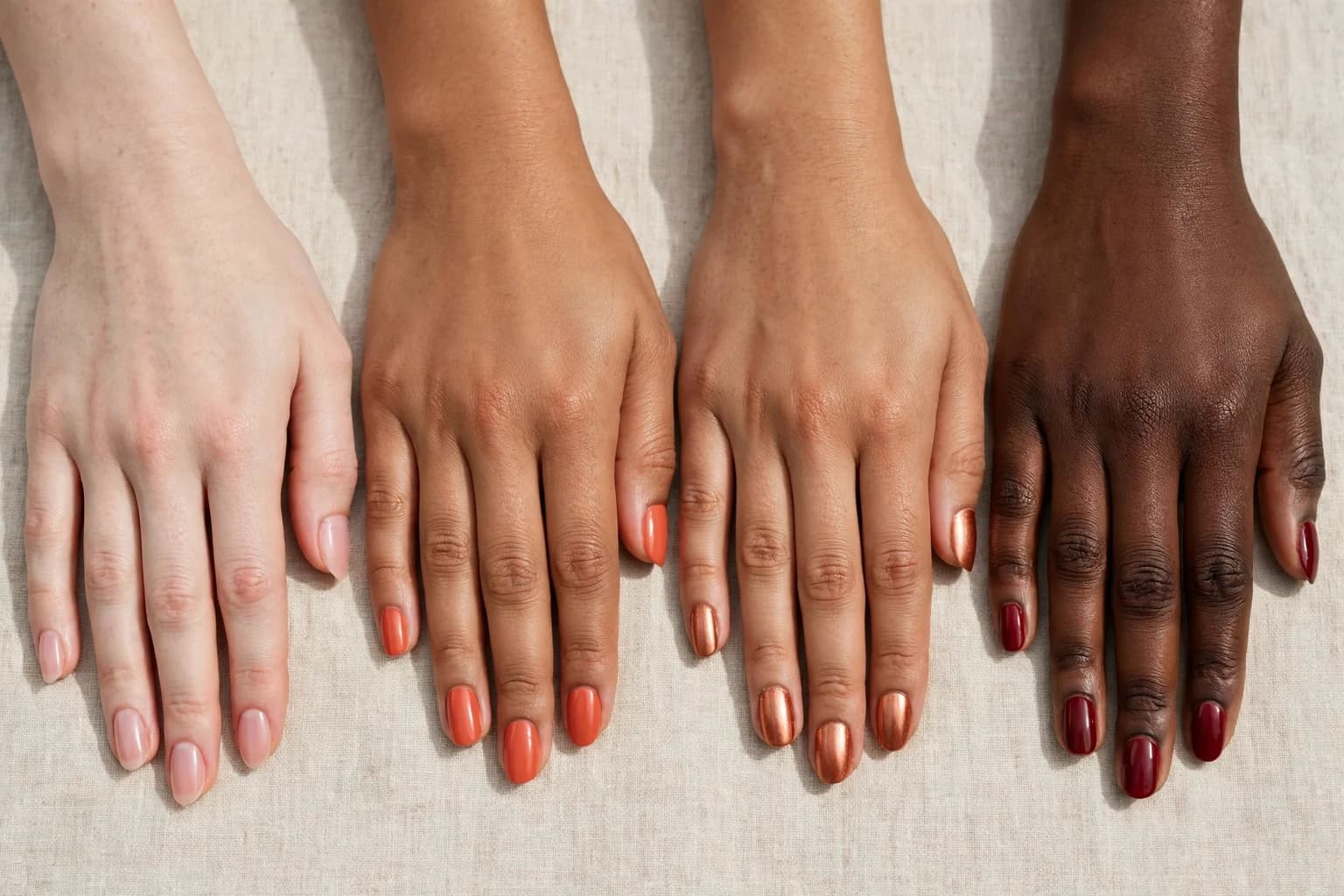
Four depths, four different right answers: the nude, the coral, the copper and the wine each belong to the hand wearing them.
Direct answer
What are the best nail colors for your skin tone? Match the polish's undertone to yours first, then adjust for depth. Warm undertones glow in coral, terracotta, tomato red and gold; cool undertones in berry, wine, blue based red and silver; olive skin in earthy shades, deep greens, chocolate and copper; deep skin carries the richest saturation of all, jewel tones, bright white and near black plums. Nude is the exception that proves the rule: a nude polish is not a colour at all, it is a match, chosen one step lighter or darker than your own skin, never exactly equal to it. The table below gives your row; the named shades after it are the bottles to start from.
How do you find your undertone before you pick a shade?
Undertone is the colour under your skin's surface, and unlike depth it does not change with a tan. Three quick checks agree often enough to trust. Look at the veins inside your wrist in daylight: blue or purple veins suggest cool undertones, greenish veins suggest warm, and veins you cannot confidently call either suggest neutral. Hold gold and then silver jewellery against your skin: the metal that makes your skin look clearer and brighter is pointing the same way, gold for warm, silver for cool. Or hold a pure white cloth beside your bare face: skin that looks rosy beside it leans cool, skin that looks yellowish leans warm. Olive skin is the special case the other guides underplay: it carries a green or golden cast, can sit at almost any depth, and behaves warm in some lights and neutral in others, which is why it gets its own row in the table rather than being folded into medium. If your checks disagree, you are probably neutral or olive; the tiebreaker is polish itself, since coral and berry are diagnostic colours, and the one that makes your hands look clearer is naming your undertone.
What does the full table say?
Read the table by your undertone within your depth row. Fair skin splits into a warm version that can borrow peach and coral from the medium row and a cool version that cannot; deep skin splits into warm, which takes spiced and chocolate shades, and cool, which takes eggplant and navy. Depth decides how much saturation you can carry, undertone decides which family it comes from, and that order, family first and strength second, is the whole method.
- Fair: Sheer pinks, ballet pink, lilac, cool berry, pastel blue; Your nude direction: Sheer pink or milky pink beige, a step lighter than skin; Your red direction: Blue based classic red; Go easy on: Orange reds, mustard, dark browns
- Medium: Coral, mauve, terracotta rose, brick red, gold; Your nude direction: Rosy beige, peachy or caramel beige; Your red direction: Brick or tomato red if warm, blue based if cool; Go easy on: Icy pastels, chalky beige nudes
- Olive: Terracotta, olive and sage green, chocolate, copper, burgundy; Your nude direction: Warm beige or greige with a yellow base; Your red direction: Bright true red or warm brick; Go easy on: Bubblegum pink, icy blue shades, neon yellow
- Deep: Emerald, sapphire, plum, bright white, metallics, hot pink; Your nude direction: Mocha, cocoa or espresso, a step deeper than skin; Your red direction: Deep wine red, near black plum; Go easy on: Pale beige, dusty chalky pastels
What are the best shades for fair skin?
Fair skin flatters most in sheer and cool leaning colour, because strong warm pigments can outshout it. The proven starting bottles are essie Ballet Slippers, the sheer pale pink that has been the default fair skin manicure for decades, essie Mademoiselle, a softer sheer pink for a barely there finish, and OPI Bubble Bath, a semi sheer nude pink that works as both a nude and a colour on fair hands. For a real colour, the blue based end of the spectrum behaves: lilac, cool berry, pastel blue and soft grey all sit quietly against pink leaning skin. Your red is a blue based classic, and OPI Big Apple Red is the named example, a true red with the cool base that keeps fair skin looking clear rather than flushed. Warm fair skin is the exception row: it can take peach, soft coral and warm beige nudes that cool fair skin cannot.
What are the best shades for medium skin?
Medium skin is the most flexible depth, which is exactly why it gets the vaguest advice; the undertone split is what makes it specific. Warm medium skin, the golden and Mediterranean pattern, takes the sunlit families: coral, peach, terracotta rose, burnt orange and gold, with OPI Samoan Sand, a warm sandy beige, as its most wearable nude and OPI Cajun Shrimp, a bright coral red with orange undertones, as its signature fun shade. Cool medium skin takes rose pink, mauve, berry and plum, with essie Angora Cardi, a creamy deep dusty rose, as the bottle that behaves like a neutral while still counting as colour. Both versions carry burgundy, emerald and teal well, and both should be careful with the same trap: a beige nude chosen by depth alone, which reads not as nude but as a colour, and usually as a mistake. Match the nude to the undertone, rosy for cool, peachy or caramel for warm, and it disappears the way a nude is supposed to.
What are the best shades for olive skin?
Olive skin is where generic charts do the most damage, because olive is an undertone wearing any depth, and its green cast argues with whole families of polish. What flatters it is warmth with depth: terracotta, caramel, chocolate, olive and sage greens, deep forest green, navy and burgundy, plus the metallic that seems made for it, copper, in bottles like essie Penny Talk, a metallic copper that picks up the golden side of olive skin. Your red is a bright true red or a warm brick; your nude is a warm beige or a greige with a slight yellow base, never a pink beige, which turns grey green against olive skin and is the most common nude failure of all. The shades to go easy on are the icy and the sugary: bubblegum pink, icy blue pastels and neon yellow all fight the green cast and lose. Notice the pattern, because it lets you shop beyond this list: olive skin wants shades that contain warmth or depth, and it punishes shades that contain ice.
What are the best shades for deep skin?
Deep skin carries saturation better than any other depth, so its best shades are the ones other rows have to dilute. Jewel tones at full strength, emerald, sapphire, plum and deep magenta; brights that stay bright, hot pink and electric blue; and the dramatic end of the red family, where essie Bordeaux, a deep red wine, and OPI Lincoln Park After Dark, a near black plum that has been a permanent classic since 2005, both read as rich rather than dark. essie's Watermelon, a vibrant pink red, is repeatedly singled out as a pop shade that deep skin wears especially well. Bright white is the surprise entry: on deep skin it is a high contrast statement, not a neutral, and metallics in gold, silver and copper all work because the skin supplies the warmth or coolness around them. The nude rule matters most here. Pale beige and dusty light pink, the default nudes of the fair rows, turn chalky and ashy on deep skin. Your nudes are mocha, cocoa and espresso, browns with the same relationship to your skin that Bubble Bath has to fair skin: one step away from it, in its own undertone.
Why is nude a match, not a colour?
Because nude is the only polish category defined by your skin instead of by the bottle. A red is a red on anyone; a nude is a relationship, the shade that reads as your skin, polished. Two rules govern it. First, match by one step: a nude about one shade lighter or darker than your own skin reads as intentional, while an exact match can make the nail visually disappear, the uncanny effect people describe as mannequin hands. Second, match the undertone before the depth: a pink beige nude on olive skin, a yellow beige nude on cool fair skin, or a beige nude of any kind on deep skin will miss at any depth, because the family is wrong before the strength is even judged. This is also why our parent guide insists on seeing shapes on your own hands, and the same logic applies to colour with interest: polish in the bottle, on a swatch stick and on your nail against your skin are three slightly different colours, and only the third one is the manicure.
Which red works for your undertone?
Red is the colour where undertone matching pays most visibly, because everyone owns the comparison already: the red that makes your hands look clean and your skin look clear is yours, and the other one makes your fingers look muddy no matter how classic it is. Warm undertones take orange based reds, tomato, brick and coral reds like OPI Cajun Shrimp, plus essie Clambake, the brand's orange red. Cool undertones take blue based reds, with OPI Big Apple Red as the standard bottle. Neutral undertones take true red, the balanced middle both families meet at, and depth then sets the strength, classic on fair skin and pushed toward the wine end, Bordeaux and Malaga Wine, on deep. If you only ever buy two reds, buy one from your undertone's bright end and one from its deep end; the pair covers summer and winter, day and evening, for your skin specifically.
How do you test the finalists on your own hands?
The table gives you a shortlist of three or four shades, and the named bottles give you a shopping list. Neither shows you the colour sitting on your skin, at your nail length, in your light, which is the only version you will actually wear. Photograph your hands in daylight and run the finalists through the nail try-on at, at the shape and length you plan to wear; if you are still choosing the shape itself, settle it first with the parent guide and its companion comparison, because a colour reads bolder on a long coffin than on a short squoval and the two decisions interact. Judge the results at arm's length as well as close up, and against the clothes you actually wear: a shade can be correct for your undertone and still wrong for a wardrobe of cool grey. When one wins, save the photo for your nail tech. A colour shown on your own hands ends the oldest salon conversation there is, the one where the bottle looked perfect and the manicure did not.
Source: OPI, "Samoan Sand": described by OPI as a warm sandy beige
Source: NewBeauty, "OPI Cajun Shrimp nail ideas": Cajun Shrimp as a bright, opaque coral red
Bottle, swatch and nail are three different colours
Every recommendation here is a starting row, not a verdict, because polish shifts as it dries, reads lighter in the bottle than on the nail, and changes under salon lighting versus daylight. Skin depth also moves across the year while undertone stays fixed, so a summer tan may push you one row down in depth without changing your families at all. Test the finalists on your own hands, in daylight, before you commit to a full set or a bottle.
Take the theory out of it.
Undertone tables narrow the field; they cannot show a shade on your skin. The try-on puts each finalist on your actual hands at the length you wear, which is the only test the salon outcome depends on.
Questions people ask
What nail color suits every skin tone?
True red, navy, sheer pink and taupe are the closest thing to universal shades, because each exists in a balanced form that neither fights warm nor cool undertones. Universal is a starting point, though: your undertone's version of each will still beat the generic one. When in doubt, test two versions on your own hands and keep the one that makes your skin look clearer.
How do I know my undertone for choosing nail polish?
Use the wrist vein check in daylight: blue or purple veins suggest cool, greenish veins suggest warm, and hard to call suggests neutral. Cross check with jewellery, gold flattering warm skin and silver flattering cool. Olive skin shows a green or golden cast and counts as its own case, with its own row in this guide's table.
What is the best nude nail polish for deep skin?
A brown based nude, mocha, cocoa or espresso, chosen about one shade deeper than your skin and matched to its undertone. Pale beige and dusty pink nudes, the defaults for fair skin, turn chalky and ashy on deep skin. The rule is the same at every depth: one step away from your skin, never an exact match, which can make nails disappear.
Which red nail polish suits warm undertones?
An orange based red: tomato, brick or coral red. OPI Cajun Shrimp is the bright version and essie Clambake the classic orange red. Cool undertones should take the opposite family, a blue based red like OPI Big Apple Red, and deep skin of either undertone owns the wine reds such as essie Bordeaux.
Why does a polish look right in the bottle and wrong on my nails?
Because the bottle shows the colour in bulk, behind glass, under shop lighting, and the dried film on your nail is thinner, warmer from the skin beneath it and seen in daylight. Depth can shift by a visible step between the two. That is why this guide ends with testing finalists on your own hands rather than trusting the bottle or a swatch stick.