






Almond vs square nails: the shape for your hands, in this season's café colours
Almond and square are the two nail shapes people actually choose between, and the right one is decided by your nail beds and finger length, not by the photo you saved.
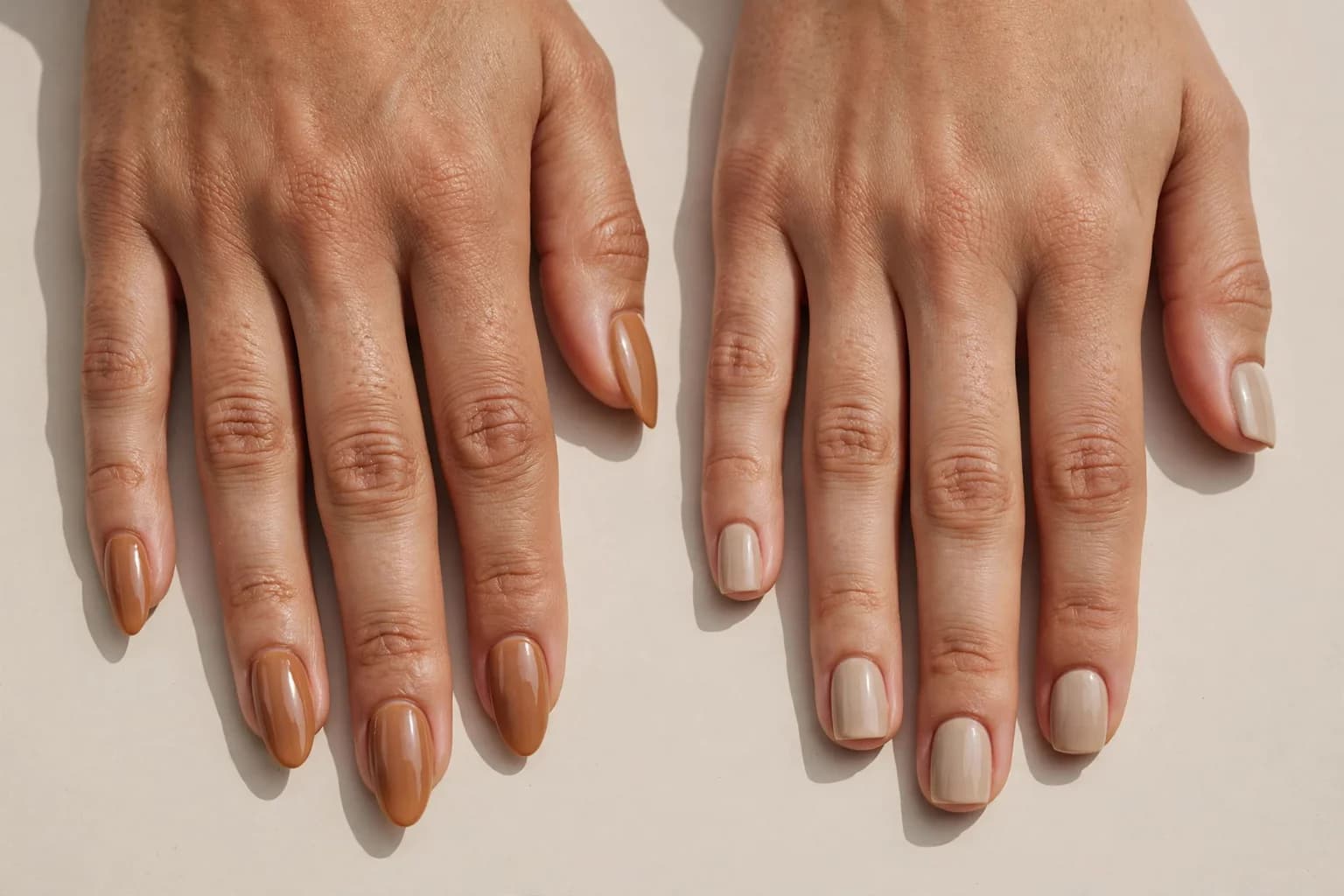
Same café palette, two shapes: the almond hand reads longer, the square hand reads neater, and both are correct, on different hands.
Direct answer
Should you choose almond or square nails? Choose almond if your fingers are shorter or wider, or your nail beds are wide: the tapered sides and rounded tip lengthen the hand visually, and the shape needs medium length or more to form. Choose square if your fingers are long and slim, your nail beds are long and narrow, or you wear your nails short: the straight edge is neat, modern and the stronger shape at short lengths. The quick test is your nail bed. Wide bed, almond. Long narrow bed, square.
What is the actual difference between almond and square?
Geometry, and one hard constraint that follows from it.
An almond nail is filed in at both sides and finished with a rounded, slightly pointed tip, echoing the nut it is named for. The side walls taper, so the widest part of the nail sits low, near the base, and the free edge ends in a soft peak. That taper is the entire visual effect: it draws the eye along the nail instead of across it, which is why the finger reads longer.
A square nail is the opposite construction. The free edge is filed straight across, the side walls run parallel, and the corners are left sharp or near-sharp. Nothing tapers, so the eye reads the nail's full width at the tip. On the right hand that reads as clean and deliberate; on the wrong hand it reads as width added exactly where the finger is already widest.
Between them sits squoval, square with the corners rounded off, which exists because it borrows square's neatness and almond's softness and offends almost no hand. It gets one paragraph here because it is the honest answer for a minority of readers, but the decision most people are actually making is the headline one.
The constraint is length. Almond cannot be filed into a nail that barely passes the fingertip, because there is no free edge to taper; attempted too short, it comes out as a stubby oval. Square has no such requirement and is at its best short. Every comparison below assumes that constraint has been respected.
Which shape suits your hands?
Shape advice generalises by two measurements you can take by looking down at your own hands: finger proportions and nail bed shape.
Two of these rows contradict the photos most people save. Almond is usually photographed on long, slim hands, where it looks elegant because almost everything does; its actual job is on the shorter, wider hand, where it changes proportions. And square is usually photographed short and neat on narrow beds, which disguises the fact that on a wide bed the same shape makes the fingertips look broader and the fingers shorter.
Essence's expert guide makes the underlying point in general form: shape choice starts from what your hands already are, elongating what is short, softening what is angular, and leaving what is balanced alone. The points above are that principle applied to two shapes.
- Shorter or wider fingers: almond. The taper lengthens the finger visually and narrows the silhouette.
- Long, slim fingers: square or squoval. Long fingers do not need lengthening; the straight edge looks deliberate and balanced.
- Wide nail beds: almond. Square adds visible width at the tip of an already wide bed; almond pulls the width inward.
- Long, narrow nail beds: square. The classic square hand: the shape follows the bed's own proportions.
- Prominent knuckles: square, softly cornered. A straighter edge softens the hand's angles by contrast; sharp pointed shapes emphasise them.
- Full or wider hands: almond at medium length. Length plus taper is the combination that slims; short square does the opposite.
Source: Essence, how to find the best nail shape for your hands
Which shape breaks less, and which is less work?
The honest trade is between corners and upkeep.
Square corners are stress points. At short lengths this barely matters, because there is little free edge to lever against anything, and square is then the stronger, lower-maintenance shape: it files straight, grows out evenly and snags on little. Let square nails grow long, though, and the corners become the first place the nail chips, catches and tears, because every knock lands on a right angle with no give in it.
Almond distributes stress along a curve instead of concentrating it in corners, which is why longer nails are usually shaped almond or oval rather than square by anyone who types, cooks or works with their hands. The cost is maintenance rather than breakage: the taper has to be re-filed as the nail grows or the shape blurs into oval, and the shape only exists at all while the length does. Break an almond nail short and you are in square or squoval until it grows back.
Lifestyle settles most real cases. Heavy keyboard use, gym, gardening, small children: short square or squoval, whichever your beds prefer. Willing to keep length and file weekly: almond is available to you, and the question returns to your hand shape, where it belongs.
Which café colours suit each shape?
The café palette, caramel, latte, coffee and espresso tones, is the colour story of the season in nails: Pinterest's 2026 beauty trend report put searches for caramel nude nails up 943 percent and coffee nails up 922 percent year on year. The shades flatter both shapes, but not identically.
Colour cannot rescue the wrong shape, and the right shape in a slightly wrong nude still reads well. Decide shape from your hands first and shade second; the trend coverage reverses that order because shades photograph better.
- On almond: the deep end of the palette. Espresso and dark coffee shades on a tapered nail read elegant rather than heavy, because the shape's length carries the depth. Glossy caramel nude is the almond signature: warm, long, polished.
- On square: the pale end. Milky latte and pale nude shades suit the straight edge, and a French tip, which needs a straight free edge to sit on, is square's home ground. Deep shades work too, but keep them short, where the combination reads as deliberate rather than severe.
- On either: a nude matched to your skin depth. The rule for café shades is the foundation rule: one shade deeper than your skin reads as polished, a shade lighter reads ashy and slightly chalky, especially in photographs. The palette is forgiving about temperature, since coffee tones run warm-neutral, but not about depth.
What should I ask for at the salon?
Shape, length and shade, in that order, with the length in words a technician can measure against. Save the shape, length and shade name as a Salon Card, so the next set, at any salon, starts from the version you already know suits your hands.
- The shape named exactly: medium almond or short square. Medium and short do real work in those phrases; shape names alone get interpreted generously.
- A photo of the shape on a hand like yours, not the most beautiful hand on the internet. Finger length and bed width are the variables, so match them.
- If your natural nails are too short for almond, say whether you want extensions for length or a grow-out plan in squoval first. Both are legitimate; drifting into extensions you did not decide on is not.
- The shade tested against your skin before the full set: one nail, dried, in daylight. Café nudes are depth-sensitive and the bottle lies.
Shape cannot fix length you do not have
Almond needs free edge. If your nails are bitten, broken or simply very short, the shape cannot be filed into what is not there, and an almond attempted on short nails reads as a mistake rather than a style. The honest sequence is square or squoval now, which suit short nails properly, and almond later if you grow the length or choose extensions deliberately. Any guide that skips this is selling the photograph, not the shape.
Take the theory out of it.
Hand-shape logic is general by necessity: it cannot see the reader's actual beds and finger proportions. The try-on puts almond and square on her own hand, in the café shades the article recommends, and the proportion change the article describes becomes something she can see rather than trust.
Questions people ask
Do almond nails make fingers look longer?
Yes. The tapered sides and rounded tip draw the eye along the nail instead of across it, so the finger reads longer and slimmer. It is the main reason almond is the recommended shape for shorter or wider fingers and wide nail beds.
Are square nails stronger than almond nails?
At short lengths, yes: there is little free edge to damage, the shape files straight and grows out evenly. At longer lengths the answer reverses, because square's sharp corners catch and chip, while almond's curve spreads stress along the edge.
What nail shape suits wide nail beds?
Almond. A wide bed already gives the fingertip width, and a square shape adds more at exactly that point, making fingers look shorter and broader. Almond's taper pulls the silhouette inward and restores the proportion.
Can I get almond nails if my nails are short?
Not yet, on natural nails: almond needs a free edge long enough to taper, and filed too short it comes out as a stubby oval. Wear square or squoval while you grow length, or choose extensions deliberately if you want almond now.
What colours suit almond and square nails this season?
The café palette: caramel nude, latte, coffee and espresso tones. Deep espresso and glossy caramel suit almond's length; milky latte shades and French tips suit square's straight edge. Match the nude to your skin depth, one shade deeper reads polished.