






What color season am I? The 12 seasons, explained in makeup and hair
Your color season is a shorthand for three things (temperature, value and chroma), and the fastest way to check it is to see a season's makeup and hair on your own face.
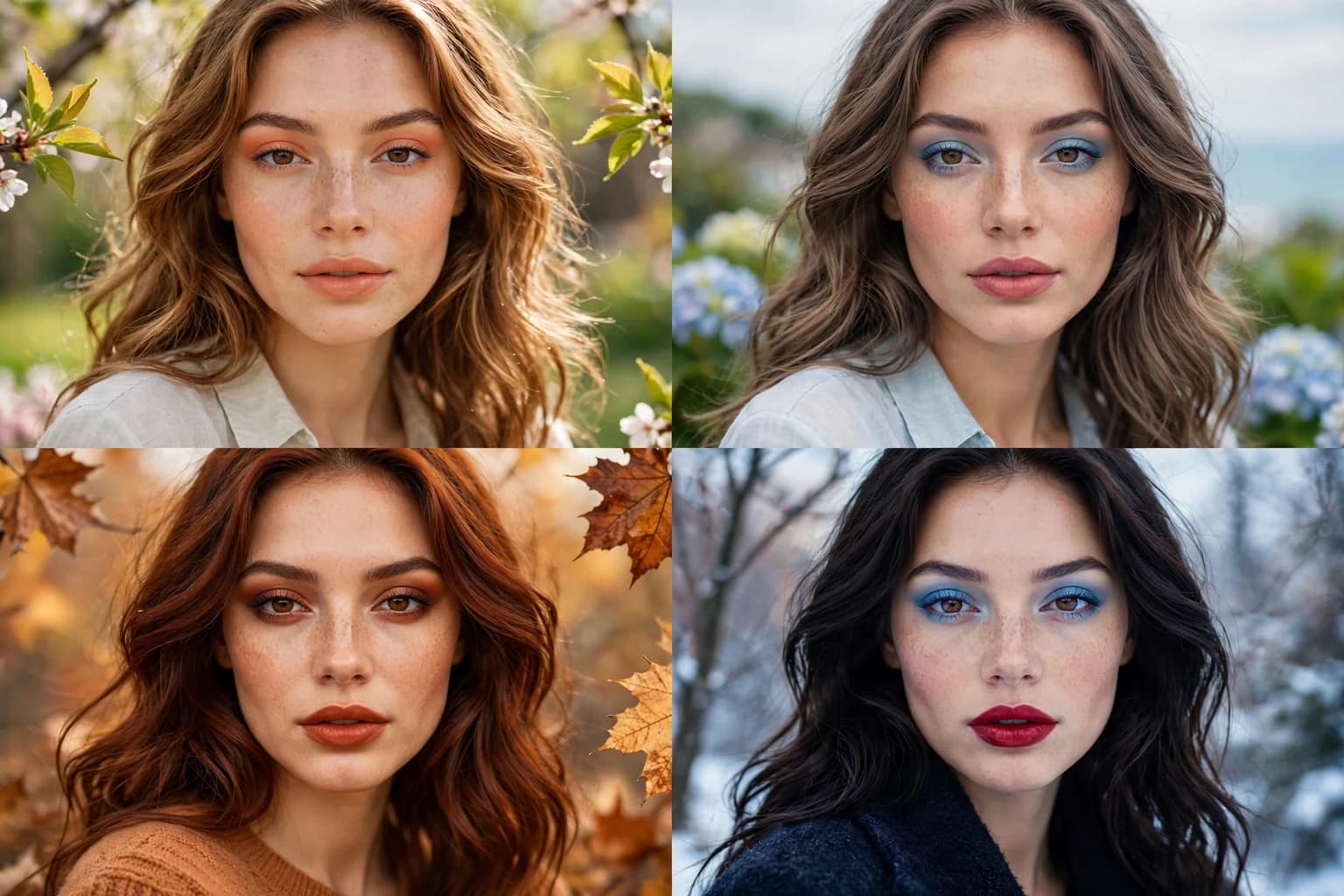
One face, four season families. The season is the one where the skin looks clearest, not the one with the prettiest colors.
Direct answer
What is a color season? A color season is a category in seasonal color analysis that groups the makeup, hair and clothing colors that share your coloring's temperature (warm or cool), value (light or deep) and chroma (bright or muted). There are 12 seasons: three sub-seasons inside spring, summer, autumn and winter. Your season does not ban colors; it tells you which version of a color (which red lipstick, which brown hair), is most likely to sit comfortably on your face.
What is seasonal color analysis, in plain terms?
It is a sorting system, not a measurement. Nobody's face comes with a season printed on it. What analysts do (in person, with fabric drapes, or from a photo) is read three qualities of your natural coloring and give the combination a name.
The name is useful because it travels. Once you know you are, say, a Soft Autumn, you can walk into a makeup shop or a salon and predict which shelf and which swatch book page to start from, instead of starting from zero every time.
It is also a vocabulary, not a diagnosis: the same honest line Uptone's undertone guide takes. Two people in the same season will not suit every identical shade, and a season result that changes between two bad photos has told you about the photos, not about your face.
Source: Curate Your Style, seasonal color analysis FAQs
Source: The Knot, seasonal color analysis for wedding planning
What are the three things that decide my season?
Temperature is whether your coloring reads warm or cool. Warm coloring has a golden or peachy cast and usually sits better with gold; cool coloring has a pink or rosy cast and usually sits better with silver. This is your undertone, and it is the first split: spring and autumn are warm, summer and winter are cool.
Value is how light or deep your coloring is overall (hair, brows, eyes and skin read together, not skin alone). A person with deep hair and deep eyes has deep value even on fair skin, which is why deep seasons span every skin depth.
Chroma is how bright or muted your coloring looks. Bright coloring has clear contrast and distinct color: the eyes have a hard edge, the hair has shine and separation. Muted coloring is blended: softer edges, colors that melt into each other, nothing stark.
Every one of the 12 seasons is just a fixed combination of those three settings. Change one setting and you move to a neighboring season, which is why the neighbors are the ones people get confused between.
What are the 12 color seasons?
Read the list by finding your row on the three axes first, then checking the makeup column sounds like the shades that have worked on you before. If the shades in your row are the ones you already reach for, the system is describing you, not instructing you.
- Light Spring (warm, light, bright-leaning): peach and warm pink lips; golden blonde, light warm brown hair.
- Warm Spring (warm, medium, bright): coral and warm red lips; copper, golden brown hair.
- Bright Spring (warm-neutral, medium, bright): clear coral and poppy lips; warm brown hair with real contrast.
- Light Summer (cool, light, muted): rose and soft pink lips; ash blonde, light ash brown hair.
- Cool Summer (cool, medium, muted): raspberry and mauve lips; ash brown, soft cool brown hair.
- Soft Summer (cool-neutral, medium, muted): dusty rose and soft berry lips; mousy ash brown, soft cool blonde hair.
- Soft Autumn (warm-neutral, medium, muted): dusty rose-brown and terracotta nude lips; honey brown, muted copper hair.
- Warm Autumn (warm, medium, muted-leaning): brick and terracotta lips; chestnut, auburn, warm chocolate hair.
- Deep Autumn (warm, deep, bright-leaning): brick red and warm burgundy lips; espresso, dark auburn, mahogany hair.
- Bright Winter (cool-neutral, medium-deep, bright): fuchsia and blue-red lips; dark brown or black hair with high contrast.
- Cool Winter (cool, deep, bright): berry, plum and blue-red lips; cool black, deep ash brown hair.
- Deep Winter (cool, deep, bright): deep berry and wine lips; black, espresso-cool hair.
Source: AvaRobe, color analysis guides
How do I know what color season I am?
Work through the axes in order, in daylight, with no makeup on. Temperature first: hold gold and then silver next to your face, or cream fabric and then bright white. The side that makes your skin look even rather than gray or ruddy is your direction.
Value second: take a photo in daylight and look at it in black and white. If hair and eyes read dark against your skin, your value is deep whatever your skin depth is. If everything sits close together, your value is light or medium.
Chroma third: put a vivid version and a muted version of the same color near your face: a bright teal against a dusty teal. If the vivid one makes your features look clearer, you lean bright. If it wears you and the muted one settles in, you lean muted.
Three answers give you a family and usually a pair of candidate sub-seasons. The tie is almost always between two neighbors, and it is settled by comparison, not by another quiz question: the same makeup look in both seasons' shades, on your face, side by side.
Which seasons get confused with each other, and how do I tell them apart?
The confused pairs share two axes and differ on one, so the test is always to isolate that one axis.
Soft Autumn or Soft Summer? Both are muted and medium value. Only temperature differs. Compare a warm muted shade (camel, dusty terracotta) with a cool muted one (cool taupe, dusty blue) at your face. The right one makes the skin look even; the wrong one reads gray or sallow within seconds.
Deep Autumn or Deep Winter? Both are deep with strong contrast. Again, temperature decides. Compare warm espresso brown against cool pure black near your face, and gold against silver. Deep Autumn warms up in the first pair; Deep Winter sharpens in the second.
Warm Autumn or Deep Autumn? Both are warm and muted-leaning. Value decides. If deep shades (espresso, burgundy, evergreen) make your features look defined, you carry depth. If they sit heavy and medium shades (chestnut, terracotta) look easier, you are Warm, not Deep.
Why do quizzes and apps keep giving me different seasons?
Because they are reading photographs, and photographs lie about color in predictable ways. Warm indoor light pushes everyone warm. A phone camera corrects skin toward its own idea of neutral. Makeup in the photo pre-decides the answer.
That is also why two honest methods can disagree at the border: neighboring seasons overlap, and a person near a boundary will test either way depending on the light. The existing Uptone undertone guide makes the same point about the vein test: the tests disagree because they measure different things under different conditions.
Treat a season as a strong starting hypothesis. The confirmation is not a second opinion from another quiz; it is seeing the season's actual makeup and hair colors on your face and checking whether your skin looks clearer in them than in the neighbor's.
Source: Her World, on the color analysis trend and its TikTok scale
What do I take to the salon once I know my season?
A season name alone is not a brief. A colorist cannot work from a season name without knowing the target shade, the depth and your starting point. Save those three things as a Salon Card and bring that, not a palette screenshot.
- The exact shades, not the season: espresso with warm auburn through the ends, not something autumnal.
- A photo of the look on your own face (a try-on preview) rather than a photo of someone with different coloring.
- Your maintenance limit, stated plainly: how often you will actually come back, which decides how far from your natural value the colorist should go.
A season is a shorthand, not a verdict
Seasons compress three continuous qualities into twelve boxes, so people near a boundary will not fit cleanly, and people at every skin depth exist in every season family, because the system reads undertone and contrast, not lightness of skin. Use the season to narrow the shelf you shop from. If a shade outside your season works on your face, the shade is right and the box was approximate.
Take the theory out of it.
The hub's job is identification. The color analysis tool reads temperature, value and chroma from the reader's own photo and returns a season with the shades attached, which is the step the article teaches manually.
Questions people ask
What are the 12 color seasons?
Light, Warm and Bright Spring; Light, Cool and Soft Summer; Soft, Warm and Deep Autumn; and Bright, Cool and Deep Winter. Each is a fixed combination of temperature, value and chroma.
How do I know what color season I am?
Read your temperature (warm or cool), value (light or deep) and chroma (bright or muted) in daylight with no makeup on. The combination names the season; neighboring seasons are settled by comparing their shades on your face.
Can my color season change?
No. Your season is based on your natural coloring, and undertone does not change with tanning, season or age. What changes is which shades within your palette you prefer.
Can I be more than one color season?
You have one closest season, but everyone borrows from a neighbor, usually the season that shares two of their three axes. Border cases are normal, not a failed test.
Does seasonal color analysis work for deep skin?
Yes, because it reads undertone, overall value and chroma, not how light or dark skin is. Deep skin can be warm or cool, bright or muted, and deep-value seasons include the full range of skin depths.