






Soft Autumn makeup and hair colors: the muted shades that work, and the ones that wash you out
Soft Autumn is the muted, low-contrast autumn (warm but grayed), and its shades are so close together that only seeing them on your face settles which ones are yours.
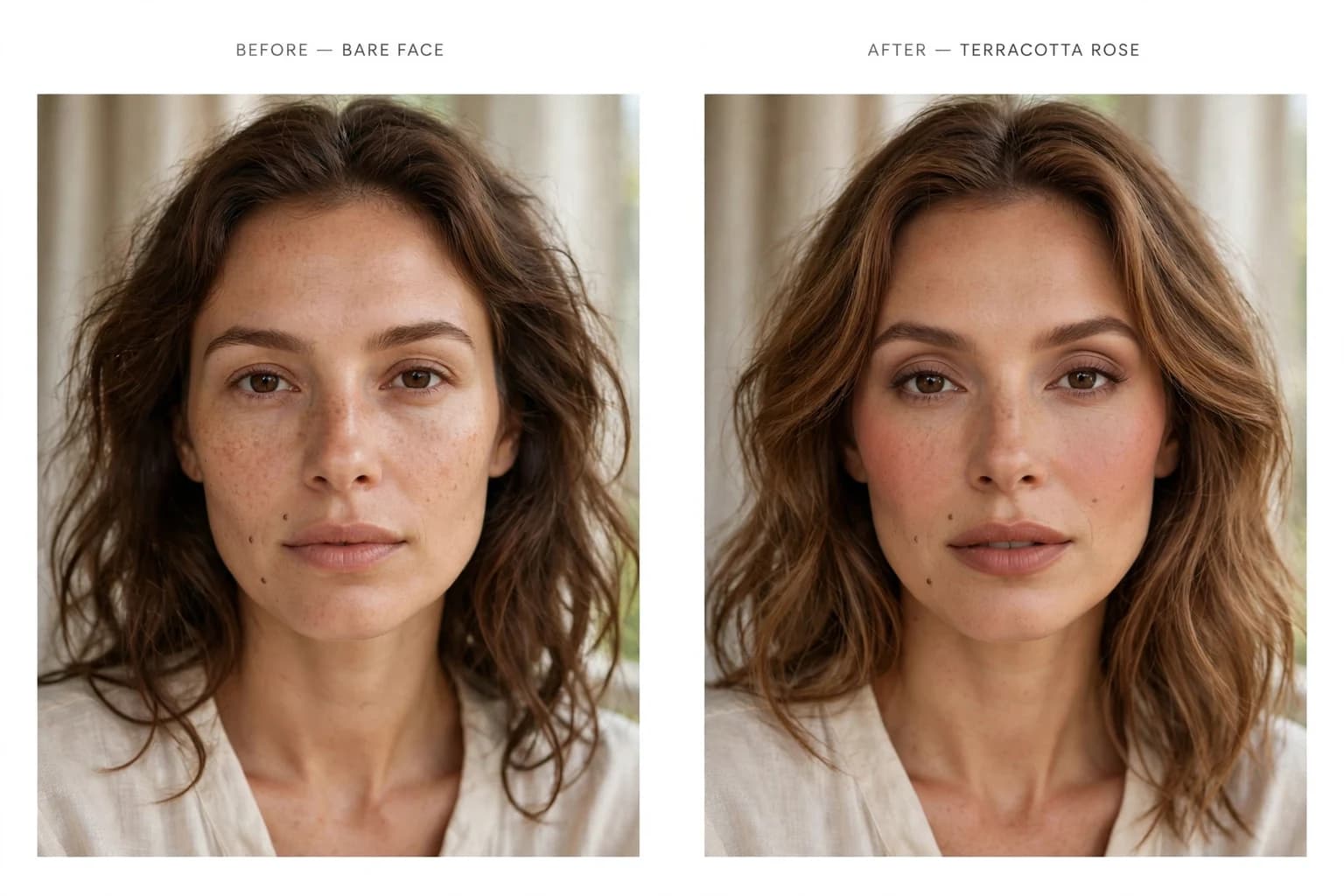
Same face, Soft Autumn shades: nothing in the after photo is brighter than the person wearing it.
Direct answer
What is Soft Autumn makeup? Soft Autumn makeup is warm, muted and low-contrast: dusty, grayed-down versions of autumn colors (rose-brown and terracotta nude lips, earth-rose blush, warm taupe and bronze eyes), with nothing icy, vivid or stark on the face. The hair that matches it sits in the same register: honey brown, muted copper and warm chestnut, never jet black or platinum.
How is Soft Autumn different from the other autumns?
All three autumns are warm. What separates them is which axis runs the season. For Warm Autumn it is temperature: the gold in the coloring. For Deep Autumn it is value: the depth. For Soft Autumn it is chroma, and chroma is set low.
Low chroma means your features do not separate sharply. Hair, brows, eyes and skin sit close in depth and blend at the edges, so there is no single feature for a strong color to answer to. Put a vivid lipstick on that face and the lipstick is what people see; the face becomes the background to it.
That is the whole logic of the season, and it runs the other way too: a shade that looks dull or unfinished in the tube often looks exactly right on a Soft Autumn, because it is the first shade that is not competing with her.
Which makeup colors suit a Soft Autumn?
Work in dusty versions of warm colors, and keep the whole face in one contrast level: a muted eye with a vivid lip undoes the effect as surely as the wrong color does.
Finish matters as much as shade here. Satin and cream finishes keep colors soft; a matte version of the same color reads deeper and more saturated, which can quietly push a correct shade out of the season.
- Rose-brown (lips, everyday): the season's neutral lip; brown keeps it warm, rose keeps it alive.
- Terracotta nude (lips and blush): a nude with clay in it, not pink; pink nudes go ashy on this coloring.
- Dusty terracotta (blush): the blush that reads as health rather than makeup on warm muted skin.
- Earth rose (blush and lips): deeper than dusty rose, warmer: the evening version.
- Warm taupe (eyes, crease): definition without contrast; replaces gray, which reads dirty here.
- Soft bronze (eyes, lid): metallic is fine if it is muted; mirror-shine gold is too bright.
- Olive-khaki (eyes, liner): a warm green that brings out hazel and green-gray eyes without shouting.
- Espresso brown (liner and mascara): brown-black, not jet black: jet black is the contrast this season cannot support.
- Cinnamon (lips and blush): the strongest warm shade most Soft Autumns can carry at full strength.
- Muted coral (lips and blush): coral with the neon removed; clear coral belongs to the springs.
Which shades wash a Soft Autumn out: and which shout?
The pattern in every pair is the same. Nothing here is wrong because of its hue alone: it is wrong because of its intensity or its temperature of finish.
- Icy pink lipstick vs rose-brown: the icy pink sits blue against warm skin and makes the skin look sallow beside it. The rose-brown disappears as a color and leaves the face looking clearer.
- Fuchsia or blue-red lipstick vs cinnamon or brick-rose: the cool vivid reds create contrast the coloring does not have. The warm, grayed reds borrow the face's own warmth instead.
- Black eyeliner vs espresso liner: black draws a hard line that becomes the highest-contrast thing on the face. Espresso defines the eye at the face's own contrast level.
- Pastel or frost eyeshadow vs warm taupe and soft bronze: frost adds a cool shine that reads as a separate layer. The muted metallics read as light on the skin.
- Stark white or true black near the face vs cream and soft chocolate: the stark pair frames the face in a contrast it cannot match, and the face looks tired by comparison.
What hair colors suit a Soft Autumn?
Stay in the warm middle, and stay blended. The hair colors that work share the makeup's rule: muted, warm, and within about two levels of your natural depth.
Avoid the two poles: jet black and blue-black (too deep, too cool, too much contrast) and icy platinum or ash blonde (too light, too cool). Both fail on contrast before they fail on color, which is why a swatch of them can look pretty and the result still looks wrong.
- Honey brown and warm chestnut: the core colors; golden but grayed, never brassy orange.
- Muted copper and soft auburn: the season's reds. Yes, Soft Autumn can go red, at this depth and dullness; bright copper and cherry red are too clear.
- Caramel and honey highlights: painted in ribbons, not stripes. Balayage-style placement suits this season because the grow-out stays low-contrast too.
- Warm dark blonde: for natural blondes going deeper for autumn; look for golden or warm in the shade name.
- Mushroom brown only with warm ribbons through it: straight mushroom or ash brown is too cool on its own and tends to make this skin look dull.
Am I Soft Autumn or Soft Summer?
This is the most common confusion in the whole system, because the two seasons share muted chroma and medium value. Only temperature differs, so only temperature tests settle it.
Compare warm muted against cool muted, in daylight: camel against cool taupe, dusty terracotta against dusty blue, a gold chain against a silver one. If the warm set makes your skin look even and the cool set looks drab or slightly gray, you are Soft Autumn. If it runs the other way, you are Soft Summer, and this article's shades will all read a fraction too yellow on you.
If both sets look acceptable, check the blush test: earth rose brings a Soft Autumn's face forward. On a Soft Summer it sits orange. That single shade separates the pair more honestly than most quizzes.
What should I ask my colorist for?
Ask for the effect in the season's own terms, because Soft Autumn alone will mean different depths to different colorists. Bring a photo of the shade on your own face and save the exact target color, your natural level and the maintenance you agreed to as a Salon Card.
- Warm and muted, nothing ashy and nothing vivid: say both halves; warm alone can still come back brassy-bright.
- Your natural level, and a target no more than two levels away from it.
- Highlights placed as ribbons or balayage, toned caramel or honey, and ask what the toner will fade to, because faded orange is this season's usual complaint.
- Gloss or toner maintenance in appointments per year, not just the first visit's price.
Muted does not mean colorless
Soft Autumn is the season most often misread as no strong colors ever, which turns into a face with nothing on it. The rule is about intensity and contrast, not about avoiding color: cinnamon, muted coral and deep earth rose are real colors. If a shade you love sits outside the list, test it on your photo at a softer finish before you rule it out. Finish can move a shade into this season.
Take the theory out of it.
Soft Autumn shades are close together, so a swatch chart cannot settle them; seeing rose-brown vs icy pink on the reader's own face is the decision this article builds toward. The Salon Card CTA closes the salon section.
Questions people ask
What makeup suits a Soft Autumn?
Warm, muted makeup at one contrast level: rose-brown or terracotta nude lips, earth-rose blush, warm taupe and soft bronze eyes, and espresso liner instead of black. Avoid icy, frosted and vivid shades.
What is the best hair color for a Soft Autumn?
Honey brown, warm chestnut, muted copper and caramel-ribboned balayage: warm, grayed colors within about two levels of your natural depth. Jet black, ash brown and icy platinum all fight this coloring.
How do I know if I am Soft Autumn?
Your coloring is warm-neutral, medium in depth and blended, with no strong contrast between hair, brows and skin. Muted warm shades make your skin look even while vivid or icy shades wear you: that response is the test.
Can a Soft Autumn wear red lipstick?
Yes, in warm grayed reds: cinnamon, brick-rose and muted terracotta red. Blue-reds and fuchsia are too cool and too bright, and they create contrast this coloring does not have.
What is the difference between Soft Autumn and Soft Summer?
Only temperature. Both are muted and medium value; Soft Autumn is warm (camel, terracotta, earth rose) and Soft Summer is cool (cool taupe, dusty blue, mauve). Compare one of each at your face in daylight to settle it.