






Deep Autumn makeup and hair colors: how much depth you can actually carry
Deep Autumn is the deep, warm autumn (the only autumn that carries a truly bold lip), and the question is never which colors, it is how much depth your face can hold.
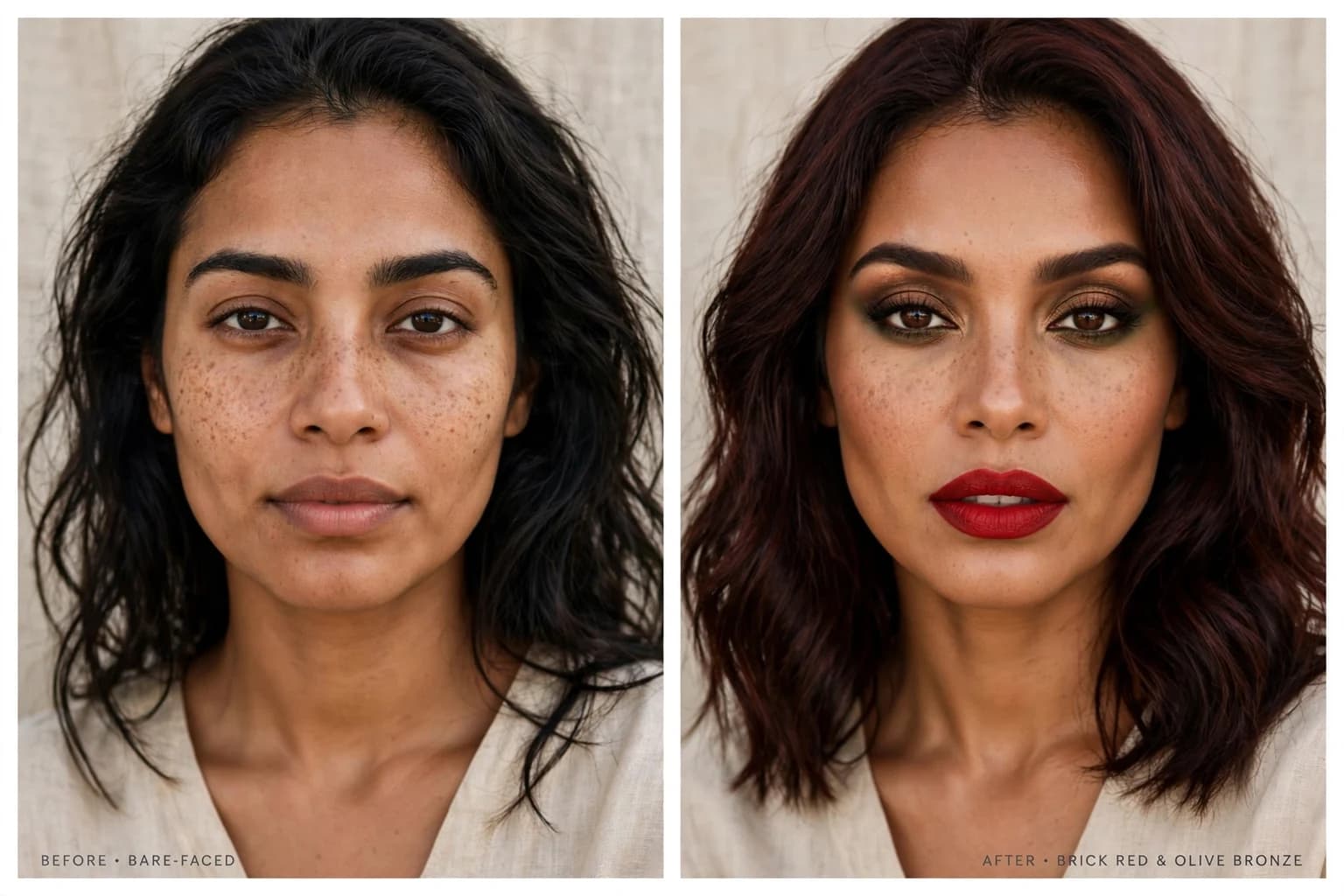
Same face, Deep Autumn depth: the lip is the strongest thing in the after photo, and the face carries it.
Direct answer
What is Deep Autumn makeup? Deep Autumn makeup is deep, warm and saturated: brick red, warm burgundy and terracotta lips; deep terracotta and bronze blush; bronze, copper, deep olive and espresso eyes. Deep Autumn (also called Dark Autumn) is the warm season defined by depth (dark hair and eyes, strong natural contrast), and it is the only autumn whose coloring can carry a bold lip without the lip wearing the face.
How is Deep Autumn different from the other autumns?
The three autumns share warmth and divide on one axis each. Soft Autumn is run by low chroma: everything muted, nothing stark. Warm Autumn is run by temperature: the golden center of the family. Deep Autumn is run by value.
Value means this coloring starts dark. In a black-and-white photo, a Deep Autumn's hair and eyes read dark even when her skin is fair, and her features stay defined with no makeup at all. That built-in depth is a budget: she can spend it on saturated color, deep shades and a strong lip, and the face still holds its own.
It is also why the family's usual advice inverts here. Shades that are kind to the other autumns (dusty, pale, washed versions of warm colors) are the ones that fail on a Deep Autumn. They do not soften her; they drain her, because they sit several levels lighter than the coloring they are meant to serve.
Among the autumns, Deep Autumn has the highest contrast, still softer than a winter's hard edges, but enough that depth, not blending, is the thing to protect in every makeup and hair decision.
Source: Paleta, Deep Autumn color season
Which makeup colors suit a Deep Autumn?
Think spice rack, not pastel box: intense, but always warm. A cold red and a pinkish beige are the two most common mistakes on this season, because both borrow winter's temperature while keeping autumn's depth.
Foundation undertone is worth one line here: golden or olive-based foundations sit natural on this coloring, while pink-based ones are a frequent reason Deep Autumn makeup looks fine in the shop and gray at home.
- Brick red (lips): the season's signature red, warm, deep, and wearable at full matte strength.
- Warm burgundy (lips): burgundy with a brown base; blue-based wine belongs to winter.
- Terracotta (deep) (lips and blush): the everyday depth shade, richer than Soft Autumn's dusty version.
- Chocolate-plum (lips): plum warmed with brown; straight purple-plum reads cool.
- Oxblood / warm berry (lips, evening): berry with warmth underneath, never icy or fuchsia-based.
- Deep terracotta / warm brick-rose (blush): blush must be deep enough to register; pale blush disappears or turns ashy.
- Bronze and copper (eyes, lid): warm metallics; swap silver shimmer for gold in the same role.
- Deep olive (eyes, crease and liner): the season's green, dark and warm, not mint or pastel.
- Espresso (eyes, liner): espresso or black-brown liner instead of pure black, which is cooler than the face.
- Aubergine (warm) (eyes): a warm purple-brown for depth; keep it brown-based, not blue-based.
Source: AvaRobe, Deep Autumn guide
Which shades drain a Deep Autumn: wrong vs right?
- Powder pink or icy pink lipstick vs brick red: the pastel sits several levels above the face's value and washes the whole face out with it. The brick red matches the face's depth, so the features look sharper, not just redder.
- Pale frost or silver eyeshadow vs bronze and copper: frost adds cool shine at the wrong temperature and the wrong depth. Warm metallics give the same light at the face's own depth.
- Dusty, muted autumn shades vs their saturated versions: this is the trap of buying by family name. A dusty terracotta made for Soft Autumn reads as a faded version of the right color on a Deep Autumn.
- Pure black and optic white near the face vs espresso and cream: Deep Autumn carries black better than the other autumns, because her depth can hold it, but black is cool, and it can add a gray cast to warm skin. Espresso and cream do the same job warmly.
- High-lift, ashy blonde hair vs mahogany: lightness plus ash removes both the depth and the warmth the season is built on, at once.
What hair colors suit a Deep Autumn?
Keep the depth: your contrast depends on it.
Avoid ash tones, cool blue-black, and high-lift blonde. Going too light is not a neutral change for this season: it removes the intensity the whole palette is built around, and makeup that used to look balanced starts to look heavy by comparison, a common reason people conclude their season changed after a big color appointment. It did not; the depth it was measured on was colored away.
- Espresso and dark chocolate brown: the core colors; warm versions, not blue-black.
- Deep chestnut and warm mahogany: brown with red warmth in it, the shades stylists reach for first on this season.
- Dark auburn and deep copper-brown: the season's reds; copper at depth, not bright copper at the lengths.
- Deep golden brown: the lightest this season usually goes without losing itself, and better as ribbons or balayage ends than as an all-over lift.
- Warm burgundy tones: as an all-over depth shade or through dark ends, brown-based rather than violet-based.
Am I Deep Autumn or Deep Winter?
The hardest call in the system, because depth and contrast (the things both seasons share) cannot separate them. Only temperature can.
Test warm depth against cool depth at your face, in daylight. Compare chocolate brown with pure black, cream with optic white, and gold with silver. If the warm side of each pair makes your skin look clear and glowing, you are Deep Autumn. If the cool side sharpens you and the warm side turns slightly muddy, you are Deep Winter.
One more tell: burgundy, rust and deep olive sit at home on a Deep Autumn and look borrowed on a Deep Winter, whose equivalents are sapphire, true red and emerald. If your instinct has always been for the earthier set, trust the pattern: it is temperature reporting itself.
And against your own family: if deep shades define your features, you are Deep; if muted shades settle your face and deep ones sit heavy, you are Soft Autumn. Depth versus mutedness is the dividing line.
What should I ask my colorist for?
Depth is easy to lose in a salon, because lightening is the default request. Brief against it explicitly. Bring a photo of the target depth on your own face, not a lighter reference photo, and save the shade name, level and gloss plan as a Salon Card.
- Keep my depth (rich and warm, no ash, and no lift beyond a level or two), say the limit out loud.
- Your natural level stated and agreed before anything is mixed; most Deep Autumn regrets are depth accidents, not color accidents.
- Warmth with a name: mahogany, auburn, chestnut, not some red, which can come back violet or bright copper.
- What the color will fade to, and the gloss plan for keeping the warmth from going brassy between visits.
Deep does not mean unlimited contrast
Deep Autumn's contrast is the highest among the autumns but still warmer and softer than a winter's. Jet black hair dye, optic white and icy accents borrow winter's hardness and can look severe rather than strong. Stay one step warm of the extreme (espresso instead of black, brick instead of scarlet), and the depth reads as richness, which is the effect this season is actually for.
Take the theory out of it.
The article's central claim (that this is the one autumn that carries a bold lip) is testable in one step: a brick red at full strength on the reader's own photo, next to the pastel that drains her. Hair depth is the mid-post secondary CTA.
Questions people ask
What makeup colors are best for Deep Autumn?
Deep, warm, saturated shades: brick red, warm burgundy and terracotta lips; deep terracotta blush; bronze, copper, deep olive and espresso eyes. Avoid pale, frosted and cool pink shades, which drain this coloring.
What hair colors suit Deep Autumn?
Rich warm darks: espresso, dark chocolate, deep chestnut, dark auburn and mahogany. Keep the depth, since your contrast depends on it; ash tones, blue-black and high-lift blonde all work against it.
How do I know if I am Deep Autumn?
Your hair and eyes read dark in a black-and-white photo, your skin has a warm, golden or olive cast, and deep rich colors define your features while pastels wash you out. Warmth plus depth together is the signature.
What is the difference between Deep Autumn and Deep Winter?
Both are deep and high-contrast, so only temperature separates them. Deep Autumn is warm (espresso, rust, olive, gold); Deep Winter is cool (black, sapphire, true red, silver). Compare chocolate against black at your face to tell.
Can Deep Autumns wear black?
Better than any other autumn, because your depth can carry it, but black is cool and can gray warm skin. Espresso, dark chocolate and warm charcoal are usually the stronger neutrals; warm black up with bronze or burgundy near the face.