




Cool Winter makeup and hair colors: pure cool, and the black and white test
Cool Winter is the true winter in the twelve season system: temperature first, contrast second, and every mistake this season makes is a shade with warmth or dust hiding in it.
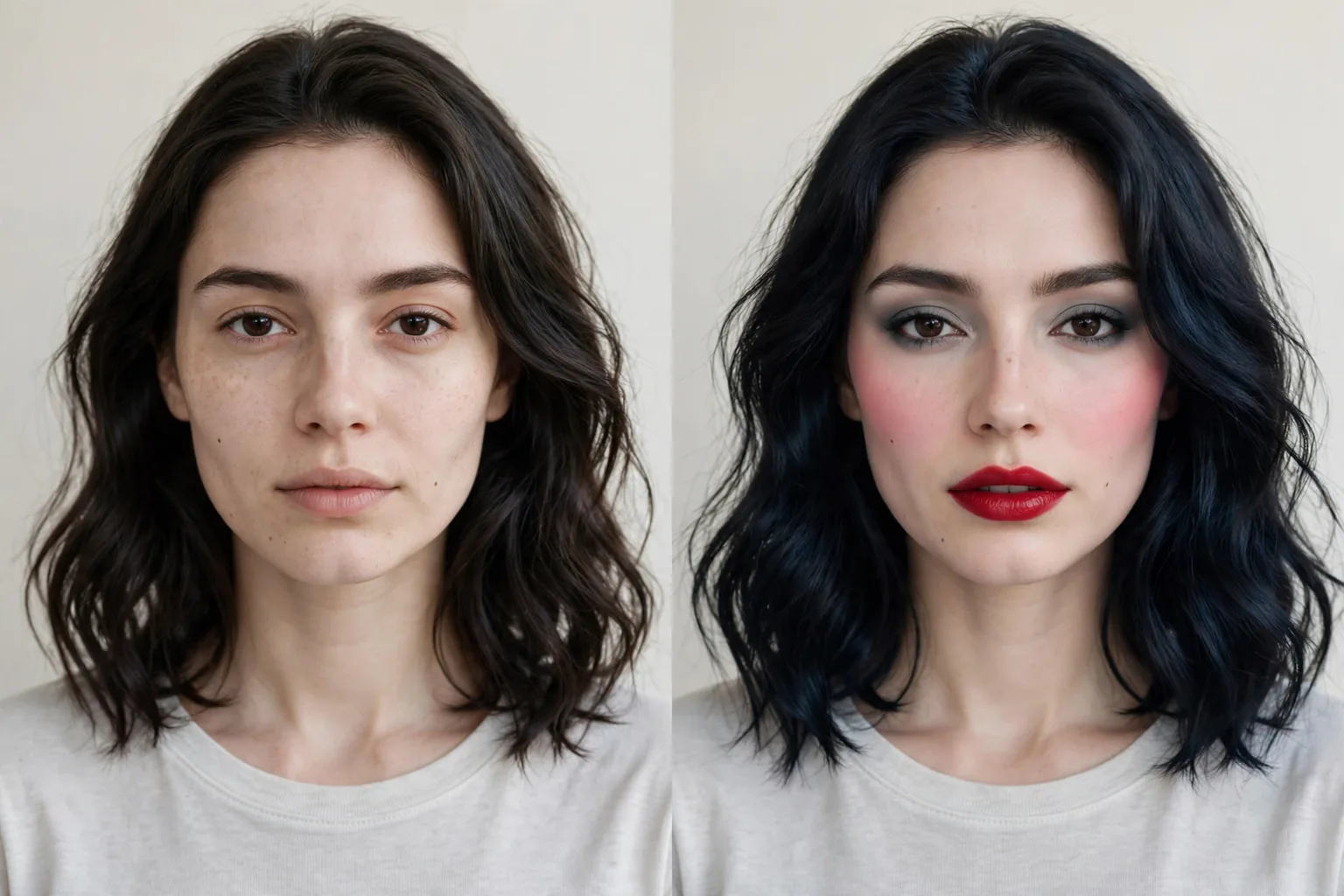
Same face, Cool Winter clarity: the lip is blue red, the blush is cool pink, and nothing about it is warm or muted.
Direct answer
What is Cool Winter makeup? Cool Winter makeup is pure cool and clear: blue red, raspberry and burgundy lips; cool pink blush; charcoal, navy, icy gray and plum eyes, with black liner worn at full strength and not one warm or dusty shade in the bag. Cool Winter (also called True Winter) is the winter season defined by temperature above all else, and its shades pass one test: this coloring wears pure black and optic white at the face and looks clearer for it, where warm white and cream read yellow by comparison.
How is Cool Winter different from the other winters?
The three winters share coolness and high contrast and divide on one axis each. Cool Winter is run by temperature: pure cool, with clarity and contrast serving the cold. Deep Winter is run by depth: the darkest version of the family, the one winter that can borrow a little warmth from autumn. Bright Winter is run by clarity: saturation pushed to jewel and neon levels, the one winter that can borrow a little warmth from spring.
That middle position is exact, and it is why Cool Winter gets mistyped in both directions. Go deeper and darker and you are dressing it as Deep Winter; go brighter and warmer in your brights and you are dressing it as Bright Winter. Cool Winter is its coolness, unmodified in either direction.
Cool Winter wears black and optic white together, the highest contrast pairing, and looks rested. Warm whites, cream and ivory are the failure: their yellow base fights the skin's blue base at close range, at the neckline.
Source: Curate Your Style, Cool Winter (True Winter) colour palette guide
Which makeup colors suit a Cool Winter?
Think of the cool palette at full saturation with the temperature turned down: every shade blue based, most of them icy or deep, none of them warm or grayed.
Foundation follows the same rule: cool, pink and neutral cool foundations sit natural on this coloring, while golden based ones are the usual reason Cool Winter makeup looks right in the shop and yellow at home.
- Blue red (true red): lips. The signature red: red with blue underneath, never orange.
- Raspberry: lips. Pink red kept cool and clear; the everyday strong lip for this coloring.
- Burgundy: lips, evening. Red deepened with blue, not brown; brown based wine shades belong to autumn.
- Cool pink: blush. Blush must be cool and clear; peach reads as a warm patch that never joins the face.
- Icy pink: lips, eyes. Pink with the warmth removed entirely; worn light, it still reads cool, never sweet.
- Charcoal: eyes, liner. The season's neutral: gray at full depth, used where other seasons use brown.
- Navy: eyes, liner. Blue at depth; the softer alternative to black that is not actually soft.
- Icy gray and silver: eyes, metallic. The metallics for this season, worn bright; gold reads warm and wrong.
- Plum (blue based): eyes, lips. Purple kept blue and clear; red based plums warm up and slide toward autumn.
- Black: liner, mascara. A tool shade here, not a risk: this face has the contrast to carry it.
Source: color-analysis.app, Cool Winter color palette and wardrobe guide
Which shades fail on a Cool Winter: wrong vs right?
Put a blue red and a brick red on your own photo and see which one your face agrees with.
- Orange red or brick lipstick vs blue red: the warm reds carry orange and brown underneath, and on a purely cool face they read as costume and heat the skin around them. Blue red keeps the strength and matches the face's own temperature exactly.
- Peach or coral blush vs cool pink: peach sits on cool skin as a visible warm layer that never joins the face. Cool pink reads as blood under the skin, which is what blush is meant to imitate.
- Warm brown and bronze eyeshadow vs charcoal and navy: browns with red or gold in them warm the whole eye area toward autumn, and at close range the mismatch is obvious. Charcoal gives the same depth at the face's own temperature.
- Dusty, muted shades of any family vs their clear versions: grayed shades are summer's tool, and on a clear winter face a dusty shade lands as dirt rather than softness. If a shade name includes smoky, dusty or muted, it belongs to another season.
- Gold jewelry and highlighter vs silver: gold is this season's clearest failure, a warm metal against cool skin, on constant display at the neck and ears. Silver, white gold and platinum match the skin's own cast.
What hair colors suit a Cool Winter?
Keep it cool, and keep the contrast. The working colors are the blue based darks and, at the other end, the iciest lights.
Avoid golden, honey, copper and warm red anything. Warmth is this season's only real enemy: a warm toner over dark hair is the most common way Cool Winter hair gets quietly moved into autumn between salon visits.
Test blue black and dark ash brown on your photo before anyone reaches for a warm gloss.
- Blue black: the signature color, black with a blue reflect; the shade this season is photographed in for a reason.
- Dark ash brown: deep brown with the red removed, for Cool Winters who want brown without warmth; if a shade name mentions chestnut, mahogany or copper, it is an autumn shade.
- Cool dark brown (espresso, cooled): brown at depth with a blue or violet base, kept clearly cool; it fails this season only when it is toned warm.
- Icy platinum: the light option, possible here because the coloring has the contrast to hold it; the moment it warms to champagne it becomes a spring shade.
- Ash and silver highlights: lightness placed in icy or silver tones against a dark base, keeping the contrast this season runs on.
Am I Cool Winter or Deep Winter?
Both are cool, dark friendly and high contrast, so the black test cannot separate them. The divider is what runs the palette: depth for Deep Winter, temperature for Cool Winter.
Test with the icy shades. Take an icy pink lip, a silver gray eyeshadow or a pale icy blue. A Cool Winter wears the icy end as easily as the deep end, because coolness, not darkness, is the point. A Deep Winter finds the icy shades thin and comes alive instead in the deepest shades: deep burgundy, dark aubergine, near black plum. Deep Winter is also the one winter that can borrow a little warmth; a deep olive or a dark warm brown can work there and never works here. If every icy shade suits you and every warm shade fails you, stay in Cool. The full Deep Winter palette is in our Deep Winter guide.
Am I Cool Winter or Bright Winter?
The divider here is clarity, and it is a matter of degree, which is why this boundary confuses people. Both seasons are cool and clear. Bright Winter pushes saturation past what Cool Winter needs: jewel tones at neon intensity, electric blue, bright fuchsia, acid accents, and it can borrow a little warmth from Bright Spring, so warm fuchsia can sit on that face in a way it never sits here.
Test with the brightest shade you own. If neon and electric shades look like a natural extension of your coloring, you are Bright. If they look like a costume on a face that prefers its cool shades icy and pure rather than loud, you are Cool. Cool Winter's clarity serves its temperature: the shades are clear because they are unmixed, not because they are turned up. The full Bright Winter palette is in our Bright Winter guide, and the whole twelve season map is in our hub.
What should I ask my colorist for?
Cool, dark hair is easy to lose in a salon, because warm glosses are the default finishing step and dark shades get warmed to add shine. Brief against it, and bring a photo of the target shade on your own face rather than a celebrity reference. Save the shade name, level and toner as a Salon Card. Testing shades on your photo first uses credits from your plan, so run the two or three finalists, not the whole palette.
- Keep it blue based: ash, violet or blue reflects only, and no warm gloss at the end. Say the gloss part out loud; it is where cool colors most often get quietly warmed.
- Your target depth stated and agreed before anything is mixed; most Cool Winter regrets are temperature accidents, a warm toner over the right depth.
- A toner with a name: blue black, ash, icy. Dark alone in a busy salon can come back warm chocolate, which is an autumn shade.
- The fade plan: cool pigment leaves first and warmth creeps in quietly, so ask which gloss keeps the reflect blue based between visits.
Pure cool does not mean every cool shade works
Cool Winter is cool and clear, and the clear half is the one people forget. Half the cool shades in any shop are summer shades: cool but dusty, softened with gray. They share this season's temperature and fail its clarity, which is why a Cool Winter can buy an entirely cool bag and still look muted in all of it. Test for purity, not just coolness.
Take the theory out of it.
The article's central claim is that temperature, not depth or brightness, runs this season, and that the icy shade test separates it from Deep Winter while the neon test separates it from Bright Winter. Both are testable in one step: the reader's own photo run through the season test, instead of another round of guessing at a makeup counter.
Questions people ask
What is Cool Winter makeup?
Cool Winter makeup is pure cool and clear: blue red, raspberry and burgundy lips; cool pink blush; charcoal, navy and icy gray eyes, with black liner at full strength. Every shade is blue based, and nothing warm or dusty belongs in the bag.
What colors suit a Cool Winter?
Pure cool, clear shades: blue red, icy pink, plum, charcoal, navy and blue black or icy platinum hair. Silver and white gold suit this season better than gold, and optic white suits it better than cream.
How do I know if I am a Cool Winter?
Your coloring is cool with strong contrast between hair, skin and eyes, and pure cool shades clear your skin while warm ones yellow it. Wearing black and optic white at your face and looking rested in them, while cream and gold tire you, is the fastest sign.
What is the difference between Cool Winter and Deep Winter?
Both are cool and high contrast. Deep Winter is run by depth, wears the darkest shades best and can borrow a little warmth; Cool Winter is run by temperature, wears icy shades as easily as deep ones and can borrow none. Test an icy pink: it flatters Cool Winter and looks thin on Deep Winter.
What is the difference between Cool Winter and Bright Winter?
Both are cool and clear. Bright Winter pushes saturation to jewel and neon intensity and can borrow a little spring warmth; Cool Winter keeps its shades pure cool, icy rather than loud. If electric shades look natural on you, you are Bright; if they look like costume, you are Cool.