






Bright Winter makeup and hair colors: clear shades, and why muted ones make you look tired
Bright Winter is the winter run by brightness: cool colouring with spring-like clarity, where the shades that fail are not the bold ones but the dusty ones.
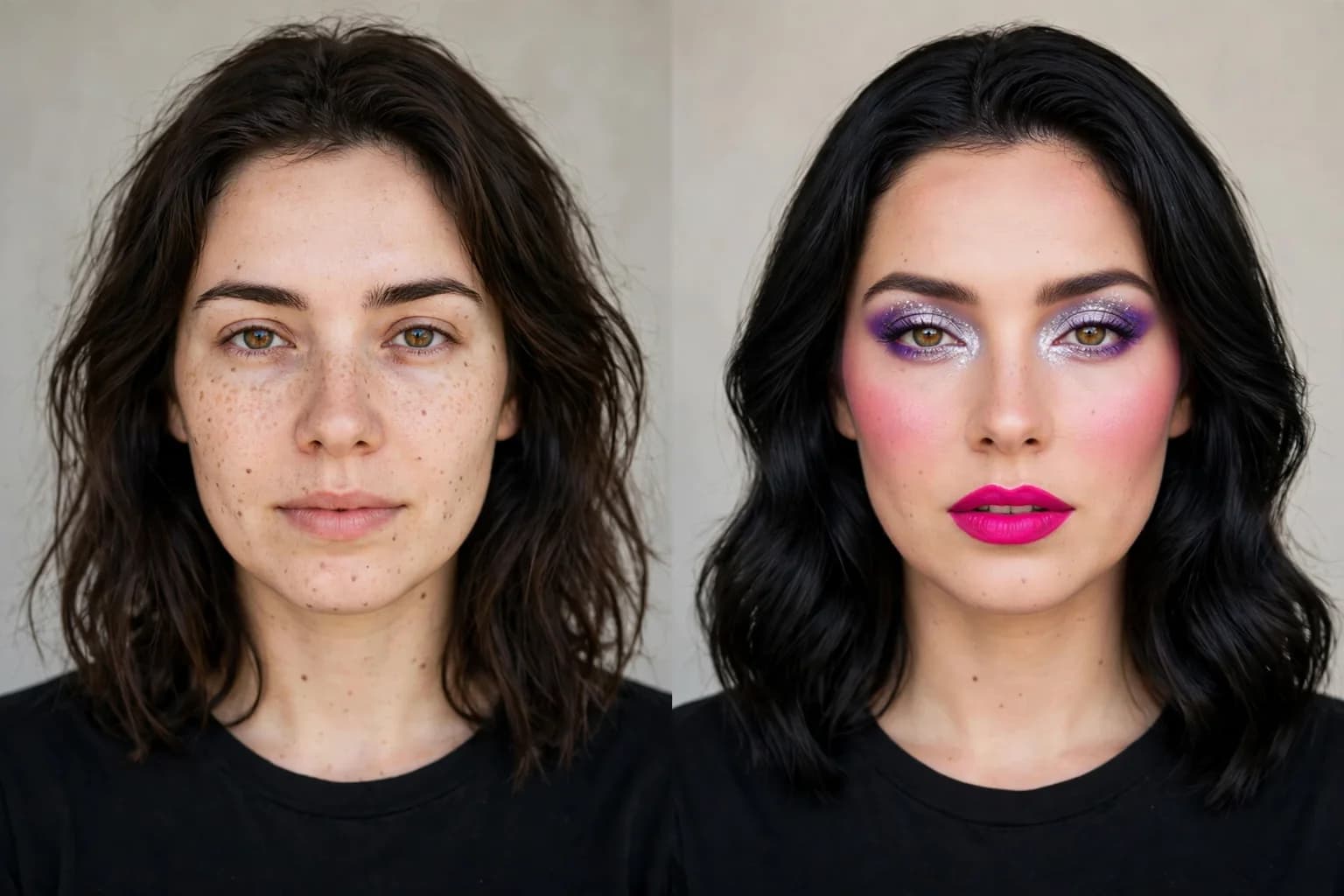
Same face, Bright Winter clarity: the lip is vivid and cool, and the muted version of it is in the article for comparison.
Direct answer
What is Bright Winter makeup? Bright Winter makeup is cool, clear and vivid: true red, fuchsia and bright pink lips; clear pink or raspberry blush; silver, icy blue, violet, emerald and cobalt eyes, with black liner worn at full strength. Bright Winter is the winter defined by chroma, brightness laid over a cool base, so the shades that fail on it are not the daring ones. They are the muted, dusty and earthy ones, which make this face look tired instead of soft.
How is Bright Winter different from the other winters?
The three winters share coolness and divide on one axis each. True Winter is run by temperature: pure, balanced cool. Deep Winter is run by value: depth first, drama second. Bright Winter is run by chroma.
Chroma means clarity: how pure and undiluted a colour is. A Bright Winter's colouring has the highest clarity in the winter family and some of the highest in the whole system, which is why this season is so often confused with Bright Spring, its warm twin across the year. The eyes are frequently the tell that guides point to first: bright, clear and contrasting with the whites, rather than deep or soft.
That clarity sets the season's one rule. Every shade that works here is a colour with nothing mixed into it: no grey, no brown, no dust. Every shade that fails has had something added to mute it. This makes Bright Winter the easiest season to shop for by description and the hardest to shop for by habit, because the beauty industry's default register for adult makeup is muted, and muted is exactly what this face cannot use.
It also means brightness is a budget, like depth is for the deep seasons. A Bright Winter can spend it on one vivid feature at full strength, a fuchsia lip or an emerald eye, and look balanced where most colourings would look costumed. Spend it on muted shades instead and the face does not look understated. It looks unwell.
Source: Sterling Style Academy, decoding the winter colour palettes
Which makeup colours suit a Bright Winter?
Think stained glass, not watercolour: the colour is cool, and light comes through it rather than sitting on it.
Foundation undertone follows the family rule: cool or neutral-cool bases sit natural, and golden bases are the usual reason an otherwise correct Bright Winter look reads slightly off in daylight.
- True red: lips. A clear, blue-leaning red at full pigment; the season's reference lip.
- Fuchsia: lips. The signature Bright Winter lip: vivid, cool, and cleaner than any muted pink.
- Hot pink and bright pink: lips. The daytime version of fuchsia; keep it clear, not milky.
- Raspberry: lips and blush. The bridge shade: vivid enough for the season, wearable anywhere.
- Clear pink: blush. Pink with nothing brown or grey in it; dusty rose is a different, failing shade.
- Silver and icy blue: eyes, lid. Cool brights for the lid; icy shades here are accents with real pigment, not washes.
- Violet and royal purple: eyes. The season's purple is saturated; lavender-grey is too muted to do the same job.
- Emerald and cobalt: eyes, liner. Jewel tones worn as liner first if a full lid feels like too much.
- Black: liner and mascara. Worn at full strength and meant to be seen; brown-black softens what should stay sharp.
- Icy pink and icy lavender: eyes, highlight. The only pastels this season uses: pale but clear, with a white base and no dust.
Which shades fail on a Bright Winter: wrong vs right?
- Dusty mauve or muted rose lipstick vs fuchsia: mauve is pink with grey added, and grey is the one ingredient this colouring cannot carry. On the face it does not read as a softer pink; it reads as the colour draining out of the whole face, lips first.
- Terracotta, bronze or peach blush vs clear pink: warm, earthy blush on a cool, clear face sits as a separate layer instead of a flush. Clear pink reads as blood under skin, which is the effect blush exists to imitate.
- Your-lips-but-better nude vs true red: the nude lip is the most respectable mistake this season makes. Beige-pink at low saturation leaves a high-clarity face looking unfinished, and people usually blame their skin rather than the lipstick.
- Taupe and greige eyeshadow, worn alone, vs silver or violet: taupe is not banned, but as the only eye colour it mutes the brightest part of this face, the eyes themselves. Use it as a base if you like, then put a clear colour over it.
- Golden or honey highlights in hair vs icy or ash tones: warmth in the hair mutes the whole head, and the face follows it. This is the salon version of the dusty lipstick.
What hair colours suit a Bright Winter?
Clarity first, temperature second: the colour must be clean, and it must be cool.
Avoid golden blonde, warm auburn and muted mushroom tones. The failure mode is always the same word: dull.
- Jet black and blue-black: the core colours. Gloss matters here more than for any other season, because shine is what the eye reads as brightness.
- Dark ash brown: brown kept fully cool and clean; the softer option that still respects the season's clarity.
- Icy platinum and cool silver blonde: the light option, and a genuine one for this season, because it is fully cool and keeps contrast high against dark brows and lashes. It needs a toner plan to stay icy rather than yellow.
- Cool vivid reds and violets, at depth: fashion shades work on this colouring when they are clear and blue-based, which is more than most seasons can claim.
- Bright ribbons against a dark base: a panel of fuchsia or cobalt in black hair spends the brightness budget in one place and keeps the rest of the head in season.
Am I Bright Winter or Bright Spring?
The most common misdiagnosis in the system, because the two seasons share the thing that is easiest to see: brightness. Their chroma is equally high. Only temperature separates them, so test temperature and ignore brightness completely while you do it.
Hold cool brights against warm brights at your face, in daylight. Compare fuchsia with coral, silver with gold, and optic white with warm cream. If the cool side of each pair clears your skin and sharpens your eyes, you are Bright Winter. If the warm side lights you up and the cool side turns slightly stark, you are Bright Spring.
The red version is the fastest single test. A blue-based true red that looks settled and expensive points to winter; if that red looks harsh and a coral or tomato red looks like home, your brightness is warm. Jewel tones versus citrus and coral report the same answer across a whole palette.
Against your own family: if bright shades define you and deep ones sit heavy, you are Bright; if depth is what your features keep asking for, read the Deep Winter guide instead. Chroma versus value is the dividing line.
What should I ask my colourist for?
Clarity is easy to lose at the basin, because toners and glosses are where yellow creeps back in. Brief for it directly, and bring a photo of the target shade on your own face. Save the shade name, toner and gloss interval as a Salon Card.
- Cool and clear: ash, icy or violet reflects, and a toner plan that keeps yellow out. Ask what the colour will look like when the toner fades, because that faded version is the one you will live in longest.
- Gloss stated as a requirement, not an extra: on this season, shine is part of the colour, and a matte finish reads as muting.
- If you are going icy blonde, the root plan agreed before the lift: shadow root, full regrowth, or a darker exit strategy. Icy hair with no root plan becomes a part-time job.
- What to do when it dulls: purple shampoo or an icy gloss refresh is maintenance for this season, not an emergency measure, and it is worth knowing the interval before you start.
Bright does not mean everything at once
Bright Winter carries one vivid feature at full strength beautifully, and a whole face of them, plus vivid clothes, tips from striking into costume. The season's working pattern is one clear colour in the lead, icy or dark neutrals carrying the rest. If a look feels like too much, the fix is rarely a muted shade; it is fewer vivid ones, each kept clear.
Take the theory out of it.
The article's central claim is that muted shades, not bold ones, are what fail on this season, and it is testable in one step: a fuchsia and a dusty mauve on the reader's own photo. Hair clarity, jet black against icy platinum, is the mid-post secondary CTA.
Questions people ask
What makeup colours are best for Bright Winter?
Cool, clear, vivid shades: true red, fuchsia and bright pink lips; clear pink or raspberry blush; silver, violet, emerald and cobalt eyes with black liner. Avoid muted, dusty and earthy shades, which make this colouring look tired rather than soft.
What hair colours suit Bright Winter?
Clean, cool colours: jet black, blue-black, dark ash brown and icy platinum, with clear blue-based reds and violets as fashion options. Avoid golden, honey and muted tones, which dull the clarity the season is built on.
How do I know if I am Bright Winter?
Your colouring is cool but vivid, with clear, bright eyes and strong contrast, and saturated cool colours make your face look awake while muted ones make it look drained. If in doubt, test fuchsia against dusty mauve: the one that clears your face names your chroma.
What is the difference between Bright Winter and Bright Spring?
Both are bright, so only temperature separates them. Bright Winter is cool (fuchsia, silver, optic white, blue-red); Bright Spring is warm (coral, gold, warm cream, tomato red). Compare fuchsia against coral at your face to tell.
Can Bright Winters wear pastels?
Yes, but only icy ones: pale shades with a clear white base and real pigment, like icy pink or icy lavender. Dusty pastels, the kind with grey mixed in, are summer shades, and they mute a Bright Winter instead of softening her.